The best oil space heater for most readers is a 1500W oil-filled radiator with a digital thermostat, remote, and overheat and tip-over protection, because it gives steady heat without a fan and keeps the temperature from swinging all night. Pick one sized for the room, then check the breaker load before you plug it in.
Key takeaways
Choose a 1,500 W oil heater for most bedrooms and offices, then use the thermostat to avoid overshooting the room.
Pick the quietest model if noise bothers you; oil-filled radiators have no fan, so the room hears less mechanical chatter.
For a large living room, look for stronger heat dispersion, a timer, and a remote so you are not walking across a cold floor to adjust it.
Do not plug any portable heater into a power strip or extension cord; use a wall outlet on a circuit that can handle the load.
If you want lower running cost, lower the watts first. An oil heater at 900 W costs less to run than the same unit at 1,500 W.
The common mistake is buying the biggest heater on the shelf and assuming more watts means better comfort. A 1,500 W oil heater still draws about 12.5 A on a 120 V circuit, so the wrong room or a crowded outlet can turn a simple purchase into a tripped breaker and a warm-but-annoying evening.
Oil-filled heaters shine when you want steady background heat in a bedroom, office, or living room. They warm slowly, hold heat after the element cycles off, and usually run more quietly than fan heaters.
Ranked Oil Space Heater Picks
#1Most rooms
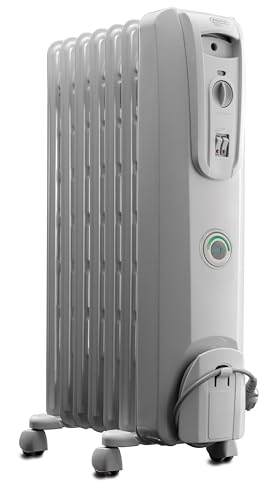
De’Longhi 1500W Oil-Filled Radiator
Best for Bedrooms and offices up to 150 sq ft where you want heat without noise or dry air
The ComfortTemp feature holds the temperature steady and cuts energy use by 20 percent compared to running the thermostat at max, so the room doesn’t swing between too hot and too cold overnight. The thermal slot design pushes more heat into the room while the surface stays cool enough to touch. Smart snap wheels fold out without assembly, and the handle sits on top where you’ll actually grab it.
Power 1500WControls Analog thermostat and power levelEfficiency 20% more efficient with ComfortTempSurface Low temperature thermal slot designPortability Integrated handle and smart snap wheels
Why it made the cut
ComfortTemp saves energy and stops temperature swings
No fan means silent operation and no dust circulation
Low surface temperature with thermal slot design
Wheels snap into place without tools
Good to know
Basic analog controls, no remote or timer
Heavier than compact models, harder to move between floors
Skip it if If you need a digital display or timer, the DREO or Amazon Basics models give you those controls for less money.
Best for Living rooms and bedrooms where you want to set the temperature from across the room
The digital thermostat holds the set temperature with a sensor and algorithm that adjusts in real time, and you control it from the couch with the remote or from the front panel. Four modes—600W, 900W, 1500W, and eco—let you match the output to the room size or the forecast. Seven fins spread heat 39 percent faster than competing designs, according to the manufacturer, and the 24-hour timer turns the unit off in the morning.
Power modes 600W, 900W, 1500W, ecoControls LED touchscreen and remoteTimer 24-hour programmableSafety Overheat, tip-over, child lock, ETL listedFins 7 oil-filled
Why it made the cut
Digital thermostat with remote control
Eco mode adjusts power automatically
24-hour timer and child lock
Large LED display, mute and screen-off modes
Good to know
LED display stays lit unless you activate screen-off mode
Heavier than compact fan heaters
Skip it if If you’d rather save thirty dollars and don’t need a remote, the Amazon Basics model has a simpler control set and the same safety features.
Best for Bedrooms and home offices where you want quiet heat and remote control without extra features
Three heat settings—600W, 900W, and 1500W—and an adjustable thermostat give you the control most people need, and the remote lets you switch modes from bed. Seven wavy fins hold heat after the unit clicks off, so the room stays warm longer between cycles. The oil is permanently sealed, so you never refill or check the level.
Power 600W, 900W, 1500WControls Remote and adjustable thermostatFins 7 oil-filled wavySafety Tip-over and overheat protection, ETL certifiedMaintenance Sealed oil, no refills
Why it made the cut
Remote control and adjustable thermostat
Three heat settings for different room sizes
Silent operation, no fan noise
ETL certified with tip-over and overheat protection
Good to know
No timer or programmable shutoff
No eco mode or automatic temperature hold
Skip it if If you want a timer or eco mode that adjusts power automatically, spend more for the DREO model.
A 1,500 W oil-filled radiator with a digital thermostat, multiple heat settings, and tip-over and overheat protection is the right starting point for bedrooms, home offices, and living rooms where you want steady, quiet heat. These heaters warm the oil sealed inside steel fins, which then radiate heat into the room without a fan. No fan means no motor noise and no dust stirred up—just the occasional click of the thermostat cycling on and off.
The thermostat matters more than most buyers expect. Oil heaters hold heat for 15 to 30 minutes after they shut off, so a model without a thermostat or with only a manual dial will overshoot the target temperature and leave you opening a window. A digital thermostat lets you set 68°F and walk away; the heater cycles to hold that temperature instead of running flat out until you notice the room is too warm.
Multiple heat settings—typically 600 W, 900 W, and 1,500 W—give you control over how fast the room warms and how often the heater cycles. In a small bedroom you’ll run 900 W most nights; in a larger open space you’ll want the full 1,500 W on cold mornings. The De’Longhi Oil filled Radiator Heater and the DREO Oil Filled Radiator Heater both offer this flexibility, along with remotes and timers that let you set the heater to warm the room before you wake up.
In short
Look for 1,500 W, a digital thermostat, adjustable heat settings, and safety shutoffs. Those four features cover what most buyers need for steady, hands-off heat.
Why oil heaters work well
Silent operation—no fan, no motor hum, just the thermostat click
Stays warm 15 to 30 minutes after shutoff, smoothing out temperature swings
Safe to leave on overnight if the model has tip-over and overheat protection
Doesn’t dry out the air or move dust around the room
Where they fall short
Takes 20 to 30 minutes to warm a cold room from a standing start
Heavy—most 1,500 W models weigh 15 to 25 pounds, harder to carry between floors
Won’t heat a drafty garage or workshop fast enough to matter
Common mistake
Buying a heater rated for 400 square feet when your bedroom is 150 square feet, then running it without a thermostat. The room overheats, you turn the heater off, the room gets cold, and you’re back to adjusting it every hour. Match the heater to the room size and let the thermostat do the work.
From HeaterGuides · our own guidePage 6: heat only the rooms you use. Page 10 covers space-heater safety.Winter Heating Bill CutterSee what every heater in your home really costs, heat the rooms you use, and cut the waste in 30 days.Cost-per-hour tables for every heaterThermostat schedule and draft-proofing planRunning-cost and bill calculator (Excel)$14.99$9.99Get it for $9.99See what's inside and watch the 2-minute video →14-page printable PDF + Excel calculator · instant download · 30-day refund
Measure the Room Before You Buy
A 1,500 W oil heater will comfortably warm a moderately insulated room up to about 150 to 170 square feet—a bedroom around 12 by 14 feet, or a home office that isn’t fighting a cold exterior wall all day. Smaller rooms heat faster and stay warm with less cycling; larger open spaces take longer to reach the target temperature and may feel uneven if the heater sits in a corner far from where you’re working.
Worked example
Say your bedroom is 12 by 14 feet with 8-foot ceilings, standard insulation, and one exterior wall with a double-pane window. That’s 168 square feet of floor area. A 1,500 W oil heater will bring the room from 60°F to 68°F in about 25 minutes on a cold morning, then cycle on and off to hold that temperature. Once the room is warm, the heater may run 20 minutes out of every hour, depending on how cold it is outside and how much heat escapes through the window.
Room size12 × 14 ft (168 sq ft)
Heater output1,500 W
Warmup timeAbout 25 minutes from 60°F to 68°F
If the room is smaller—say, 10 by 10 feet—you can drop to a lower heat setting, often 900 W, and let the heater cycle less often. The Amazon Basics Portable Oil Space Heater and similar models let you dial back the wattage, which cuts running cost and keeps a small room from climbing past your target temperature.
1,500 W
What every plug-in space heater tops out at
A standard 120 V outlet circuit in the US is 15 amps, and 1,500 W draws about 12.5 amps—close to the limit. You won’t find a portable plug-in heater that goes higher without tripping the breaker.
Garages, basements, and rooms with poor insulation lose heat faster than the oil heater can replace it. A two-car garage with an uninsulated door that opens three times a day won’t stay warm with a 1,500 W oil heater—you’re heating the outdoors. Oil heaters work only in enclosed, moderately insulated indoor spaces where the heat you add stays in the room. If the garage is reasonably sealed, modestly sized, and you’re working in one corner for a few hours, a small oil-filled space heater may take the edge off. If the door is up or the walls are bare metal, you need a different tool.
Room type
Typical size
Heat setting to start with
Small bedroom or office
10 × 10 to 10 × 12 ft
900 W, then adjust
Medium bedroom or den
12 × 14 to 14 × 16 ft
1,500 W
Large open living room
16 × 20 ft or larger
1,500 W, expect longer warmup and more cycling
Enclosed, insulated garage
12 × 20 ft, one or two cars
1,500 W if rarely opened; reconsider if door is up often
These are starting points for moderately insulated rooms with standard ceiling height. Drafty rooms and spaces with high ceilings need more time or a second heater.
Indoor use only
Oil-filled radiators are designed for indoor spaces with normal ventilation. They’re not rated for unheated garages with poor air sealing, tents, or vehicle cabins where temperature swings are extreme. Plug straight into a wall outlet, never an extension cord or power strip.
Check Running Cost Before You Click Buy
Running a 1,500 W oil heater for eight hours costs about $2.04 at the national average rate of 17 cents per kWh, and you’ll see that number every time you run it on high through the night. The formula is straightforward: watts ÷ 1,000 × hours × price per kWh. So 1,500 W becomes 1.5 kW, times 8 hours is 12 kWh, times $0.17 gives you $2.04. Over a month that’s about $61 if you run it every night, which is why the lower settings matter.
Most oil heaters offer three power levels—typically 1,500 W, 900 W, and 600 W—and switching down when full heat is too much cuts cost in direct proportion. Running at 900 W for the same eight hours drops the cost to about $1.22 a night, and 600 W brings it down to 82 cents. That difference adds up fast if the room stays comfortable on medium.
Heater
Watts
Per hour
Per day (8 h)
Per month (30 days)
1,500 W oil heater (high)
1,500 W
26¢
$2.04
$61.20
900 W oil heater (medium)
900 W
15¢
$1.22
$36.72
600 W oil heater (low)
600 W
10¢
82¢
$24.48
Calculated at 17¢ per kWh. Monthly cost at 8 hours per night and 17 cents per kWh, the approximate US average in late 2026.
ECO mode and a thermostat can save money, but only by reducing how many hours the heater actually runs. Once the room hits the set temperature, the heater cycles off; when it drops a degree or two, it cycles back on. The label doesn’t reduce wattage or improve efficiency—it just keeps the element from heating air you don’t need. If you set the thermostat too high or the room loses heat quickly through single-pane windows, runtime stays long and savings disappear.
Compare your actual rate
Check a recent electric bill for your cost per kWh. Rates range from under 12 cents in some states to over 30 cents in others, so your real running cost could be half or double the numbers shown here.
Budget oil heaters exist at the low end, but many cut corners on features like the thermostat or remote control. Without these, you’ll need to adjust heat manually and may find the heater cycles less precisely. Stepping up to a model with digital controls and a timer helps avoid wasting heat in empty rooms and can save more on your energy bill over time.
Compare Quiet Heat, Smart Controls, and Safety
Tip-over protection, overheat protection, and an ETL or UL listing are the safety features that matter first on any plug-in heater, oil-filled or otherwise. Tip-over switches cut power if the unit falls—important because the metal surface stays hot for 20 minutes after shutoff. Overheat protection stops the element before internal temperatures climb into unsafe territory. ETL or UL certification means an independent lab confirmed the design meets recognized safety standards.
Safety features to confirm before buying
Tip-over shut-off switch
Overheat protection (sometimes called thermal cutoff)
ETL, UL, or CSA safety listing
3-foot clearance space around the heater when placed
Remotes, timers, child locks, and screen-off modes make daily use more convenient, but they don’t substitute for the core safety mechanisms. A timer keeps you from forgetting to turn the heater off when you leave for work. A child lock prevents small hands from cranking the heat to maximum. Screen-off mode dims or turns off the display so the glow doesn’t bother light sleepers. All useful, none of them a reason to overlook missing tip-over or overheat protection.
Surface temperature
Oil heater panels get hot enough to burn skin on contact, especially on the high setting. Keep them away from curtains, bedding, and furniture, and don’t let kids or pets brush against the fins while the unit is running or for the first 15 to 20 minutes after it clicks off.
Fanless oil heaters suit bedrooms and offices better than forced-air models if you’re sensitive to noise or dislike the dry, moving air a fan pushes around the room. Oil radiators warm by convection and radiation: air rises along the hot fins, circulates naturally, and objects in the room absorb radiant heat. You won’t hear a fan hum, and humidity stays where it was. That makes them a good fit for seniors who find fan noise distracting or anyone who sleeps lightly.
Oil heater advantages
Silent operation with no fan noise
Gentle, sustained heat that doesn’t dry the air
Stays warm for 20 to 30 minutes after shutoff
Where they fall short
Takes 15 to 20 minutes to feel warm when first switched on
Heavier than ceramic or infrared heaters, harder to move between rooms
Hot surface requires clearance and careful placement
Automatic shutoff appears on most models as either the tip-over switch, the overheat cutoff, or both—terms that all describe the heater turning itself off when something goes wrong. Some units add a timer-based auto-off after a set number of hours, which helps if you forget to turn it off manually but isn’t a substitute for the safety switches. Oil filled radiator space heater safety covers placement and clearance in more detail.
Choose the Right Oil Heater For Long Winter Runs
Oil-filled radiators are electric resistance heaters, so they need a 120 V wall outlet and draw about 12.5 A on high—close to the 15 A limit of a standard circuit. Plug one directly into the wall, never into an extension cord or power strip, and check what else is running on the same breaker before you turn it on. Battery-operated, solar-powered, and other non-electric space heaters sound appealing until you run the numbers: a small rechargeable battery pack might deliver 100 to 200 watts for an hour or two, nowhere near the 1,500 W you need to heat a cold room through the night. Propane heaters work, but only models rated for indoor use with an oxygen depletion sensor, and they bring their own risks.
Myth
A solar-powered or battery-powered space heater can replace a plug-in oil heater for winter.
Fact
No portable battery holds enough energy to run 1,500 W for more than a few minutes, and solar panels indoors or on a winter day won’t come close. Heating a room takes serious power, and that means a wall outlet or fuel.
Oil heaters warm slowly. Expect 20 to 30 minutes before the room feels different, because the oil inside has to heat up first, then the metal fins, then the air. Once warm, the thermal mass keeps radiating heat after the element cycles off, so the temperature stays steadier than a ceramic fan heater that clicks on and off sharply. That makes oil heaters well suited to bedrooms, offices, and living rooms where you’ll be for hours, but the wrong tool if you need fast spot heat in a bathroom or garage.
Placement matters
Keep the heater upright on a level, hard floor—never on a rug, near drapes, or within three feet of furniture or bedding. Tipping one over while hot can damage the unit and trip the safety switch, and blocking airflow around the fins reduces efficiency and can trigger the overheat cutoff.
Oil-filled radiators stay hot for 15 to 30 minutes after you switch them off, so they keep working while you sleep without cycling the element all night. Run one overnight only if the model’s manual says it’s designed for unattended use, the tip-over and overheat protections work, and the thermostat holds steady. Most 1,500 W models with a digital thermostat and timer will handle a full night without issue.
In short
Oil heaters need a wall outlet and draw nearly the full 15 A a circuit allows, so they’re not candidates for battery or solar power. They warm slowly but hold heat longer, which suits steady all-night use better than quick bursts.
Frequently Asked Questions
What is the best oil space heater for a bedroom?
A 1,500 W oil-filled radiator with a digital thermostat and remote works well in bedrooms up to about 150 square feet, because you can set the target temperature from bed and the unit cycles quietly without a fan. Look for models with a timer so you can warm the room before you wake up, and check that it has tip-over and overheat protection before you leave it running overnight.
How many watts does an oil space heater use?
Most plug-in oil-filled radiators run at 1,500 W on high, 900 to 1,000 W on medium, and 600 W on low, because that’s the limit of a standard 120 V household outlet. The wattage stays the same whether the heater has five fins or twelve—the thermostat cycles the element on and off to hold temperature, so actual consumption depends on how often it runs.
Do oil-filled heaters use a lot of electricity?
An oil heater on high uses as much electricity as any other 1,500 W space heater—12 kWh over eight hours, or about $2.04 at 17 cents per kWh. The oil doesn’t make it cheaper to run, but it does let the heater coast on stored heat after the element clicks off, so the thermostat may cycle less often in a well-insulated room than a ceramic heater would.
Are oil-filled space heaters safer than fan heaters?
Oil-filled radiators have cooler surface temperatures than ceramic or coil heaters—warm enough to burn if you grab a fin and hold on, but not hot enough to ignite a shirt that brushes it. Both types are safe with tip-over and overheat protection and a direct wall-outlet connection; the oil heater’s edge is that it doesn’t blow dust and it’s harder for a child or pet to reach the heating element.
Can I run an oil space heater all night?
Most oil-filled radiators with a thermostat, tip-over switch, and overheat cutoff are designed to run unattended, and many manufacturers say overnight use is fine if the unit sits on a flat surface with three feet of clearance. Check the manual for your model, never use an extension cord, and make sure the heater is the only high-draw appliance on that circuit so the breaker won’t trip at 2 a.m.
What size oil heater do I need for a large room?
You’ll need about 10 watts per square foot in a moderately insulated room, so a 250-square-foot space calls for 2,500 W—but no plug-in heater delivers that. A single 1,500 W oil radiator will take the edge off but won’t keep a large room warm in January; consider two units on separate circuits, or look at a hardwired baseboard or a ductless mini-split if the room needs serious heat.
Why does my oil space heater keep heating after it clicks off?
The oil inside the radiator fins stays hot for ten or fifteen minutes after the heating element shuts off, and those fins keep radiating that stored heat into the room. That thermal inertia is why oil-filled heaters feel steadier than fan heaters—the temperature doesn’t drop the instant the thermostat clicks, and it doesn’t spike when the element kicks back on.
Before you go · a welcome giftGet the Winter Heating Bill Cutter for $4.99See what every heater in your home really costs, heat the rooms you use, and cut the waste in 30 days. Normally $14.99; your welcome price saves $10.00. We'll email your link right now.or buy it now for $9.99 without the gift →One email with your link now. We never share your address.


 Winter Heating Bill CutterSee what every heater in your home really costs, heat the rooms you use, and cut the waste in 30 days.Cost-per-hour tables for every heaterThermostat schedule and draft-proofing planRunning-cost and bill calculator (Excel)