For most readers, the best pick for cozy evenings is a plug-in infrared heater with 900W to 1500W settings, because it gives direct warmth fast without gas fumes or hardwired work. If your space is a screened porch, patio, or garage, the right wattage matters more than the flashiest feature.
What to remember
Pick infrared for a screened porch or patio where you want direct warmth and quick feel.
Use 1,500 W as the practical ceiling for a standard 120 V plug-in heater.
Choose hardwired 240 V heat only if you need to cover a larger area and can install it safely.
Check tip-over, overheat protection, and a UL, ETL, or CSA listing before you buy.
Say your screened porch is 12 by 14 feet and partly open to the night air. A 1,500 W electric heater can take the edge off, but a 900 W unit may only warm the seat you’re sitting in, not the whole room.
The trick is matching the heat type to the space. Direct infrared works well when you want warmth on people and furniture; a ceramic blower makes more sense for a small enclosed room that can hold heat.
Best Heater Picks for Cozy Evenings
#1Best all-round porch pick
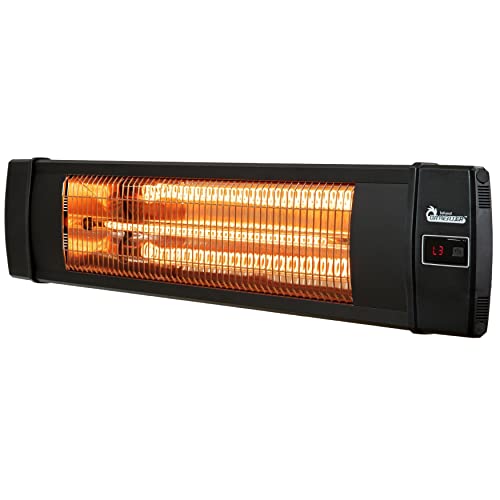
DR. INFRARED HEATER Portable Infrared Heater
Best for Screened porches and patios where you want wall or ceiling heat without wiring
This one earns the top spot because it runs on a standard 120V outlet and still gives you three real settings: 900W, 1200W and 1500W. You can mount it on the wall or hang it from the ceiling with the included bracket, which keeps the floor clear on a narrow porch. The IP55 rating and weatherproof aluminum body mean it tolerates damp air and the odd sideways rain that finds its way through screen. A remote handles the switching, so you don’t have to cross a cold deck to turn it down.
Power settings 900W / 1200W / 1500WVoltage 120V, 60HzRating IP55, indoor and outdoorMounting Wall and ceiling bracket includedControl Remote control
Why it made the cut
Three power settings let you dial the draw to the circuit
Wall and ceiling bracket included, no floor space lost
IP55 rating for indoor and outdoor use
Mirror aluminum reflector pushes 90% of the heat forward
Good to know
No thermostat, so you adjust by setting and distance, not by temperature
Infrared warms people and surfaces, not the air in the room
Skip it if Skip it if you want a heater that holds a set temperature on its own, because this one has no thermostat.
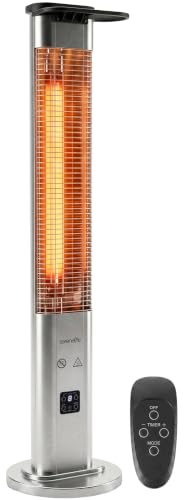
Best for Patios and gazebos where you want a freestanding heater with tip-over protection
SereneLife’s standing unit is the pick when you’d rather not drill into a porch wall or ceiling. It’s ETL certified, runs at 900W, and carries an IP65 rating, which is a step up in water resistance from most porch heaters. The 360-degree tip-over switch, overheat protection and mesh guard around the element matter on a porch where kids and dogs move through. The 37.4-inch height puts warmth at seated level, and the remote saves you getting up to change the two heat levels.
Heat output 900W, two heat levelsRating IP65Coverage Up to 15 sq ftCertification ETL certifiedSafety 360-degree tip-over switch, overheat protection, mesh guard
Why it made the cut
IP65 rated for wet outdoor conditions
360-degree tip-over switch and overheat protection
Mesh guard keeps hands and paws off the element
Remote control for both heat levels
Good to know
Coverage is listed at 15 sq ft, so it’s a personal-warmth heater, not a room heater
900W is the only output, with no higher setting for deep cold
Skip it if Skip it if you need to warm a whole seating group, since 15 sq ft covers roughly one or two chairs.
Best for Covered porches and garages where a dedicated 240V circuit is already in place
If your porch is really a three-season room and the wind cuts through, 1,500W won’t keep up. ThermoMate’s carbon fiber tube puts out 3000W on high, or 1500W on low, and the listing covers about 100 sq ft outdoors and 130 sq ft enclosed. It’s ETL certified, IP54 rated, and mounts on the wall or ceiling with a 45-degree tilt to aim the heat where people sit. The catch is the install: it must be hardwired to a dedicated circuit breaker, so budget for an electrician.
Best for Garages, workshops and greenhouses up to about 200 sq ft
Buyplus builds this around a PTC ceramic element, which starts throwing heat in about three seconds and keeps blowing it into the room rather than only onto whoever sits closest. The 1500W output is rated for a 200 sq ft garage, and the 3.2-pound body with a handle moves from bench to doorway without a fight. Overheat protection, a tip-over switch and flame-retardant housing cover the basics. It’s a portable plug-in, so it suits a garage outlet far better than a hardwired install.
Best for Enclosed porches, bedrooms and offices where you want a thermostat and timer
WINHL’s heater fits well in a closed sunroom where holding a steady temperature matters. It offers a thermostat, five heat settings, a 12-hour timer, and 70-degree oscillation for even warmth. The remote control works from across the room. ETL certified, it has built-in overheat and tip-over protection. At 1500W, it requires a dedicated wall outlet and should not be used with an extension cord.
For cozy evenings, start with electric infrared unless you need a permanently installed gas wall heater. Infrared warms people and nearby surfaces directly, which suits a screened porch where open sides make heating all the air a losing contest.
For cozy wall furnaces using propane, choose a wall-mounted, indoor-rated unit only when you need fixed heat for a larger space or want heat that can operate during a power outage. It must have the correct venting and clearances, and propane needs safe storage. A vent-free gas heater may be restricted or prohibited where you live, so check local code before buying.
Myth
The most efficient gas wall heater is always the biggest one.
Fact
Efficiency depends on the unit’s rated efficiency and how it’s installed and sized for the space. Compare the manufacturer’s efficiency rating, and favor a properly installed vented model when you need permanent indoor heat; a higher output alone doesn’t mean lower fuel use.
The difference between Comfort Glow wall heaters and Ashley Hearth-style units is best understood by installation type, not brand name: a vented gas wall heater is a fixed installation, while a portable electric heater plugs in for more flexible use. Check the exact model’s fuel, venting, installation requirements and certification before treating two products as interchangeable.
Need
Pick from this product set
Best overall for most screened porches
DR. INFRARED HEATER Portable Infrared Indoor and Outdoor Sp…
Best for large spaces
ThermoMate Infrared Patio Heater 3000W 240V Hard Wired, if a suitable 240 V circuit and permanent installation are available
Quietest
An infrared model is a reasonable place to start if fan noise matters; confirm whether the specific model uses a fan
Best budget
Buyplus Outdoor Heater is a candidate; compare its listed output and controls before choosing
Best smart controls
No smart-control feature is confirmed in the available product details; check the exact listing
These are use-case matches, not claims about unverified features.
Wall heater or plug-in heater?
A fixed gas wall heater needs installation and venting suited to that exact model. A portable electric heater avoids fuel and venting, but it needs an appropriate outlet and is easier to move. For propane options made for outdoor use, see best outdoor propane heater for cozy evenings; outdoor-rated equipment does not belong inside.
How To Choose The Right Heater Output
For a screened porch, choose output by the area you need to warm, then check that the heater is rated for that location. A 1,500 W heater uses 1.5 kWh per hour at full power; the housing, brand, and heating element don’t change that arithmetic.
Are ceramic heaters energy efficient? They convert electricity to heat efficiently, but a ceramic model drawing 1,500 W still uses 1.5 kWh per hour. A thermostat can reduce use by switching the element off after the room reaches its set temperature; it doesn’t make each hour at full power cheaper.
Are radiant heaters energy efficient? They can be efficient for spot heating because they warm people and nearby surfaces directly instead of first heating all the air. That’s useful on a porch when you’re seated in one place, but it won’t warm every corner evenly.
The most efficient mini heater is usually the lowest-wattage model that still warms the exact seat, desk, or small bathroom you use. A Dyson-style fan heater may feel efficient in a small, sealed room because airflow spreads warmth quickly and thermostat control can cycle the heater, but running cost still follows wattage—not the name on the casing.
Spec to check
Why it matters
Wattage
Higher output can warm a larger area, but draws more power while running.
Mounting style
A wall- or ceiling-mounted unit can aim warmth at a seating area; a portable unit is easier to move.
Coverage area
Treat the maker’s stated area as a guide, especially in a screened or drafty space.
Controls
A thermostat, timer, or multiple heat settings can help match output to how you use the space.
Intended location
Check whether the model is rated for indoor, outdoor, or indoor-outdoor use.
Match the heater’s rating and output to the spot you want warm.
Compare the same setting
Use the heater’s wattage at the setting you’ll actually run. For example, 900 W for one hour uses 0.9 kWh; 1,500 W for one hour uses 1.5 kWh.
How Long A 20 Lb Tank Lasts
A 20 lb propane tank’s runtime depends on the heater’s BTU rate, thermostat cycling, and outdoor temperature, so use the model label rather than a general estimate. For an exact runtime, you need the heater’s fuel consumption rate and the tank’s usable fuel; don’t assume every patio heater burns at the same rate.
For electric heat, the arithmetic is direct: a 1,500 W heater running for 8 hours uses 1.5 kW × 8 = 12 kWh. At an assumed rate of 17 cents per kWh, that’s 12 × $0.17 = about $2.04 for one evening at full power.
An oil-filled radiator is usually quiet and comfortable because its oil stores heat and releases it after the element cycles off. That stored heat smooths out the temperature, but it doesn’t make the heater use less electricity than another resistance heater with the same wattage and run time.
A Small Screened Porch
Say you want warmth at one chair, not across the whole porch. A 900 W infrared heater running for 4 hours uses 0.9 kW × 4 = 3.6 kWh; at 17 cents per kWh, that’s about 61 cents. A 1,500 W full-room heater for the same 4 hours uses 6 kWh, or about $1.02. These are hypothetical full-power costs; thermostat cycling can lower actual use.
Spot heater900 W × 4 hours = 3.6 kWh
Full-room heater1,500 W × 4 hours = 6 kWh
Assumed electricity rate$0.17 per kWh
Check the propane label
The heater’s BTU input or stated fuel rate is the useful starting point for tank-runtime estimates. A thermostat may stretch runtime by cycling the burner, while colder weather can increase how often it runs; use the manufacturer’s figures for your model.
Safety And Certification For Cozy Evenings
An exhaust fan with a heater can be a smart comfort upgrade for a bathroom, provided it’s properly installed and sized and you use it exactly as the fan and heater manuals require. In a screened porch, start with the heater’s listing and instructions; a model suitable for a living room isn’t automatically suitable outdoors.
Plug heaters straight into the wall
Electric space heaters and electric fireplaces must plug directly into a wall outlet—never an extension cord or power strip. Keep at least 3 feet between the heater and curtains, furniture, cushions, or other combustibles. Stop using it if the plug or outlet becomes hot, discolored, or loose.
Check before you buy
Look for tip-over and overheat protection, plus a UL, ETL, or CSA listing.
Confirm the manual permits the location where you plan to use the heater; follow its clearance and mounting instructions.
Make sure the outlet and circuit can handle the heater. Don’t run multiple high-wattage heaters on the same circuit.
Fuel-burning heaters add carbon monoxide risk. Use only an indoor-rated model indoors, provide the ventilation required by its manual, and keep a working CO alarm in the home. Outdoor patio heaters aren’t indoor heaters, even if the porch has screens.
Keep fuel heaters in their rated setting
Propane and kerosene heaters belong only in the locations their labels and manuals permit. Never use a patio heater or other outdoor-rated fuel heater in a sleeping space, tent, or vehicle cabin. Kerosene models require the specified fuel; never substitute gasoline.
What Screened Porches Need From a Heater
Cozy wall furnaces using propane can heat an enclosed area, but a screened porch is often a tricky half-indoor space: moving air carries warmth away, so the coverage printed on a box may overstate how comfortable the seating area feels. If you want gas wall heat, have a licensed installer assess the venting, gas line, and required clearances; those aren’t weekend DIY details.
On a porch, mounting height and wind exposure can matter as much as wattage. Screens slow some airflow but don’t seal the space; open railings leave even more room for warmth to escape. Aim heat toward the people and seating you use, and check the heater’s manual for approved mounting height and clearances.
A hardwired 240 V patio heater is generally a better fit for a larger semi-open area, while a plug-in 120 V model suits a smaller sitting zone. The ThermoMate Infrared Patio Heater is a hardwired 240 V option; it needs a suitable circuit and professional electrical work. For smaller zones, compare the plug-in models’ location ratings and output rather than choosing by appearance.
Before buying, powering, or calling a technician
Measure the seating zone and note screens, open railings, and usual wind direction.
Check the heater’s approved location, mounting instructions, clearances, and electrical requirements.
For a hardwired heater, confirm that the circuit and installation can be handled by a licensed electrician.
For propane or other fuel heat, verify the indoor or outdoor rating, required ventilation, and CO alarm.
If choosing a gas wall furnace, ask a licensed installer to assess venting, gas supply, and clearances before you buy.
Questions People Ask
Is a ceramic heater energy efficient for a small room?
A ceramic heater converts nearly all the electricity it uses into heat at the room, like other electric resistance heaters. Efficiency at the meter is similar across electric models; a thermostat that cycles off when the room reaches your setting can reduce consumption. For example, a 1,500 W heater running continuously for one hour uses 1.5 kWh.
Are radiant heaters energy efficient on a screened porch?
Radiant heaters can feel efficient on a screened porch because they warm people and nearby surfaces directly instead of first heating all the air. Wind still carries heat away, so aim the heater at the seating area and check that the model is listed for the porch’s exposure and location. A heater’s indoor-only rating does not make it suitable for an open or screened outdoor space.
What is the most efficient mini heater for a bedroom or office?
For one person at a desk or bedside, a small radiant heater can direct warmth where you need it; for a whole small room, choose a model with a thermostat and tip-over and overheat protection. No plug-in electric heater makes more heat per kilowatt-hour than another resistance heater, so the useful savings come from heating a smaller area or letting the thermostat cycle the unit off. Plug it directly into a wall outlet and keep it at least 3 feet from bedding, curtains, and furniture.
Is an exhaust fan with a heater a good idea for bathroom comfort?
It can be useful for taking the chill off while the exhaust fan clears moisture, but only if the fan-heater unit is approved for the bathroom location and installed to its instructions and local electrical code. Have a licensed electrician handle new wiring or a circuit change. Run the fan as directed after bathing, since a heater does not remove humidity.