For most readers, the best heat lamp for a well house is Product 1 because it has a safety shutoff, a sturdy guard, and a 16 ft cord for awkward installations. If your goal is freeze protection in a tight enclosure, those are the details that matter more than a flashy wattage claim.
Say your well house is 6 by 6 feet, the pipes sit near one wall, and the first hard freeze is due overnight. In that case, a guarded lamp with an automatic shutoff is the safer starting point than an open bulb hanging from a nail.
A heat lamp is a local fix, not a whole-house heater. The right choice depends on clearance, mounting, bulb wattage, and whether the fixture can shut itself off if it gets bumped out of position.
Best Heat Lamps For A Well House
#1Best Safety Pick
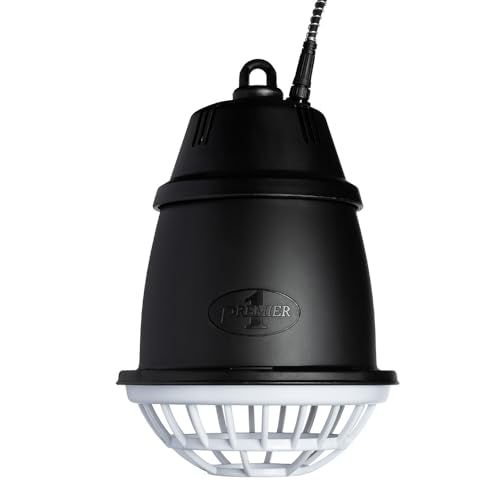
Premier 1 Prima Heat Lamp
Best for Most well houses needing a guarded 250W heat lamp
Product 1 is the strongest fit because its integrated Safety Switch shuts the lamp off if it tilts to an unsafe angle. The heavy-duty grill protects the bulb, and the 16 ft cord with anti-chew spring wire helps with awkward well-house installations. Its ceramic fixture accepts standard BR40 or infrared bulbs up to 250W, but the bulb isn’t included.
Maximum bulb power Up to 250WCord 16 ft with anti-chew spring wireFixture Ceramic; fits standard BR40 or infrared heat lamp bulbsDimensions 9-3/8″ diameter, 15″ tallSafety feature Integrated Safety Switch shuts off at an unsafe angle
Why it made the cut
Integrated tilt safety shutoff
Heavy-duty protective grill
16 ft cord with anti-chew spring wire
Accepts bulbs up to 250W
Good to know
Bulb is not included
Designed as a hanging lamp, not a thermostat-controlled heater
Skip it if Skip it if you need built-in temperature control rather than a guarded lamp and separate controller.
Best for Pairing with a heat lamp when you need automatic temperature control
Product 4 is a thermostat outlet rather than a heat lamp, but it can control a compatible heater by switching at a set temperature. Its 15A/1800W output supports high-power heaters, while the temperature range runs from -40°F to 210°F with 0.1°F precision. Use it with a properly installed lamp and follow both manuals.
Maximum output 15A/1800WTemperature range -40°F to 210°FTemperature precision 0.1°FModes Heating and coolingDisplay Clear figure display
Why it made the cut
Supports heaters up to 1800W
Heating and cooling modes
-40°F to 210°F range
Power memory and cyclic timing modes
Good to know
Does not produce heat by itself
The data does not state a cord length or weather rating
Skip it if Skip it if you need a complete heat lamp rather than a controller to add to one.
Best for A dry, accessible enclosure where a two-lamp setup is practical
Product 2 provides two 250W heat lamps and covers a stated 12″ × 20″ warming area. Its adjustable 22″ to 30″ stand and non-slip feet suit a stable surface, while the ventilated shades help manage bulb heat. The food-warmer design makes it a poor match for many cramped well houses, so check the installation space first.
Bulbs 2 × 250WWarming area 12″ × 20″Stand height 22″ to 30″Bulb lifespan Over 5000 hoursSafety testing UL499-tested; ETL Intertek certified
Why it made the cut
Two 250W bulbs included
Adjustable 22″ to 30″ stand
Non-slip feet
UL499-tested and ETL Intertek certified
Good to know
Built for food warming, not livestock or well houses
Needs a stable surface and has no stated cord length
500W total heat may be excessive for a small enclosure
Skip it if Skip it if your well house is tight, damp, or needs a hanging fixture with a long cord.
Best for Large pass-through-style installations with under-shelf mounting
Product 3 uses an undermount design with included mounting hardware and hanging chains, which can work where a fixed strip is easier to protect than a hanging bulb. Its aluminum heat reflectors focus the infrared pattern, and the toggle switch gives direct control. The 1100W load is far more than most small well-house setups need.
Power 1100WLength 48″Mounting Undermount design with included hardware and hanging chainsControl Toggle switch with 180° full-view indicator lightReflector Aluminum heat reflectors
Why it made the cut
Undermount design
Included mounting hardware and hanging chains
Aluminum heat reflectors
Toggle switch with indicator light
Good to know
1100W power is excessive for many well houses
Designed for foodservice installations
No cord length or automatic temperature control is stated
Skip it if Skip it for a small well house unless the mounting layout specifically suits a 48-inch strip.
Best for Greenhouses needing supplemental full-spectrum plant lighting
Product 5 is a solar-powered grow-light strip, not a listed heat source for freeze protection. Its 16.4 ft strip provides full-spectrum light, and the design emphasizes fast heat dissipation rather than warming a well house. Choose it for plants when light is the goal, not for protecting pipes or a pump from freezing.
Strip length 5m/16.4 ftPower source Solar panelLight type Full spectrumHeat design Fast heat dissipationUse Indoor and outdoor gardens, greenhouses
Why it made the cut
Solar-powered system with included panel
16.4 ft light strip
Full-spectrum lighting
Designed for fast heat dissipation
Good to know
No heat output is stated
Designed for plant growth rather than freeze protection
No well-house mounting or safety shutoff is stated
Skip it if Skip it if you need measurable heat to protect a well-house installation.
Choose a well-house heat lamp by its mounting safety and placement reach before its wattage. A lamp protects pipes, pressure tanks, and controls in a small enclosure; it won’t improve fireplace heat production or replace whole-house insulation and airflow work.
Start by checking the fixture’s listed bulb limit, sturdy guard, cord length, and shutoff behavior. Product 1 is the strongest fit here because its safety shutoff, guarded bulb, and 16 ft cord suit awkward well-house installations. The shutoff helps if the lamp tips or hangs at the wrong angle, but correct mounting and clearance still do the real safety work.
Spec
What to check
Why it matters
Bulb limit
Use only the wattage listed for the fixture
A larger bulb can overheat the socket, guard, or enclosure
Guard
Look for a sturdy guard around the hot bulb
It helps keep insulation, wood, and equipment from touching the bulb
Cord
Measure the outlet-to-mounting distance
A 16 ft cord can prevent a strained plug or unsafe extension-cord workaround
Safety shutoff
Confirm the product states how tipping or bad angles trigger it
The lamp can stop heating when its position becomes unsafe
The useful specs control placement and protection; wattage comes after them.
Match the lamp to the enclosure, not to a food-service or animal-heating label. The VORIGY Food Heat Lamp with 2 x 250W Bulbs, 5000+ Hour Lifes… is built around food-heating use, and the Winco 48″ Food Heat Lamp Strip Heater with Undermount Brack… is a strip-style fixture; neither name proves the mounting position or heat pattern is suitable beside plumbing.
Best fit for awkward well-house mounting
Premier 1 “Prima” Heat Lamp®
Product 1 is the practical pick when the outlet is far from the vulnerable equipment because its 16 ft cord, sturdy guard, and safety shutoff address the three placement problems that matter most.
If you searched for ways to improve home heat efficiency, start with air leaks and damaged insulation before adding a lamp. For a broader comparison of winter plumbing protection, see the best well house heater for winter.
A wattage trap
More wattage can warm the area near the bulb faster, while a small enclosure has less space to shed heat. Stay within the fixture’s listed limit and use the lowest output that keeps the cold-sensitive equipment above freezing.
In short
Choose the listed bulb limit, guard, cord, and shutoff first. Product 1 fits awkward well-house installations; a food or animal heat fixture needs separate confirmation that its mounting and heat pattern suit the enclosure.
Sizing And Running Cost
Size a well-house heat lamp for the coldest vulnerable equipment, then estimate its cost from actual run time rather than the bulb’s label alone. A 250 W lamp running eight hours per day uses 2 kWh per day; at $0.17 per kWh, that is about $0.34 per day before heat losses.
Worked example
Say a small well house uses one 250 W lamp for eight hours each day. Convert 250 W to 0.25 kW, then multiply 0.25 × 8 = 2 kWh per day. At 17 cents per kWh, 2 × $0.17 = $0.34 per day, or about $10.20 over 30 days if it runs that full schedule.
Lamp250 W
Daily use8 hours
Energy2 kWh per day
Assumed rate$0.17 per kWh
Heater
Watts
Per hour
Per day (8 h)
Per month (30 days)
250 W well-house lamp
250 W
4.3¢
34¢
$10.20
Calculated at 17¢ per kWh. Estimated electricity cost at 8 hours per day, 30 days, and $0.17 per kWh.
0.25 kW
A 250 W lamp in the cost formula
Use watts ÷ 1,000 × hours × electricity rate. Actual cost falls when a thermostat cycles the lamp off and rises when colder weather keeps it running longer.
A heat lamp is usually a spot heater, so the safest practical choice is often the lowest wattage that keeps the pump components and exposed pipes above freezing. Improve home heat efficiency first by sealing drafts and insulating approved pipe sections; those measures reduce the lamp’s workload without asking a hotter bulb to warm the whole building.
The same calculation works for any electric lamp: watts ÷ 1,000 × hours × rate. A controller may reduce run time, but it doesn’t change the lamp’s draw while the lamp is on, and insulation can’t make an over-limit bulb safe.
Safety In A Small Enclosure
Keep the heat lamp’s fire and shock risks under control before you worry about extra warmth. Plug it straight into a wall outlet—never an extension cord or power strip—and leave 3 feet of clearance from wood framing, insulation, stored cardboard, and other combustibles.
If you meant improving heat production from a fireplace, the safe gains come from a clean flue, dry fuel suited to that fireplace, and an unobstructed air path. A fireplace does not belong in a well house, and adding one there would create a far greater fire and carbon-monoxide risk than a listed electric lamp.
Keep The Connection Simple
A small enclosure can hide a hot plug, damaged cord, or overloaded outlet. Stop using the lamp if the plug, receptacle, or cord feels hot, smells scorched, or shows damage. Keep water lines and damp surfaces away from electrical connections.
A safety shutoff matters if the fixture tips or overheats. A metal or reinforced guard keeps a hot bulb away from nearby material, while a chew-resistant cord gives rodents fewer chances to expose live conductors around the framing. Those details matter more here than a decorative housing or a higher wattage claim.
Use The Right Kind Of Heater
Outdoor patio heaters, food-warming lamps, and grow lights are poor substitutes for a purpose-built enclosed-space heat lamp. Patio heaters are designed for outdoor use, food warmers for service areas, and grow lights for plants; none should be assumed safe for a damp well house or for freeze protection.
Before You Energize It
Wall outlet used directly, with no extension cord or power strip
3 feet of clearance maintained on every side
Guard, cord, plug, and socket checked for damage
Lamp mounted securely and protected from splash water
Working smoke and carbon-monoxide alarms installed where appropriate
No patio heater, food warmer, or grow light used as a substitute
What Most Buyers Miss
Improve home heat efficiency first by sealing obvious air leaks, keeping insulation dry and intact, and stopping cold air from reaching the plumbing; a well-house lamp should protect vulnerable equipment, not compensate for a wide-open enclosure.
Myth
A higher-wattage bulb is the easiest way to make any heat lamp work better.
Fact
Bulb compatibility and availability matter more after installation. A fixture that accepts a common BR40 or infrared bulb is easier to keep running than one that depends on an unusual replacement, provided the bulb matches the fixture’s rating.
Adjustable stands and food-warming lights belong in kitchens or service settings, where people can monitor them and the fixture is used as listed. They’re a poor fit for a damp well house, where a bumped stand, moisture, or nearby insulation can turn a convenience feature into a failure point.
Controllers Need Permission
A thermostat controller can reduce runtime only if the lamp and its manual allow that type of control. If the instructions are silent or prohibit external switching, choose a simple listed fixture with built-in protection instead. Solar-powered grow lights don’t solve the heating problem; they’re lights, not freeze protection for plumbing.
What To Check Before You Buy
Before you buy a well-house heat lamp, check the installation site, bulb limit, cord reach, and safety shutoff; a lamp can’t fix a leaking enclosure or improve a fireplace’s heat production. Seal air leaks and restore damp or missing insulation first. For broader ways to improve home heat efficiency, see energy-efficient home heating.
Check The Lamp And Site
Confirm the socket accepts the bulb you plan to use and that the bulb stays below the fixture’s maximum wattage.
Look for a safety shutoff and a guard that keeps the hot bulb away from pipes, insulation, wood, and stored items.
Measure the route from the outlet to the mounting point. Product 1’s 16 ft cord helps with awkward well-house layouts, but it still must reach without an extension cord or power strip.
Follow the fixture’s listed clearance on every side. Extra insulation or a tighter mount doesn’t make the lamp safer.
Use an accessible, grounded outlet with the moisture protection required by local code; don’t place a connection where condensation or standing water can reach it.
Check for wet spots, dripping pipes, loose insulation, and anything that could fall onto the lamp before you choose the mounting point.
Product 1 fits a cramped or awkward well house because its 16 ft cord reaches farther than a short lead, while the guard and safety shutoff address two predictable hazards. Verify the bulb type and watt limit on the fixture before installation; the cord length doesn’t make an unsafe location acceptable.
A Fireplace Is Different
A heat lamp can protect vulnerable plumbing in a small enclosure, but it won’t make a fireplace heat a room efficiently. Improve fireplace heat production with a clean flue, a properly sized fire, and reduced drafts around the room; never block the fireplace’s required air supply or ventilation.
Before You Leave It Running
Mount the lamp firmly and aim it at the vulnerable plumbing while keeping the manufacturer’s clearance.
Install the correct bulb below the fixture’s watt limit.
Run the cord directly to the outlet without rubbing, pinching, or crossing a wet area.
Keep insulation, cardboard, tools, and stored items away from the guard and above the lamp.
Control condensation, close the well-house door, and test the safety shutoff before relying on the lamp.
Check the area after it warms. Stop using the lamp if you find scorching, melting, a hot plug, damaged insulation, or moisture at the connection.
More Questions, Answered
Can a heat lamp keep a well house from freezing?
Yes, if the lamp’s heat can offset heat loss and the vulnerable pipes stay above freezing. Place a thermometer near the lowest or most exposed plumbing, then use a backup plan for power outages; the lamp can’t protect anything while the breaker is off.
What wattage heat lamp do I need for a small well house?
There isn’t one reliable wattage for every enclosure. Start with the fixture and bulb wattage allowed by the manufacturer, improve insulation and air sealing first, and verify the coldest plumbing area with a thermometer rather than judging by room temperature.
Can I plug a well house heat lamp into an extension cord?
No—plug it directly into a properly grounded wall outlet. If the cord won’t reach, have an electrician install a closer outlet or use a properly installed, code-compliant solution; extension cords and power strips can overheat in a small enclosure.
What safety features should I look for in a heat lamp?
Look for a sturdy wire guard, tip-over protection, overheat shutoff, and a UL, ETL, or CSA listing. Match the bulb to the socket and fixture rating, keep combustibles clear, and don’t use a damaged cord or cracked guard.