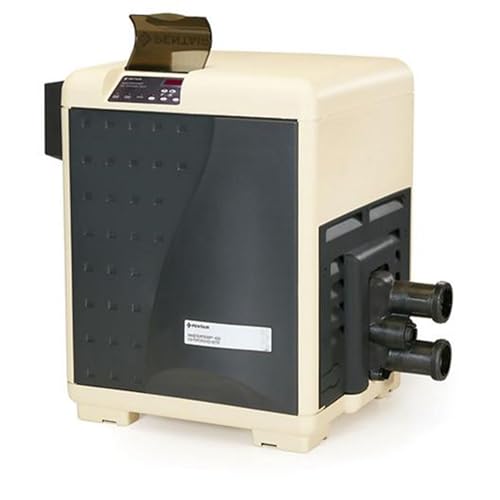
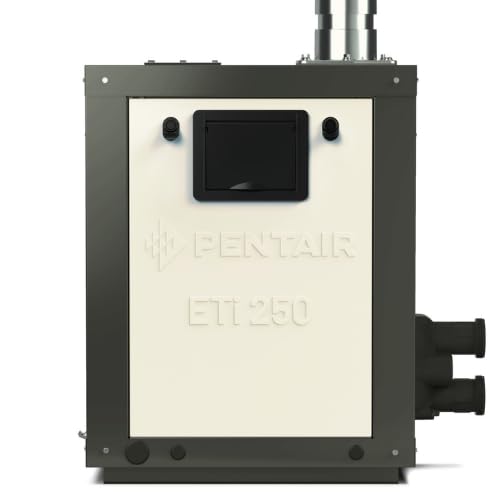
For most inground pools, the Hayward H-Series 250,000 BTU natural gas heater is the pick: cupro nickel exchanger, low-NOx certified, and rated for pools and spas up to 750 sq ft. Choose propane or a titanium exchanger only if your fuel line or water chemistry demands it.
Half-true belief worth naming up front: a bigger BTU number always heats faster. It does raise water temperature faster, but only if your gas line, pump flow and venting can feed it, and an oversized heater short-cycles and wears out sooner.
So the job here is matching a 250,000 BTU unit to your pool volume and fuel, then picking the exchanger and ignition that survive your water and your winters.
The Best 250,000 BTU Gas Pool Heaters
#1Best Overall
Hayward 250K Natural Gas Heater
Best for Inground pools and spas up to 750 sq ft
Product 1 is the strongest fit for most inground pools because it combines a cupro nickel heat exchanger with low-NOx certification. Its digital display provides temperature control and self-diagnostics, while right- or left-side connections make installation more flexible. Choose it when you have natural gas and want clear operating feedback.
Heat output 250,000 BTUFuel Natural gasHeat exchanger Cupro nickelCoverage Pools and spas up to 750 sq ftGas connection Built-in 3/4-inch connection
Why it made the cut
Cupro nickel heat exchanger
Low-NOx certified
Self-diagnostic digital display
Fits pools and spas up to 750 sq ft
Good to know
Natural gas connection required
Coverage is listed in square feet, not gallons
Skip it if Skip it if your property uses propane or your water chemistry calls for a titanium exchanger.
Best for Inground pools with a propane fuel supply
Product 2 suits an inground pool that already runs on propane. Premix combustion technology is designed for fast, efficient warm-ups, and the controls can rotate for easier access. Built-in safety features and indoor or outdoor installation certification add flexibility, subject to the installation instructions and local requirements.
Heat output 250,000 BTUFuel PropaneCombustion Premix combustion technologyInstallation Certified for indoor and outdoor installation
Why it made the cut
Propane fuel
Premix combustion technology
Rotatable operation controls
Certified for indoor and outdoor installation
Good to know
Propane fuel limits it to properties with a propane supply
No coverage figure is provided
Skip it if Skip it if your pool equipment is set up for natural gas.
Best for Pools and spas needing call-for-heat ignition
Product 3 uses intermittent spark ignition, so its pilot comes on only when the heater calls for heat. The digital electronic ignition and natural-gas design suit pools and spas where automatic operation matters. Its material is designed not to retain residual heat after shutdown.
Heat output 266,000 BTUFuel Natural gasIgnition Digital electronic ignitionSafety control Intermittent spark ignition pilotModel P-R266A-EN-C
Why it made the cut
266,000 BTU output
Intermittent spark ignition pilot safety controls
Designed for pools and spas
Doesn’t retain residual heat after shutoff
Good to know
Output is above 250,000 BTU
No pool-size coverage figure is provided
Skip it if Skip it if you need a heater specified at exactly 250,000 BTU.
Best for Buyers prioritizing digital controls and low-NOx operation
Product 4 offers a rotating digital control panel for viewing settings and diagnostics from a more convenient angle. Its listing identifies it as a 250K BTU natural gas heater with certified low-NOx emissions. The description also says 400,000 BTU, so confirm the exact output before ordering.
Best for Pools where corrosion resistance is the deciding factor
Product 5 centers on a titanium heat exchanger, which is the standout choice in this group for buyers concerned about corrosion. The unit lists up to 96% thermal efficiency, multiple gas-line connection orientations, and keypad access. A three-year parts and labor warranty is included in the product data.
Heat output 250,000 BTUThermal efficiency Up to 96%Heat exchanger TitaniumControls KeypadWarranty Three-year parts and labor
Why it made the cut
Titanium heat exchanger
Up to 96% thermal efficiency
Multiple gas-line connection orientations
Three-year parts and labor warranty
Good to know
Fuel type isn’t specified
No coverage figure is provided
Skip it if Skip it if you need a documented natural-gas or propane configuration before purchase.
Gas Pool Heaters for Inground Pools: What Separates Them
For gas pool heaters for inground pools, compare the heat exchanger, fuel type, ignition system and pad layout before you compare the brand name. A 250,000 BTU gas pool heater can be an excellent fit, but the wrong fuel suffix or connection side can turn a simple replacement into a plumbing project.
Spec
What to check
Why it matters
Heat exchanger
Cupro nickel, titanium or stainless steel
Cupro nickel gives treated water better corrosion resistance than plain copper. Titanium is the safer choice for saltwater, aggressive chemistry or frequent chemical swings. Stainless steel resists corrosion well, but its suitability still depends on the water chemistry and the model’s listing.
Fuel
Natural gas or propane
The burner, orifices and gas controls are matched to one fuel. A natural-gas model isn’t converted by changing the hose. Match the full model suffix to your gas supply.
Ignition
Standing pilot, intermittent spark or premix
A standing pilot burns a small gas flame continuously. Intermittent spark lights the burner only when heat is called for, so it has no standing-pilot gas use. Premix systems blend gas and air before combustion and typically use electronic ignition; check the manual for the actual control system.
Pad fit
Overall footprint, gas side and water connection sides
The new heater has to fit the existing slab, unions and gas pipe. Connection sides can differ even among heaters with similar BTU ratings.
These are the specifications that decide the replacement, not the 250,000 BTU label alone.
Fuel choice is fixed by the service already at the pad: natural gas comes from a building gas line, while propane comes from a tank and needs the correct regulator and supply capacity. That is why two versions of an otherwise similar heater carry different suffixes. The MasterTemp Pentair EC-462027 is the propane example in this group; the Hayward H-Series and Raypak 266,000 BTU models listed above are natural-gas examples.
Efficiency changes firing time
Atmospheric gas pool heaters commonly fall roughly between 82% and 96% efficiency. For the same useful heat, an 82% heater needs about 17% more gas input than a 96% heater: 96 ÷ 82 = 1.17. That doesn’t predict your bill by itself, because water temperature, weather and runtime still do the heavy lifting.
Check the pad and connection drawing before ordering, especially if last year’s heater was a different brand. A heater that fits the slab but puts the water unions or gas inlet on the opposite side may need new pipework, and gas connections should be handled by a qualified professional.
Size the Heater to Gallons, Not to the Label
For “inground swimming pool heaters gas,” a 250,000 BTU unit is a reasonable starting point for roughly 15,000 to 20,000 gallons in a moderate climate, but gallons and temperature rise decide the actual run time. The label tells you the heater’s input; the pool tells you how hard it has to work.
6.7 hours
Ideal heating time for 20,000 gallons
Raising 20,000 gallons by 10°F takes about 1.67 million BTU before heat loss. At 250,000 BTU per hour, 1,670,000 ÷ 250,000 equals about 6.7 hours.
Worked Example
Say your inground pool holds 20,000 gallons and starts at 70°F. The basic formula is gallons × 8.34 pounds × temperature rise ÷ BTU output = hours. So, 20,000 × 8.34 × 10 ÷ 250,000 = 6.67 hours, or roughly seven hours before wind, evaporation and uncovered-water losses. A cover can matter more than adding a larger heater when the pool is losing heat quickly.
Pool20,000 gallons
Temperature rise10°F
Heat neededAbout 1.67 million BTU
Ideal run timeAbout 6.7 hours
A 250,000 BTU gas pool heater burns about 2.7 gallons of propane or 250 cubic feet of natural gas per hour. At an assumed $3 per gallon for propane, seven hours costs 2.7 × 7 × $3, or about $56.70. At $1.50 per 1,000 cubic feet for natural gas, seven hours costs 250 × 7 ÷ 1,000 × $1.50, or about $2.63; your utility rate can change that result sharply. Use those burn rates with your local fuel price in the cost block when comparing a Hayward H-Series, MasterTemp or another 250,000 BTU model.
Myth
A higher efficiency rating changes the heat-load formula.
Fact
Efficiency changes how much fuel becomes useful heat, not the gallons × 8.34 × temperature-rise calculation. A heater around 96% efficiency delivers more of each input BTU to the water, so it needs fewer fuel BTUs for the same rise; the nameplate input and actual losses still matter.
For gas pool heaters, about 96% thermal efficiency is the high end you’ll commonly see in this class. Choose that efficiency when the added purchase cost makes sense for frequent heating, then compare fuel prices and expected operating hours rather than assuming a bigger 400,000 BTU label will always be cheaper.
Venting, Clearance and the CO Rule
A gas pool heater and chiller combo is two separate appliance decisions: the heater warms water, while a dedicated chiller removes heat; a heater alone cannot chill your pool. For most 250,000 BTU units, plan on an outdoor installation unless the exact model has an approved indoor venting option.
Most heaters in this size class are outdoor-rated only, including many versions of the Hayward H-Series, MasterTemp Pentair EC-462027 and Raypak 266,000 BTU models. An indoor or enclosed installation needs the manufacturer’s vent kit, combustion-air provisions and a professional installation; putting an outdoor heater in a shed is not a shortcut.
Carbon Monoxide
Never run a gas pool heater in a sealed shed, garage or enclosure. Keep a working CO alarm in a protected nearby location where the alarm maker permits it, and follow the heater manual for ventilation and exhaust placement. Exhaust can contain carbon monoxide even when the flame looks normal.
Low-NOx certification matters in air-quality districts that require it, so check the certification and installation rules before ordering. A low-NOx label doesn’t override local code, and it doesn’t make an outdoor-rated heater suitable for an enclosed room.
Clearances to windows, doors, soffits and combustible walls come from the installation manual, not from a familiar-looking gap around another appliance. The exhaust needs room to disperse, and nearby siding, fencing or overhangs can change the required layout.
Before the Heater Arrives
Confirm the model is listed for outdoor use or has the manufacturer-approved indoor vent kit.
Check the manual’s clearances for windows, doors, walls, overhangs and service access.
Verify low-NOx certification if your air-quality district requires it.
Plan a protected nearby CO alarm and keep the equipment area open to the required air.
Have a licensed plumber size the gas line and install the sediment trap where local rules require it.
Myth
The existing gas line is large enough because the heater fits the same pad.
Fact
A 250,000 BTU heater can need a larger gas supply than an older appliance. Gas-line sizing, shutoff placement, leak testing and the sediment trap belong to a licensed plumber in most jurisdictions; don’t improvise with fittings on startup day.
1
Match the fuel and venting
Confirm natural gas or propane, then check the exact model’s vent category and approved vent parts. The Hayward H-Series natural gas heater and the MasterTemp propane model aren’t interchangeable just because both are near 250,000 BTU.
2
Mark the exhaust path
Measure from the proposed pad to openings and combustible surfaces using the manual. If an enclosure, wall or roof changes the path, stop and have the installer redesign it.
3
Approve the final setup
Before lighting, have the gas connection, venting, clearances, CO protection and local low-NOx requirements checked. A heater that fires is not automatically a heater that passes inspection.
High Efficiency Gas Pool Heaters and the Payback Math
High-efficiency gas pool heaters are condensing models, and the highest efficiency you can get on a gas pool heater is about 95 to 97 percent. Standard atmospheric units usually land near 82 to 84 percent, so the condensing design burns less fuel for the same heat delivered to the pool.
Heater type
Typical efficiency
What it needs
Atmospheric
82–84%
Standard venting and a suitable drain path
Condensing
95–97%
Condensate drain and cooler return water
Efficiency is the share of the fuel’s heat that reaches the pool water.
Condensing units need a drain for acidic condensate, and they need cool enough return water to condense properly. A pool kept warm with high return-water temperature may give the heater fewer chances to operate in condensing mode, so the nameplate percentage isn’t the whole installation story.
Here is the payback math: to put 1,000,000 BTU into the water, an 83-percent heater uses about 1,205,000 BTU of fuel, while a 96-percent heater uses about 1,042,000 BTU. That saves roughly 163,000 BTU, or about 13.5 percent of the fuel, before the condensing unit’s higher purchase and installation cost.
Who should choose it
A condensing heater makes more sense for a long swimming season, frequent heating or expensive fuel. Short seasons rarely justify the premium; an atmospheric unit is usually the saner pick for a pool you heat only a few weekends.
Water chemistry can change that decision. Titanium heat exchangers resist salt and aggressive chemistry better than cupro nickel, so a saltwater pool or difficult chemistry may reward the titanium option even when its fuel savings are modest. For a larger pool that may need more output than these 250,000 BTU models, compare the options in our 400,000 BTU natural gas pool heater guide.
Run This Checklist Before You Buy or Light It
Gas pool heaters are easier to buy and safer to light when you verify the pool, pad, fuel and water flow before touching the controls.
Confirm before ordering
Measure the pool’s gallons and match the heater’s output to the pool, climate and heating season.
Measure the equipment pad and confirm the manufacturer’s clearance around the heater, vent and service panels.
Check the fuel type at the gas meter or propane tank, then have a qualified technician verify the existing gas-line size and supply pressure.
Confirm the electrical supply required for ignition and controls matches the heater installation instructions.
Photograph the data plate, model number and serial number before calling for service.
1
Start the pump first
Run the pool pump and confirm water flows through the filter and exchanger before the heater fires. A heater should not operate without the required water flow.
2
Call before changing gas work
Have a licensed gas technician handle line changes, connections, leak checks or venting corrections; don’t improvise with fittings or a bypass.
Questions People Ask
How many gallons will a 250,000 BTU pool heater heat?
A 250,000 BTU heater is commonly sized for roughly 15,000 to 20,000 gallons in a moderate climate, but that range isn’t a capacity limit. Insulation, wind, desired temperature, pool cover and local air temperature can push the right size higher or lower. A heater’s BTU rating describes heat input per hour, not a fixed gallon rating.
How fast will a 250,000 BTU heater raise my pool temperature?
For a 20,000-gallon pool, raising the water 10°F takes about 1,668,000 BTU in a perfect calculation: 20,000 × 8.34 × 10. Dividing by 250,000 gives roughly 6.7 hours before accounting for heat lost to the air, so the real time will be longer, especially without a cover.
What is the highest efficiency you can get on a gas pool heater?
Condensing gas pool heaters reach roughly 95% to 97% efficiency, which is the high end for gas models. They capture more heat from the exhaust, but they also need a condensate drain and venting that matches the installation instructions. A lower-efficiency heater may be the simpler choice if the pad cannot support those connections.
Can a gas pool heater also chill the pool?
A gas-fired pool heater only adds heat; it doesn’t chill the water. Cooling requires separate equipment, such as a dedicated pool chiller or a heat-pump system designed for cooling. Confirm the plumbing layout before buying a heater-and-chiller setup, because the two appliances need compatible flow and controls.
What maintenance does a gas pool heater need before winter?
Before freezing weather, shut off the gas and pump, then drain the heat exchanger according to the heater manual; trapped water can split it. Check the vent, burner area, unions and drain plugs for damage, and have a licensed technician inspect gas connections or combustion problems. A pool cover helps during the season, but it doesn’t winterize the heater.