Product 1 is the best electric heater for most small rooms because its 1,500-watt ceramic heater is compact, ETL certified, quiet below 35 dB, and protected against tip-over and overheating. Choose product 3 or 5 for broader room coverage, or product 4 for precise smart controls.
The common mistake is buying by wattage alone. Five 1,500-watt heaters can draw about 12.5 amps at 120 volts, yet differ sharply in thermostat control, noise, coverage and where you can safely use them.
These picks separate those details so you can buy the right electric room heater for home use instead of expecting a small plug-in unit to heat the whole house.
The Best Electric Heaters For Home Use
#1Best For Most Rooms
R.W.FLAME Compact Ceramic Heater
Best for Small rooms and offices where quiet, personal heat matters
The 1,500-watt ceramic heater is compact, runs below 35 dB, and has two simple control knobs. ETL certification plus tip-over and overheat protection make it a sensible pick for everyday use in a small room.
Power 950 W / 1,500 WNoise Below 35 dBHeating area 108–130Safety ETL certified; tip-over and overheat protection
Why it made the cut
Compact 6.22 × 6.22 × 8.78-inch body
Low and high heat settings: 950 W and 1,500 W
Built-in handle and 6 ft power cord
Good to know
The listed heating area is 108–130, with no unit specified
Manual knob controls, not a remote or digital thermostat
Skip it if Choose a model with wider oscillation if you need to spread heat across a larger room.
Best for Bedrooms and living spaces where oscillation and quiet operation help
A 70° oscillation range helps distribute heat across the room, while the 34 dB operation suits spaces where fan noise is distracting. ECO mode adjusts the working mode to maintain your set temperature, and the 12-hour timer gives you a simple way to limit run time.
Power 1,500 WOscillation 70°Noise 34 dBTimer 12 hoursSafety ETL certified; tip-over and overheat protection
Why it made the cut
70° wide-angle oscillation
34 dB operation
Remote control, ECO mode and 12-hour timer
Good to know
Maximum heat output is 1,500 W
The listed controls and modes may be more than you need for a small personal space
Skip it if Pick the first heater if you want a smaller, simpler unit for one person or a compact room.
Best for Larger living areas where you want radiant heat and air circulation
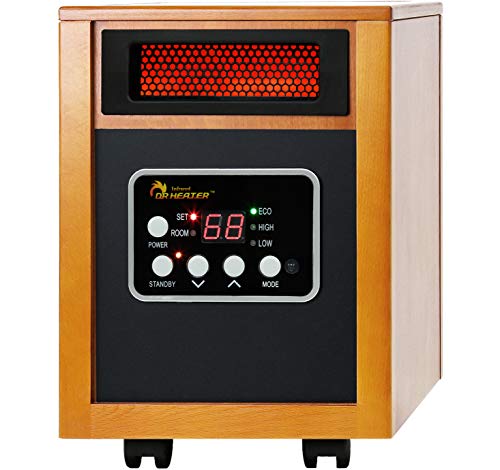
The DR-968 combines infrared quartz heat with PTC heat and a blower, so it adds radiant warmth while circulating heated air. Its listed coverage is up to 1,000 sq. ft.; the 50°F–85°F thermostat, remote and 12-hour timer add convenient control.
Power 1,500 WListed heat output Up to 5,200 BTUCoverage Up to 1,000 sq. ft.Noise 39 dBThermostat range 50°F–85°F
Why it made the cut
Infrared quartz and PTC dual heating
Listed coverage up to 1,000 sq. ft.
Remote, electronic thermostat and 12-hour timer
Good to know
At 39 dB, it is louder than the 34 dB pick
The larger-area coverage claim does not change its 1,500-watt rating
Skip it if Choose an oscillating ceramic heater if you want heat spread across a room without a larger cabinet-style unit.
Best for Bedrooms and offices where you want fine thermostat adjustments
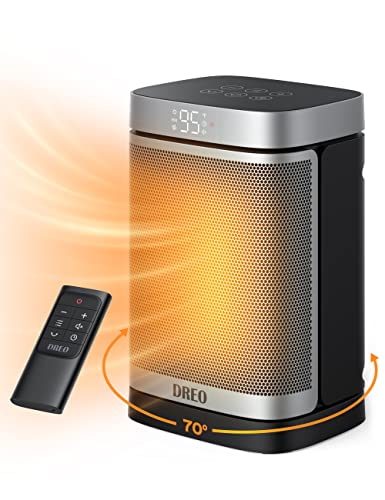
Its digital thermostat adjusts from 41°F to 95°F in 1°F increments, giving you more precise control than a basic dial. ECO mode adjusts heat automatically, and 70° oscillation spreads warmth while the unit runs at up to 37.5 dB.
Power Up to 1,500 WThermostat range 41°F–95°FOscillation 70°Noise Up to 37.5 dBSafety ETL listed; tip-over and overheat protection
Why it made the cut
Digital thermostat adjusts in 1°F increments
70° wide-angle oscillation
Remote, ECO mode and 12-hour timer
Good to know
Noise is listed at up to 37.5 dB
No room-coverage figure is provided
Skip it if Choose the first pick if you prefer straightforward knobs over a digital thermostat and remote.
Best for Garages, basements and workshops that need simple manual heat
The rugged milkhouse design and metal housing suit utility spaces, while the adjustable thermostat includes an anti-freeze setting. Two heat settings and a fan-only mode cover basic heating and air circulation without adding remote or digital controls.
Heat settings 2Fan mode Fan-onlyThermostat Adjustable, with anti-freeze settingHousing Metal
Why it made the cut
Sturdy metal housing
Two heat settings and fan-only mode
Adjustable thermostat with anti-freeze setting
Good to know
No wattage or room-coverage figure is provided
Manual controls, with no remote listed
Skip it if Choose a heater with stated coverage and built-in tip-over protection if those details are priorities.
For electric room heaters for home, match the heater to the room and how you use it; the best electric heater for a house isn’t automatically the one with the biggest coverage claim. A 1,500-watt plug-in heater draws about 12.5 amps at 120 volts, close to the practical limit of a standard outlet circuit.
Room or need
A fitting choice
What to know
Small office or bedroom
R.W.FLAME Small Space Heater
Lists 108–130 square feet; its ceramic element and fan move warm air around the room.
Garage, basement or workshop
COMFORT ZONE Milkhouse Utility Space Heater
Metal housing and an anti-freeze setting suit utility spaces.
Quiet, wider coverage
DREO Space Heaters for Indoor Use with Thermostat
Oscillating coverage for larger rooms; supplied data gives no exact square-foot rating.
Precise temperature adjustments
DREO Space Heater, Portable Electric Heaters for Indoor Use
Digital controls for fine adjustments; no exact square-foot rating is supplied.
Broader room coverage
Dr Infrared Heater DR-968 Portable Space Heater
Lists coverage up to 1,000 square feet; check your room conditions before relying on that figure.
Coverage figures are product claims, not guarantees for every home.
Ceramic fan heaters warm air and circulate it; the DREO oscillating model spreads that moving air across a wider area. The Dr Infrared combines infrared and PTC heat: radiant warmth can reach nearby people and surfaces quickly, even before the room air feels warm.
Check The Room Size
A 12-by-14-foot room is 168 square feet. That’s larger than product 1’s listed range, so consider a model intended for larger rooms rather than treating the 1,500-watt rating as a room-size promise.
Room12 × 14 ft
Floor area168 sq ft
Product 1 listed range108–130 sq ft
Room Conditions Matter
Insulation, drafts, ceiling height and outdoor temperature can overwhelm a simple square-foot rule. A leaky room may feel cold with a heater whose coverage claim looks generous.
Before You Place It
Product 1 has a 6-foot cord and a handle, which can make positioning easier.
Plug any electric space heater directly into a wall outlet, never an extension cord or power strip.
Keep the heater at least 3 feet from bedding, curtains and other combustibles.
Electric heaters are energy-efficient at turning electricity into heat at the point of use, but they can still cost plenty to run: every 1,500-watt resistance heater uses 1.5 kWh for each hour it runs. At an assumed rate of 17 cents per kWh, eight hours at full power costs $2.04 before the thermostat cycles it off.
Heater
Watts
Per hour
Per day (8 h)
Per month (30 days)
1,500-watt electric heater
1,500 W
26¢
$2.04
$61.20
Calculated at 17¢ per kWh. Assumes electricity costs 17 cents per kWh and the heater runs at full power for eight hours daily; actual use may be lower when its thermostat cycles off.
A thermostat lowers the bill by reducing runtime, not by making resistance heat produce more heat per watt. Your room reaches its set temperature, the heater switches off, then cycles back on as the room cools.
Question
Practical answer
Can electric heat be primary heat?
Yes, in a small, well-insulated space. Several 1,500-watt heaters may exceed circuit capacity and can cost more to run than a central system.
What about baseboard thermostats?
Fixed electric baseboards need a wall thermostat rated for the circuit and voltage, installed according to local electrical rules. A portable heater’s built-in controls aren’t a substitute.
What changes from oil to electric?
Electric heat can simplify fuel delivery and reduce local combustion emissions. Operating cost depends on your electric rate, oil price, insulation and whether you replace or supplement the existing system.
The right comparison depends on the house and the energy rates you pay.
Water Heaters Are A Different Job
An electric water heater supplies domestic hot water; it won’t heat your rooms. Tank or tankless choices depend on household demand and electrical service. For those options, see the water heater buying guide.
If you’re weighing oil against electric, compare the cost of the heat you actually need before replacing equipment; a portable heater can supplement a room without proving that a whole-house conversion will save money.
Use The Safest Electric Heater Setup
The safest electric space heater for home use is a listed model with tip-over and overheat protection, placed on a level floor with clear space around it. No portable heater is risk-free, so a working thermostat and a careful setup matter as much as the model. Look for a recognized ETL, UL or CSA listing when comparing what safety features to look for in an electric heater.
In this group, products 1 and 3 are ETL certified, product 4 is ETL listed, and product 5 is UL certified. No certification information was supplied for product 2, so don’t assume it has one. A listing is a useful check, not permission to ignore the manual.
Check Before Each Use
Inspect the plug and cord for damage; don’t use the heater if either is frayed, cracked or loose.
Plug the heater directly into a wall outlet. Never use an extension cord or power strip.
Check that the outlet and plug aren’t unusually warm during operation; stop using the heater if they are.
Keep the grille clear, set the heater on a level floor and leave at least 3 feet between it and bedding, curtains, furniture or clothing.
Confirm the thermostat and automatic shutoffs work as described in the manual.
A tip-over switch cuts power if the heater is knocked over; overheat protection cuts power if its internal temperature gets too high. Neither feature prevents a fire caused by nearby fabric, a damaged cord or poor placement, and neither replaces supervision.
Don’t Leave It Running Unattended
Don’t sleep with a portable heater running or leave one on while you’re away unless the manufacturer specifically says that model is designed for those conditions. A patio, construction or outdoor heater isn’t an indoor substitute. Indoor fuel-burning heaters need an indoor rating, the ventilation required by the manual and a working carbon-monoxide alarm.
Keep Heat During A Power Outage
Non electric indoor heating options include a properly installed wood or pellet stove, a code-compliant fireplace, and an indoor-rated propane or kerosene heater where local rules and the manufacturer allow it. These are the main options for heating home without electricity; a portable electric heater stops heating when the power goes out.
Wood and pellet appliances need the clearances specified by their listing, the correct chimney or vent, and annual chimney inspection and sweeping. Burn only approved fuel: never trash or treated wood. A fireplace also needs to meet local code and be used as its instructions specify.
Control Carbon Monoxide Risk
Propane and kerosene heaters produce carbon monoxide. Use only an indoor-rated model, provide the ventilation its manual requires and keep a working CO alarm in the home. Kerosene heaters burn 1-K kerosene only; never use gasoline. Vent-free gas heaters are banned or restricted in some states and cities, so check local code before buying or using one.
Myth
An outdoor heater can keep a room warm during an outage.
Fact
Outdoor patio heaters, torpedo heaters and construction heaters must not be used indoors, in tents or in vehicle cabins. Diesel heaters exhaust outside the cabin; follow the manufacturer’s installation and operating instructions.
A generator can power electric heat only if the generator is suitable for the load and used according to its instructions. Operate it outdoors with the required separation from the home to prevent exhaust, including carbon monoxide, from entering. Never run a generator in a home, garage or other enclosed space.
More Questions, Answered
What is the safest electric space heater for home use?
Choose a heater with a UL, ETL or CSA listing, tip-over shutoff and overheat protection. Plug it directly into a wall outlet, keep it at least 3 feet from anything that can burn, and follow the manual’s instructions about unattended use.
What thermostats work with electric baseboard heating?
Electric baseboards usually need a line-voltage thermostat rated for the heater’s voltage and electrical load; a standard low-voltage furnace thermostat won’t control them directly. Check the baseboard label and thermostat wiring before buying, and have an electrician handle wiring if you’re unsure.
What are the best non-electric indoor heating options?
A properly installed wood or pellet stove can provide steady heat without household electricity, though some pellet stoves need power to run their controls and feed system. Indoor-rated propane or kerosene heaters are another option only where local rules allow them; use the required ventilation and a working carbon monoxide alarm.
Can I heat my home without electricity?
Yes, if you have a heat source designed to operate without household power, such as a properly installed wood stove or a code-compliant fireplace. Some gas appliances also need electricity for ignition or fans, so check the manual; never run an outdoor or construction heater indoors.
Are electric water heaters at Home Depot a good option for a home?
They can be, if the tank capacity and recovery rate fit your household’s hot-water use and the unit matches your home’s electrical service and available space. Compare those specifications before choosing; installation involving 240-volt wiring is generally a job for a licensed electrician.
Is an electric hot water tank a good option for a home?
An electric tank can suit a home without gas service or where simpler equipment is a priority, but its running cost depends on your electricity rate and hot-water use. Check the first-hour rating against your household’s peak demand, and have a licensed plumber or electrician handle connections and the T&P discharge line.