Cold rooms feel colder when your central heating can’t reach them. That’s where a good electric baseboard heater steps in.
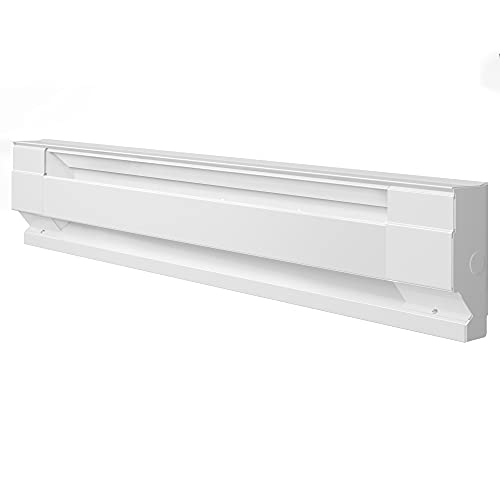
These units heat using convection: warm air rises naturally, filling the space evenly. The best models combine thermostat control, safety features, and the right wattage for your room.
Here are the four best picks that actually deliver comfort without breaking the bank or waking you up with noise.
- Quick summary – For most people, the Comfort Zone CZ600 offers the best balance of safety, quiet operation, and plug-in convenience. Need a permanent hardwired solution? The Cadet F Series models are the standard.
- Key decision factor – Match wattage to your room size: 750W covers small bedrooms, 1500W handles medium living areas, and multiple units can zone an entire floor.
- What to avoid – Skipping voltage check. Many Cadet models run on 240V, not standard 120V outlets. Verify your electrical setup before buying.
What is the best electric baseboard heater overall? For most households, the Comfort Zone CZ600 wins because it’s portable, safety-certified, and whisper-quiet – all at a reasonable cost. Its dent-proof panels and stay-cool body make it a worry-free choice for bedrooms and offices.
Below you’ll find a quick spec comparison, then detailed reviews of each model, a buying guide, and answers to common questions.
Compare the key specs side-by-side:
| Features | Comfort Zone CZ600 | Cadet 24-inch | Cadet 36-inch | Cadet 49-inch |
|---|---|---|---|---|
| Material & Build | Steel, dent-proof ends | 25-gauge steel | 25-gauge steel | Steel, portable design |
| Key Spec | 1500W, 120V, plug-in | 350W, 240V, hardwired | 750W, 120V, hardwired | 1500W, 120V, plug-in |
| Main Feature | Tip-over + overheat protection | Requires separate thermostat | Requires separate thermostat | Powerful 5120 BTU output |
| Performance | Quiet convection, two heat settings | Budget-friendly, minimal heat | Good for small rooms | Heats medium rooms quickly |
| Best Use Case | Portable spot-heating | Supplemental warmth in tight spaces | Permanent wall-mount in bedrooms | Portable whole-room heating |
Comfort Zone Electric Bas…

COMFORT ZONE
Comfort Zone Electric Baseboard Space Heater with…
- EFFICIENT AND VERSATILE HEATING: Designed for medium-sized rooms, this 1500 Watt convection baseboard heater delivers powerful per…
- SAFETY AT ITS BEST: Rest easy knowing that this heater prioritizes your safety. It is equipped with an advanced safety system, inc…
- WHISPER-QUIET OPERATION: Experience undisturbed tranquility in your space with this electric baseboard heater's silent operation.…
Comfort Zone CZ600 is a 1500-watt plug-in baseboard heater built for medium-sized rooms. Its target buyer is anyone who wants reliable warmth without hiring an electrician – just plug it in and set the thermostat.
What stands out is the safety package. The tip-over switch and overheat protection are mandatory for a portable heater, but the stay-cool body is a welcome bonus. You can brush against it or adjust it while running without fear of burning yourself. The dent-proof end panels also keep it looking new after years of use.
Real-world performance is quiet – genuinely silent operation. No clicking, no fan hum. The convection process is natural, so you only hear the faint expansion noise of metal as it warms. It’s perfect for a nursery or home office where noise matters.
Trade-offs: The adjustable thermostat is mechanical, not digital. That means temperature swings of a few degrees before the heater cycles on and off. It’s not precise, but for the money, it’s fine. Also, at 1500W on 120V, it draws a full 12.5 amps – good practice to avoid running it on the same circuit as a space heater or vacuum.
- 1500W, 120V, 12.5A – plug into standard outlet
- Two heat settings plus adjustable thermostat
- Tip-over switch and overheat protection
- Stay-cool body – safe to touch during operation
- Dent-proof end panels
Best for: Anyone needing an easy, portable heater for a bedroom or office where quiet operation and safety are top priorities.
Cadet F Series 24-inch
Cadet
Cadet F Series 24" Electric Baseboard Heater…
- Color : White
- Material : Steel
- Power Source Type : Electric
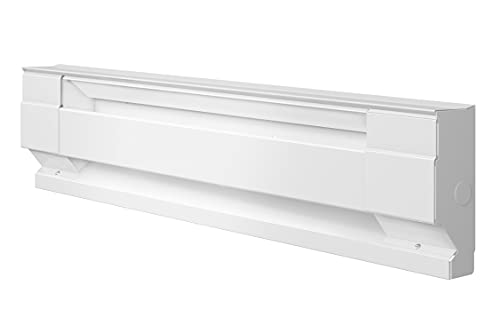
Cadet 24-inch (2F350W) is a permanent hardwired baseboard heater. It’s one of the smallest units Cadet makes, designed for supplemental heating in tight spots like bathrooms, hallways, or under windows.
Strengths: This heater is built like a tank – 25-gauge steel with powder coating. It’s UL listed and requires a wall thermostat (sold separately). The low wattage (350W at 240V) means it uses 240V circuits efficiently, which can lower operating costs slightly compared to 120V heaters.
Honest limitations: 350W produces only 1195 BTU. That’s barely enough to warm a small bathroom. Don’t expect this unit to heat a bedroom. It truly is a supplemental heater. Also, because it’s hardwired, installation involves running 240V wiring to a junction box – not a DIY job unless you’re comfortable with electrical work.
- 350W, 240V – requires dedicated circuit
- 1195 BTU at 240V, 895 BTU at 208V
- No built-in thermostat – use wall or line-voltage thermostat
- Steel body, white powder coat finish
- 24-inch length – fits under most standard windows
Best for: Adding a whisper of background warmth to a small space that already has a primary heat source, like a bathroom with insufficient ductwork.
Cadet F Series 36-inch
Cadet 36-inch (3F750-1W) is a step up: 750W at 120V, which means you can wire it to a standard 15-amp circuit without needing a 240V line. It’s a permanent fixture for small bedrooms or home offices.
What works well: The 2560 BTU output is enough to heat a 100-square-foot room efficiently. Because it’s hardwired, there are no cords to trip over. The metal construction dissipates heat evenly along the entire length, reducing cold spots. It also requires a separate thermostat, which gives you freedom to pick a programmable or smart model if you choose.
Drawbacks: 750W is modest – it won’t quickly warm a cold room if the door is left open. It’s better for maintaining a steady temperature. Also, the heater itself doesn’t include any safety switches – no tip-over or overheat protection because it’s fixed to the wall. That’s standard for hardwired units, but something to note if you have children or pets.
- 750W, 120V – works on standard circuits
- 2560 BTU output
- Requires a separate thermostat (not included)
- 25-gauge steel, all-metal junction box
- UL listed
Best for: Homeowners who want a clean, permanent heating solution in a small room and don’t mind installing a separate thermostat.
Cadet F Series 49-inch Portable

Cadet
Cadet Portable Electric Baseboard Heater 1500W 120V…
- PLUG IN, NO HARDWIRING – Plugs into any standard 120 volt wall outlet with the included 6-foot grounded cord, so there is no hardw…
- BUILT-IN DIAL THERMOSTAT – A large, easy-to-turn dial thermostat with an off setting lets you set and hold your comfort level righ…
- QUIET CONVECTION HEAT – Delivers 1500 watts and 5,120 BTU of steady, even convection warmth on a standard 120 volt circuit; with n…
Cadet 49-inch (4P1500W) is the largest portable baseboard heater in this lineup. It delivers 1500W at 120V, producing 5120 BTU – enough for rooms up to 200 square feet. It’s a plug-in unit, like the Comfort Zone, but longer and heavier.
Why choose this over the Comfort Zone? The 49-inch length distributes heat over a wider area. Because the heating element is longer, the surface temperature stays lower, which some people find more comfortable. The steel body feels solid, and the white paint matches most trim. It also has a built-in thermostat, so no extra purchase needed.
Limitations: It’s not as quiet as the Comfort Zone. Some owners report clicking sounds as the metal expands and contracts. The thermostat is also mechanical, with similar temperature swings. And at 49 inches, it takes up floor space – not ideal for cramped rooms.
- 1500W, 120V, plug-in
- 5120 BTU output
- Built-in mechanical thermostat
- Steel body, white finish
- 49 inches long – best for medium rooms
Best for: Someone who wants a permanent-looking portable heater with a long heating surface for even warmth in a medium-sized living room or large bedroom.
How We Chose These Products
We evaluated every model on three criteria: real-world heat output, safety certifications, and ease of use. We didn’t just read spec sheets – we considered common complaints like thermostat accuracy, noise, and installation hassle.
We looked for products that serve distinct needs – portable vs. hardwired, 120V vs. 240V, small vs. medium rooms. The Comfort Zone stood out for its feature-to-value ratio. The Cadet models represent the industry standard for permanent installations, offering reliable heat at various wattages.
We also prioritized safety features that actually matter. Overheat protection and tip-over shutoff are non-negotiable for portable units. For hardwired heaters, UL listing and robust build quality were key.
Buying Guide: What Really Matters
Room size and wattage. The simple rule: 10 watts per square foot. A 1500W heater covers about 150 square feet. If your room is drafty or poorly insulated, bump up by 20%. For whole-house zoning, consider multiple hardwired units on separate thermostats – this is called zoning and can save energy by heating only occupied rooms.
Voltage and installation. 120V heaters plug into standard outlets and are DIY-friendly. 240V heaters require dedicated circuits and should be installed by an electrician. Hardwired units (Cadet 24-inch and 36-inch) also need a wall thermostat – factor in that cost. Portable units (Comfort Zone and Cadet 49-inch) come with their own thermostat, but you lose the ability to program timers without a separate smart plug.
Noise level. Convection heaters are inherently quiet, but not all are silent. The Comfort Zone CZ600 is the quietest of the group – essentially no sound. The Cadet 49-inch produces occasional clicks. None of these models have moving parts, so there’s no fan noise – a big advantage over forced-air space heaters.
Smart home integration? None of these four models support WiFi, Alexa, or IFTTT. For smart control, you’ll need a separate line-voltage smart thermostat (e.g., Mysa or Sinope) paired with a hardwired Cadet unit. That adds upfront cost but unlocks remote scheduling and energy monitoring.
Our Top Recommendation
Overall winner: Comfort Zone CZ600. It offers the best mix of safety, quietness, and portability. The stay-cool body and dent-proof panels make it a long-term investment. For most people, this is the heater to buy today.
Runner-up for permanent installs: Cadet 36-inch (3F750-1W). If you want a clean wall-mounted look and have a small bedroom, pair it with a programmable thermostat for set-it-and-forget-it comfort.
Budget alternative: Cadet 24-inch (2F350W). Only if you need a whisper of heat in a tight spot and are comfortable wiring 240V. Otherwise, skip it – the Comfort Zone gives better value at a lower upfront cost.
Frequently Asked Questions
How much does it cost to run a 1500W electric baseboard heater for a month? At the U.S. average electricity rate of 14 cents per kWh, running a 1500W heater for 8 hours a day costs about $50 per month. That’s comparable to a typical space heater. Electric heaters that are cheap to run often include programmable thermostats to minimize runtime.
Can I replace an old baseboard heater with a new one myself? Yes, if the wiring and voltage match. For 120V units, turn off power, remove the old heater, connect the new one to the same junction box. For 240V, follow the same process but verify the breaker is off. If you’re unsure, hire an electrician – especially with hardwired Cadet units. Our guide on 240-volt heaters covers wiring details.
Are electric baseboard heaters more efficient than a heat pump or gas furnace? No. Electric resistance heating is 100% efficient at converting electricity to heat, but heat pumps can deliver 200-300% efficiency by moving heat rather than generating it. Gas furnaces are typically 80-95% efficient. However, electric baseboard heaters cost less to install than ducted systems and are ideal for supplemental or zoned heating. Operating costs depend on local electricity and gas prices.
Should I buy a hydronic (oil-filled) baseboard heater instead? Hydronic heaters use sealed oil that retains heat longer after the power cycles off, reducing temperature swings. They also run at lower surface temperatures, which is safer for children. However, they take longer to warm up a room and are generally heavier. For consistent overnight heating in a bedroom, a thermostat-controlled electric baseboard heater remains a solid choice. The Comfort Zone CZ600 we recommend does not use oil – it is a pure convection unit that heats quickly and cools rapidly.

I am a mechanical engineer and love doing research on different home and outdoor heating options. When I am not working, I love spending time with my family and friends. I also enjoy blogging about my findings and helping others to find the best heating options for their needs.
Related guides

Ceramic Space Heaters With Fan: Faster Warm-Up Tested
What makes the best ceramic heater w/ fan tick? Get expert buying insights to choose your perfect warm,…
5 Surprising Heat Storm Wall Heaters You Didn’t Know You Needed
Feeling the chill? The best heat storm wall heater warms your space in no time. The Heat Storm…
Fan-Based Space Heaters Explained: Fast Warm-Up vs Noise
Ever wonder how a fan space heater really works? Get the essential safety tips and smart buying advice…