Best Heater for Three Season Room: Fast, Quiet, and Safe Heat
Joye
Updated September 28, 2026 13 min read
Bottom line
The DREO 25 Inch Electric Space Heater is the best heater for most three season rooms, thanks to its fast, quiet heat, wide coverage up to 270 sq ft, and safety features that fit varied needs.
The essentials
Select a heater with adjustable thermostat and timer for precise temperature control and energy savings.
Size your heater to cover your room’s square footage—roughly 10 to 15 watts per square foot for a three season room.
Look for ETL certification plus tip-over and overheat protection to ensure safe operation indoors.
Consider noise levels if your three season room doubles as a workspace or bedroom; below 30 dB is ideal.
Smart features like remote control and eco modes add convenience but are not essential for everyone.
Many believe any space heater will do for a three season room, but only some offer the right mix of efficiency, safety, and quiet operation. This guide shows which models truly fit the bill, and why.
Choosing a heater for a three season room means balancing power, size, noise, and controls to keep your space warm without wasting energy or risking safety.
Best for Rooms up to 270 sq ft needing quiet, fast heat
This DREO heater covers up to 270 sq ft with its 70° wide oscillation and fast 11.5 ft/s heat delivery. It runs quietly at 25 dB, making it ideal for bedrooms or offices. Safety features include 45° tip-over protection, overheat shutoff, and a child lock, all ETL certified. The precise thermostat and four heat modes let you dial in comfort while saving energy.
Best for Large rooms up to 250 sq ft needing quiet, energy-saving heat
This model heats rooms up to 250 sq ft with a 25% larger heating plate and dual DC motors for double airflow. ECO mode can save up to 40% energy, while the 70° oscillation spreads heat evenly. It runs quietly at 34 dB and offers 1°F precise temperature control, a 12-hour timer, and multiple safety features including child lock and cool-touch housing.
Heat Output (W) 1500Room Coverage (sq ft) Up to 250Safety Features Child lock, tip-over, overheat, cool-touchNoise Level (dB) 34
Why it made the cut
Energy-saving ECO mode with precise temp control
Quiet operation at 34 dB
Wide 70° oscillation for even heat distribution
12-hour timer for convenient scheduling
Good to know
Slightly noisier than the DREO 25 Inch model
No remote control included
Skip it if Skip if you need wider oscillation or extra quiet operation.
Best for Very large rooms up to 300 sq ft needing customizable heat and oscillation
With a 30″ size and 120° oscillation, this heater warms spaces up to 300 sq ft efficiently. It offers nine comfort levels including ECO and fan modes, plus ultra-quiet operation at 25 dB. Safety is comprehensive with eight protections including child lock and flame-retardant materials. Precise temperature control and energy savings up to 50% make it a solid choice for large rooms.
Heat Output (W) 1500Room Coverage (sq ft) Up to 300Safety Features Child lock, tip-over, overheat, flame retardant, 8 protectioNoise Level (dB) 25
Why it made the cut
Largest room coverage at 300 sq ft
Customizable oscillation angles up to 120°
Ultra-quiet at 25 dB
Nine heat and fan settings for flexible comfort
Good to know
Largest size may not fit compact spaces
Remote required for full control
Skip it if Skip if your room is smaller or you want a simpler heater.
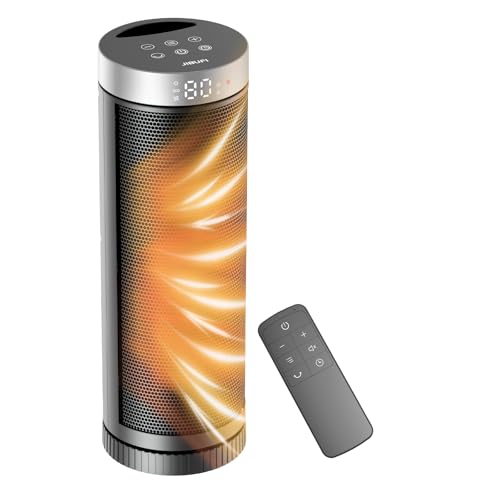
JIBUFI 17 Inch Electric Heater with Smart Thermostat
Best for Small to medium rooms needing adjustable heat and timer
This compact 17″ heater offers three power settings (700W, 1000W, 1500W) and a smart thermostat that adjusts heat automatically. It has a 1-12 hour timer and remote control for convenience. Safety features include tip-over and overheat protection plus flame-retardant materials, making it safe for families with children or pets.
Best for Rooms up to 200 sq ft needing wall-mounted, smart control heating
This wall-mounted heater saves floor space and offers WiFi, remote, and touch controls for easy use. It features a precision thermostat and ECO mode to manage running costs, plus multiple safety protections including tip-over and overheat shutoff. At 1500 watts, it heats well-insulated rooms up to 200 sq ft rapidly and safely.
Heat Output (W) 1500Room Coverage (sq ft) Up to 200Safety Features Tip-over, overheat, flame retardantNoise Level (dB) —
Why it made the cut
Space-saving wall mount design
Smart WiFi and remote control
Energy-efficient ECO mode with precise thermostat
Multiple safety features including flame-retardant materials
Good to know
Installation requires drilling and mounting
Not portable for room-to-room use
Skip it if Skip if you prefer a portable heater or larger coverage.
The best heater size for a three season room depends on its square footage and insulation, aiming for 10 to 15 watts per square foot.
A three season room usually has less insulation and more exposure to outdoor temperatures than a standard heated room. That means you often need closer to 15 watts per square foot in colder climates, and around 10 watts in milder areas or better insulated spaces.
For example, a 12 by 14 foot room covers 168 square feet. Multiply that by 12 watts per square foot for moderate insulation and climate, and you get about 2,000 watts. Since 1 watt equals roughly 3.4 BTU, that’s about 6,800 BTU to heat this room efficiently.
Oversized heaters waste energy and cycle on and off too often, causing wear and uneven heat. Undersized heaters struggle to keep up, leaving you cold and running the unit at full blast continuously.
If your room is 10 by 12 feet (120 sq ft), a heater rated 1,200 to 1,800 watts fits well. For larger rooms like 15 by 20 feet (300 sq ft), look for units rated 3,000 to 4,500 watts—often multiple heaters or higher capacity models.
Sizing Checklist
Measure your room’s floor area in square feet
Estimate insulation quality (poor, average, good)
Decide on wattage per sq ft (10-15 W based on insulation and climate)
Calculate heater wattage = area × wattage per sq ft
Avoid heaters too small or too large for your room
Sizing Example
Say your three season room is 14 by 18 feet (252 sq ft) with average insulation and a cool climate. Use 13 watts per square foot: 252 × 13 = 3,276 watts. A 3,000- to 3,500-watt heater suits this room best.
Choose Safety Features That Protect Your Home and Family
Space heaters can be safe for three season rooms if they have the right safety features, starting with ETL certification.
ETL certification means the heater meets North American safety standards, covering electrical, fire, and mechanical risks. It’s a reliable sign the heater won’t fail catastrophically or cause hazards under normal use.
Look for tip-over protection: this feature automatically shuts the heater off if it falls. It uses a switch inside the base that trips when tilted, preventing fires from accidental knocks.
Overheat protection is another must. It senses when internal parts get too hot and cuts power to avoid damage or ignition of nearby materials.
Heaters with cool-touch housing reduce burn risk, especially important if children or pets share the space. A child lock on controls helps prevent unintended changes or turning the heater on or off.
Avoid Uncertified or Outdoor-Only Heaters Indoors
Outdoor heaters or those without certification lack these safety features and may produce unsafe fumes or overheat, making them unsuitable for enclosed three season rooms.
Fuel-burning heaters like propane or kerosene are less suitable because they consume oxygen and produce carbon monoxide. Unless specifically rated for indoor use with proper ventilation and ODS (oxygen depletion sensors), they pose serious health risks.
Heater Safety Features to Verify
ETL certification or equivalent
Tip-over shutoff switch
Overheat protection
Cool-touch housing
Child lock if needed
Indoor rating for fuel-burning units
Myth
All space heaters are equally safe indoors
Fact
Only heaters with proper certification and safety features like tip-over and overheat protection are reliably safe for three season rooms.
Understand Running Costs and Energy Efficiency
A typical 1,500-watt space heater running for 8 hours at a rate of 17 cents per kWh costs about $2.04 a day. That’s 1,500 watts ÷ 1,000 times 8 hours times $0.17. It adds up over a month but stays manageable for seasonal use.
Heaters with thermostats and ECO modes save energy by cycling off once the room hits the set temperature or by trimming power to maintain gentle warmth. They avoid wasting electricity by running continuously at full blast.
Timer functions also help cut costs. Setting a heater to run only during occupied hours prevents it from heating an empty room all night or while you’re away.
Fuel heaters like propane or kerosene burn fuel directly and often cost less per hour to run than electric models, but they need ventilation and carry carbon monoxide risks indoors. Electric heaters are simpler and cleaner but more costly to run.
Continuous Running Warning
Running any heater nonstop without thermostat or timer control wastes energy and risks overheating. Always use controls designed to limit run time or power.
Pick Features That Fit Your Lifestyle and Room Use
A quiet heater for a three season room generally runs below 50 decibels, about the sound level of a quiet conversation. Fans add noise, so models without fans suit bedrooms or reading nooks better.
Oscillation spreads heat evenly across the room, preventing hot and cold spots. For wider or irregularly shaped rooms, a heater that swings side to side can cut down cold corners.
Remote controls and smart features let you adjust settings without leaving your seat. Timers and multiple heat settings add convenience and save energy by tailoring warmth to your schedule and comfort level.
If you mostly heat a small, enclosed space, simple models without oscillation or smart controls might be enough. For frequently used larger rooms or rooms where you want to adjust settings often, these features add real value.
Feature Fit Checklist
Is quiet operation important for your use? Choose heater under 50 dB.
Do you want even heat in a wide or oddly shaped room? Pick oscillating heater.
Need to adjust heat without getting up? Look for remote or smart controls.
Want to save energy and hassle? Use timers and multiple heat levels.
What Competitors Miss: Why Wide Oscillation Matters
Wide oscillation spreads heat evenly across a three season room, preventing cold spots and making the entire space feel comfortable.
Most heaters swing between 70° and 120°, but the difference matters. A heater with only 70° oscillation might warm a narrow zone well, while 120° coverage can reach corners and odd angles easier.
Rooms larger than about 150 square feet or with irregular shapes benefit most from wide oscillation. Heat moves around furniture and walls instead of pooling near the heater. That reduces the need for multiple units or constant repositioning.
Oscillation Range
Room Size and Shape Fit
70° to 90°
Small, rectangular rooms under 150 sq ft
100° to 120°
Medium to large rooms or irregular layouts
Typical Oscillation Angles and Room Suitability
Choose a heater with oscillation angle matched to your room. Narrow rooms can do fine with less swing, but wider or L-shaped rooms demand more coverage to avoid chilly corners.
Cheap Heaters May Skip Oscillation
Some low-cost models don’t oscillate at all, trapping heat in one spot. That saves a motor but sacrifices comfort and efficiency in larger spaces.
Myth
Oscillation is just a gimmick that doesn’t improve heating performance
Fact
Oscillation actually helps distribute warm air, which means you feel heat more evenly and the heater doesn’t have to run harder to keep the whole room comfortable.
If you want even heat distribution, the DREO 25 Inch Electric Space Heater stands out. It offers wide oscillation up to 120°, rapid heat-up, and quiet operation, making it a solid choice for three season rooms.
1
Check your room size and shape
Measure your three season room to decide if you need wide-angle oscillation.
2
Look for oscillation specs
Confirm the heater’s oscillation angle in the manual or product sheet.
3
Match heater to room
Pick wider oscillation for rooms over 150 sq ft or irregular layouts to avoid cold spots.
4
Avoid non-oscillating models
Skip heaters without oscillation if your room is anything but tiny and square.
Wide oscillation isn’t just a nice feature—it’s a practical one that helps your heater perform better and makes your three season room feel warmer without extra cost or effort.
More Questions, Answered
What size heater do I need for a 12×14 ft three season room?
For a 12 by 14-foot room, which is 168 square feet, aim for a heater that delivers between 1,680 and 2,520 watts. That means a 1,500-watt heater might be slightly undersized if your room is poorly insulated, but it usually suffices for typical three season room insulation.
Are electric heaters safe to use in three season rooms?
Electric heaters can be safe in three season rooms when they have ETL certification and built-in safety features like tip-over and overheat protection. Always ensure the heater is plugged directly into a wall outlet, not an extension cord, and keep it away from flammable materials.
How much does it cost to run a 1500W space heater for 8 hours?
Running a 1,500-watt heater for 8 hours uses 12 kilowatt-hours. At an electricity rate of 17 cents per kWh, that adds up to about $2.04 per day. This cost scales directly with your local electricity rates and daily usage.
Is an oscillating heater better for a three season room?
Oscillating heaters spread warmth more evenly across the room, reducing cold spots and making the entire space feel comfortable. This is especially helpful in three season rooms that often have large windows or less insulation.
Can I leave a space heater on overnight in my three season room?
Leaving a space heater on overnight is generally not recommended unless the model is specifically designed for unattended use. Even then, use a heater with automatic shut-off features and keep a working smoke alarm nearby for safety.
What safety certifications should I look for when buying a heater?
Look for ETL, UL, or CSA certification marks on the heater. These indicate the product has been tested to meet safety standards. Additional features like tip-over switches and overheat protection add layers of safety you should prioritize.
Share
Written byJoye
HeaterGuides covers home heating, water heating and HVAC: how the equipment works, what it costs to run, and how to use it safely.