The best 120 volt electric heater for most small rooms is a 1500-watt ceramic model with a thermostat, tip-over shutoff, and overheat protection. That size tops out at about 12.5 amps on a standard 120 V circuit, so it fits the usual wall outlet limit without special wiring.
What to remember
A 1,500-watt heater is the ceiling for a normal 120V outlet, and that is the number to check first.
Ceramic heaters warm fast; oil-filled radiators stay quiet; infrared heaters aim heat at people and objects.
Use the thermostat and timer to cut runtime, because a heater that cycles correctly costs less than one that runs flat out.
Keep 3 feet of clearance and plug the heater straight into a wall outlet, not a power strip.
If the plug feels hot, stop using the heater and check for a loose outlet, a bad cord, or an overloaded circuit.
A 120V electric heater is just a plug-in heater that turns household electricity into heat, usually through a ceramic element, resistive coil, infrared element, or oil-filled radiator. The difference is how fast it warms the room, how quietly it runs, and whether it feels like a blast of air or a slow, even heat.
For a small room, the question is usually less about raw power than about control. A 1,500-watt heater can handle a bedroom or office, but a good thermostat, clear safety listing, and the right type matter more than a shiny badge on the box.
Best 120 Volt Electric Heaters for Small Rooms
#1Most small rooms
DREO Portable Electric Heater with Thermostat
Best for Bedrooms and offices up to 200 sq ft where quiet operation matters
The upgraded NTC chipset lets you set temperature in 1°F steps from 41°F to 95°F, so the heater cycles less often and holds a tighter band than most thermostats. At 34 dB it runs quieter than a whisper, thanks to a brushless DC motor and a fan design that cuts turbulence. The tilt sensor improves tip-over accuracy over older mechanical switches, and the V0 flame-retardant case adds a margin of safety.
Power 1500 WHeating coverage Up to 200 sq ftNoise 34 dBThermostat range 41–95°F in 1°F stepsTimer 12 hours
Why it made the cut
Thermostat adjusts in 1°F increments across a wide 41–95°F range
34 dB noise level from brushless motor and winglet fan
Tilt-detection sensor for reliable tip-over shutoff
ETL certified with overheat protection and V0 flame-retardant materials
Good to know
No oscillation, so heat stays in one direction
Remote required to access all modes from across the room
Skip it if Pick the oscillating DREO model if you need wider heat spread in a larger space.
Best for Light sleepers and anyone who needs heat without the hum
At 35 dB this runs quieter than turning a page, so it won’t wake you when the thermostat cycles on. The 24-hour timer lets you set an eight-hour shutoff before bed, and ECO mode claims to save 20% over constant high heat by modulating power. A child lock keeps curious hands from changing settings, and the carry handle makes it easy to move from bedroom to bathroom.
Power 1500 WHeating coverage Up to 200 sq ftNoise 35 dBThermostat precision ±1°FTimer 24 hours
Why it made the cut
35 dB operation, quieter than most competitors
24-hour timer for overnight or all-day scheduling
Child lock prevents accidental adjustments
Remote and touch controls for flexibility
Good to know
Thermostat precision listed as ±1°F, wider than DREO’s
Coverage tops out at 200 sq ft, same as smaller units
Skip it if Choose a model with oscillation if you’re heating a long or irregularly shaped room.
Best for Living rooms, basements, and open-plan spaces where one spot won’t do
The 70° oscillation swings heat across the room using a trackball system rated for over 750,000 cycles, which the company says boosts coverage by 20% over a fixed heater. ECO mode switches between 1000 W and 1500 W to hold your set temperature without running full blast all the time. Noise stays at 34 dB thanks to oblique airflow tech that cuts wind noise by 12%, and the usual DREO safety suite—tip-over, overheat, V0 materials—is all here.
Power 1500 WOscillation 70°Noise 34 dBTimer 12 hoursECO mode 1000 W / 1500 W switching
Why it made the cut
70° oscillation spreads heat across larger or irregular rooms
ECO mode toggles between 1000 W and 1500 W to save energy
34 dB quiet operation with oblique airflow design
ETL certified with tip-over and overheat protection
Good to know
Heavier and bulkier than non-oscillating models
Thermostat range not specified in the product data
Skip it if If you’re heating a single bed or desk area, a fixed model costs less and takes up less floor space.
Best for Readers who want infrared warmth mixed with convection heat
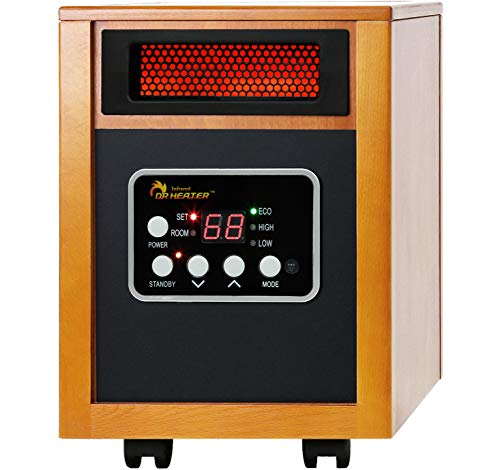
This combines an infrared quartz tube with PTC ceramic, which Dr Infrared claims delivers 60% more heat than ceramic alone and rates at around 5200 BTU. The dual system warms objects and people directly while the blower circulates air. Noise lands at 39 dB, a touch louder than the DREO units but still quiet enough for most rooms. Caster wheels let you roll it between rooms, and the electronic thermostat covers 50°F to 85°F.
Power 1500 WHeat output Approx. 5200 BTUNoise 39 dBThermostat range 50–85°FWeight 19 lbs
Why it made the cut
Dual infrared quartz and PTC system for direct and convected heat
Caster wheels for easy room-to-room moves
12-hour auto shutoff timer
Lifetime filter reduces dust recirculation
Good to know
39 dB is louder than the quietest models here
Weighs 19 lbs, heavier than compact ceramic heaters
Thermostat range stops at 85°F, lower than DREO’s 95°F
Skip it if Skip this if noise below 35 dB or a compact footprint is your priority.
Best for Garages, workshops, and greenhouses where rugged build trumps quiet
A cold-rolled steel and high-hardness alloy body stands up to the bumps and humidity of a workshop or greenhouse better than plastic housings. The 15° adjustable tilt aims warm air at plants, a workbench, or seating without moving the whole unit. At 3.75 lbs with an 80-inch cord, it’s easy to carry and reaches farther outlets. Simple knob controls mean no remote to lose, and the built-in thermostat cycles the heater to hold temperature.
Power 1500 W high / 750 W lowHeating time 3 secondsTilt adjustment 15°Weight 3.75 lbsCord length 80 inches
Why it made the cut
Cold-rolled steel body resists scratches and humidity
15° tilt adjustment directs heat where you need it
Weighs just 3.75 lbs with an 80-inch cord for portability
Doubles as a 20 W fan in summer
Good to know
No remote control or digital thermostat
No tip-over protection listed in the safety features
Noise level not specified
Skip it if Choose a model with tip-over shutoff and a quieter rating if you’re heating a bedroom or living space.
A 120-volt electric heater plugs into a standard US wall outlet and converts household current directly into heat. Most models max out at 1,500 watts because that draws about 12.5 amps—close to the 15-amp limit of a typical bedroom or office circuit. Go higher and you’ll trip the breaker, so 1,500 W is the practical ceiling for plug-in heat without dedicated wiring.
Three heat technologies show up in small-room models, and each behaves differently. Ceramic heaters blow air across a heated ceramic element; they warm a room fast and cost less up front, but the fan adds noise. Oil-filled radiators heat silently and keep radiating warmth after they click off, though they take longer to reach temperature. Infrared units heat objects and people directly rather than the air, so you feel warmth right away, but step out of the beam and the effect fades.
The features that change day-to-day comfort are thermostat range, oscillation, timer, noise level, and remote control. A thermostat that reads in degrees—not just a numbered dial—lets you set a target and forget it. Oscillation spreads heat across a wider area without hot spots near the unit. A timer shuts the heater off before you leave for work or after you fall asleep. Noise matters in bedrooms and home offices; oil-filled models run silent, while ceramic fans vary from a low hum to a kitchen-appliance roar. A remote saves you from crossing a cold room to adjust settings.
Myth
A quiet heater is always more efficient than a noisy one.
Fact
Noise comes from the fan, not the heating element. A ceramic heater with a loud fan can be just as efficient as a silent oil-filled radiator—it simply moves air faster. The wattage and runtime determine the electricity cost, not the sound level.
Myth
The heater that warms the room fastest is the best choice for overnight use.
Fact
Fast heat usually means a ceramic fan blowing hard, which dries the air and cycles the thermostat more often. Oil-filled radiators take longer to warm up but hold heat between cycles, keeping the temperature steadier through the night without the fan noise.
12.5 A
Current draw of a 1,500 W heater on 120 V
A standard outlet circuit is rated for 15 amps, so a 1,500-watt heater leaves just 2.5 amps of headroom. Plug a lamp or phone charger into the same circuit and you’re fine; add a vacuum or hair dryer and the breaker trips.
How Much Heat A Small Room Needs
A 1,500-watt heater puts out about 5,100 BTU per hour, enough to warm a well-insulated room up to 150 square feet in moderate climates. That covers most bedrooms, home offices, and dorm rooms. The rule breaks down fast when insulation is poor, ceilings are high, or cold air leaks in around doors and windows.
Insulation, ceiling height, and drafts change the heat requirement more than square footage alone. A 10 by 12 bedroom with double-pane windows and weather-stripped doors holds heat; the same room with single-pane glass and a gap under the door loses it as fast as the heater produces it. An eight-foot ceiling traps warmth near the floor where you feel it; a vaulted ceiling sends half the heat upward. Concrete slab floors and uninsulated exterior walls act as heat sinks, pulling BTUs out of the air before the room warms up.
Bedroom heating example
Say your bedroom is 12 by 12 feet with standard eight-foot ceilings, double-pane windows, and a door that closes snugly. That’s 144 square feet, well within the range of a 1,500 W ceramic or oil-filled heater. Set the thermostat to 68°F an hour before bed, and the room should hold that temperature overnight with the heater cycling on and off. The same heater in a drafty garage corner will run constantly and never quite catch up.
Room size12 × 12 ft, 144 sq ft
Heater output1,500 W, 5,100 BTU/hr
ResultComfortable in an insulated bedroom
A 120-volt heater can warm a small, insulated room, but a drafty two-car garage or a poorly sealed sunroom may need a different approach. Sealing gaps and adding insulation helps more than buying a bigger heater, because you can’t pull more than 1,500 watts from a standard outlet. Readers shopping for best 120v electric heater for garage use often need multiple units or a higher-voltage model on a dedicated circuit.
Heaters rated for 240 volts plug into the same outlets as electric dryers and draw more current, so they produce more heat—typically 3,000 to 5,000 watts. Those are permanent or semi-permanent installs with dedicated wiring, not the plug-and-move convenience of a 120-volt unit.
In short
A 1,500-watt heater covers most insulated rooms up to 150 square feet. Drafts, high ceilings, and poor insulation cut that number in half or worse.
Running Cost And Electricity Use
Electric resistance heaters turn nearly 100% of the power they draw into heat, so a 1,500-watt model consumes 1,500 watts while it’s running. The cost depends on how many hours it runs and what your utility charges per kilowatt-hour. To find the monthly bill, divide watts by 1,000 to get kilowatts, multiply by hours per day, multiply by days in the month, then multiply by your rate per kWh.
Worked example
Say you run a 1,500-watt heater for 8 hours every night in a bedroom, and your utility charges 17 cents per kWh. That’s 1,500 ÷ 1,000 = 1.5 kW, times 8 hours = 12 kWh per day. Over 30 days that’s 360 kWh, times $0.17 = $61.20 for the month.
Heater1,500 W
Runtime8 hours/day, 30 days
Rate$0.17/kWh
Monthly cost61.20
Heater
Watts
Per hour
Per day (8 h)
Per month (30 days)
1,500 W ceramic heater
1,500 W
26¢
$2.04
$61.20
750 W low setting
750 W
13¢
$1.02
$30.60
Calculated at 17¢ per kWh. Monthly cost at 17 cents per kWh, 8 hours a day.
A thermostat or ECO mode cuts the bill by stopping the heater once the room reaches your set temperature, so it cycles on and off instead of running flat-out. That shortens runtime; it doesn’t make the heat itself any cheaper per watt. Oil-filled radiators store heat in the thermal mass of the oil, so they keep warming the room for a few minutes after the element shuts off. Once the space is up to temperature they tend to cycle less often than a fan-forced ceramic model, which can trim total runtime by 10 to 20% in a well-insulated room.
12.5 A
What a 1,500 W heater draws on 120 V
That’s close to the 15-amp limit on a standard household circuit, leaving little margin for other devices on the same breaker.
Lower wattage settings use less power and cost less to run, but they also deliver less heat. If your room needs the full 1,500 watts to stay comfortable, dropping to 750 watts won’t save money—it’ll just leave you cold.
Safety And Certification That Matter
Only indoor-rated electric heaters belong inside a house, and every model you’re considering should carry a UL, ETL or CSA listing on the label or in the manual. Tip-over shutoff cuts power if the unit gets knocked over; overheat protection stops the element before internal temperatures climb into the danger zone. Both are standard on the picks here, and you shouldn’t buy a heater without them.
Safety features to confirm
UL, ETL or CSA certification mark
Tip-over shutoff switch
Overheat protection or thermal fuse
Cool-touch housing or grille guard
Stable base that won’t rock on carpet
Plug the heater straight into a wall outlet, never into an extension cord or power strip. A 1,500-watt load draws 12.5 amps, and most extension cords aren’t rated for continuous current that high; the wire heats up, the insulation softens, and you’re looking at a fire risk. Keep three feet of clearance around the intake and the outlet grille—no curtains, furniture, bedding or storage boxes.
Hot plug or outlet
If the plug, the cord near the plug, or the outlet face gets warm to the touch, unplug the heater and stop using that outlet. A hot connection means worn contacts inside the receptacle, a loose wire behind the faceplate, or too many devices on the circuit. Call an electrician before you plug anything high-wattage back in.
Seniors benefit from models with large, clearly labeled controls and a remote, so they don’t have to bend or reach. A digital display that shows the set temperature helps anyone who has trouble reading small analog dials. Kids and pets need a stable, heavy base that won’t tip easily; some models add a child lock that disables the control panel. No heater is safe to leave running unattended unless the manual explicitly says otherwise, and even then a working smoke alarm in the room is non-negotiable.
Cord and plug inspection
Check the power cord before each heating season. Fraying, exposed wire, a cracked plug body, or scorch marks on the prongs all mean it’s time to retire the unit or have it repaired by the manufacturer.
Don’t drape clothes, towels or anything else over the heater to dry, and keep it off furniture or beds where it could tip or block airflow. Set it on a hard, level floor where foot traffic won’t knock it over. If you’re using the heater in a bathroom, make sure the model is rated for damp locations and keep it away from the tub, sink and shower spray.
Which Pick Fits Your Room
Most small bedrooms and home offices do best with the DREO Space Heaters for Indoor Use with Thermostat, the 1,500-watt ceramic model that balances effective heat, quiet operation, and the adjustable thermostat you’ll use daily. Its tip-over and overheat shutoffs meet the safety standard seniors and families expect, and the oscillation spreads warmth across rooms up to about 200 square feet without pointing the unit directly at furniture or bedding.
For the quietest pick, the Dr Infrared Heater DR-968 runs nearly silent because it heats primarily through infrared rather than blowing air. That makes it the best and safest small electric heater for seniors who sleep lightly or need consistent background warmth without fan noise. Skip it if you’re heating an open room quickly from cold—infrared takes longer to raise air temperature than forced-air models.
Larger small rooms, around 150 to 200 square feet, benefit from the DAHTEC 1500W Electric Space Heater, which pairs a high-velocity fan with the same 1,500-watt output to push heat farther. You’ll feel warmth across the room faster than a compact tower can manage. Not the choice for anyone sensitive to fan noise or looking to leave it running overnight in a bedroom.
Budget-conscious buyers often check Walmart small electric heaters first, and the R.W.FLAME Small Space Heaters delivers solid performance without extra features. It heats a typical 120-square-foot bedroom, carries the required safety shutoffs, and costs less than models with remote controls or app connectivity. You’re trading convenience—no thermostat dial, just high and low settings—for a lower entry price.
The DREO Space Heater, Portable Electric Heaters suits anyone moving a heater between a daytime office and an evening living room. Its carry handle and lighter build make that practical, though the smaller footprint means less stable placement on thick carpet. Not ideal for homes with active pets or toddlers who might tip it more easily.
Pick
Best For
Skip If
DREO with Thermostat
Bedrooms, home offices, families
You need silent overnight heat
Dr Infrared DR-968
Seniors, light sleepers, quiet rooms
You’re warming from cold in a hurry
DAHTEC 1500W
Larger small rooms, fast warmth
Fan noise bothers you at night
R.W.FLAME
Budget pick, basic heating
You want a thermostat dial
DREO Portable
Multi-room use, frequent moves
Thick carpet or active pets
Match the heater to the room and the household, not the hype.
What To Do Before The First Cold Snap
Start by deciding which heat type matches how you’ll use the room. Ceramic heaters warm air quickly and work well for mornings and evenings when you’re awake and moving around. Oil-filled radiators heat more slowly but stay warm after they cycle off, so they suit bedrooms where you’ll sleep with the heater running through the night. Infrared models deliver focused warmth to people and objects without waiting for the air to heat up, which helps in drafty spaces or when you need heat at a desk.
Oil-filled heaters are still electric
An oil-filled radiator plugs into a 120-volt outlet and draws the same power as a ceramic or infrared model at the same wattage. The oil inside never burns; it’s just a heat reservoir that smooths out temperature swings and keeps the metal surface cooler to the touch.
Small non-electric heaters—propane, kerosene, or catalytic models—belong to a different category. Most need ventilation, an oxygen depletion sensor, and a working carbon monoxide alarm, and many outdoor-rated units are unsafe indoors. If you’re comparing electric to fuel-burning options, check that any non-electric heater you’re considering carries an indoor rating and the safety certifications the manual lists.
1
Measure the room
Calculate square footage by multiplying length by width. A 1,500-watt heater covers up to about 150 square feet in a well-insulated room.
2
Check the outlet and circuit
Confirm the outlet is grounded (three prongs) and not shared with other high-draw appliances. A standard 15-amp circuit handles one 1,500-watt heater, which draws about 12.5 amps.
3
Choose the heat type
Pick ceramic for speed, oil-filled for overnight quiet, or infrared for drafty spots where you need direct warmth.
4
Verify the safety listing and controls
Look for a UL, ETL, or CSA mark on the label. Tip-over shutoff and overheat protection are non-negotiable; a thermostat saves electricity and keeps the room from overheating.
Your next move
Bedroom users: go with an oil-filled model that won’t cycle loudly at 3 a.m. Office workers: choose a ceramic heater with a thermostat for quick morning warmth. Drafty utility rooms: infrared delivers heat you can feel without waiting for cold air to circulate.
Questions People Ask
What is a 120 volt electric heater?
It’s any electric heater designed to run on standard US household voltage, which is 120 volts at most wall outlets. These heaters plug directly into an ordinary two- or three-prong outlet and draw up to about 12.5 amps, the typical circuit limit. Models rated for 240 volts need a dedicated circuit and a different plug, the kind you see for a clothes dryer or an oven.
Are small electric heaters safe for indoor use?
Yes, as long as the model carries a UL, ETL or CSA listing and you follow the clearances in the manual—usually 3 feet on all sides. Plug straight into a wall outlet, never a power strip or extension cord, and look for tip-over shutoff and overheat protection. Don’t leave one running while you sleep or leave the house unless the manufacturer says that model is designed for unattended operation.
How much electricity does a small space heater use?
A 1,500-watt heater draws 1.5 kilowatt-hours for every hour it runs at full power. At the US average of about 17 cents per kWh, that’s roughly 26 cents an hour, or about $2 for eight hours. Models with a thermostat cycle on and off, so real use is lower—often half to two-thirds of the maximum, depending on how cold the room is and how high you set the dial.
What is the largest heater you can run on 120 volts?
1,500 watts, which draws about 12.5 amps and sits just under the safe continuous load for a standard 15-amp household circuit. A few older or commercial models go higher—1,800 watts or more—but those can trip a breaker if anything else on the circuit is drawing power at the same time. Stick with 1,500 watts for a plug-in heater unless you know the circuit can handle more.
Why does my electric heater plug get hot?
A loose connection between the plug blades and the outlet creates resistance, and resistance generates heat. Try a different outlet; if the plug stays cool, the first outlet is worn and should be replaced by an electrician. If the plug heats up everywhere, inspect the cord for damage and stop using the heater—a hot plug can melt insulation or start a fire.
Is an oil heater better than a ceramic heater for a small room?
Oil-filled radiators hold heat longer after they shut off and stay warm to the touch for 20 or 30 minutes, so the room temperature glides instead of spiking. Ceramic fan heaters warm the air faster and cost less up front, but they click off and on more often and blow dust if the room is dusty. Pick oil if you want steady, silent background heat; pick ceramic if you need warmth now and can tolerate a little fan noise.
Do I need a 240 volt heater for a garage or basement?
Only if the space is larger than about 400 square feet and poorly insulated, or if you want to heat it faster than a 1,500-watt plug-in model can manage. A 240-volt heater draws more power—often 3,000 to 5,000 watts—so it delivers more BTU per hour, but it also needs a dedicated circuit and costs more to run. For a one- or two-car garage that you use a few hours at a time, a 120-volt model is usually enough.