For a single sink, the 2.5-gallon Ariston mini-tank is the most practical pick here: it stores hot water instead of asking a 110V, 3,000–3,500W tankless unit to heat flowing water quickly. These compact heaters suit point-of-use jobs; the listed products don’t establish a safe, reliable whole-house or shower solution.
Say the bathroom sink is far from the main water heater and you wait for hot water every morning. A point-of-use heater can shorten that wait, but a small 110V tankless unit has limited power; it won’t behave like a full-size household heater.
The picks below separate stored hot water from on-demand heating. That distinction matters more than phrases such as “whole house” on a product listing.
Best 110 Volt Water Heaters by Use
#1Best for One Sink
Ariston 2.5-Gallon Mini-Tank
Best for A single sink where stored hot water is more practical than tankless flow.
The 2.5-gallon tank stores hot water near the faucet, so you’re not relying on a low-power tankless unit to heat flowing water quickly. Its plug-in design and under-sink fit suit a remote sink or compact space.
Best for A sink that needs a larger stored supply than a compact mini-tank provides.
The 4-gallon tank gives you more stored hot water than the 2.5-gallon option, while keeping the same under-sink or compact-space use. Choose it when extra capacity matters and you have room for the larger tank.
Best for A sink with a modest hot-water demand and compatible plumbing and electrical service.
The listing gives specific flow-and-temperature figures: a 82°F rise at 0.3 GPM and a 131°F rise at 0.5 GPM. Those figures make it easier to judge the trade-off between flow and temperature rise, but don’t establish shower performance.
Power 3,000WVoltage 110VFlow and temperature rise 0.3 GPM at 82°F rise; 0.5 GPM at 131°F riseInstallation Vertical onlyConnections 1/2 inch NPT
Why it made the cut
Lists flow and temperature-rise figures
LED display
Dry-boil and overheating protections are stated
Good to know
Requires vertical installation
The listed flow is limited for higher-demand fixtures
Skip it if Skip it if you need a shower or cannot install it vertically.
Best for A kitchen or bathroom sink when you want a compact tankless unit.
The listing identifies sink washing as the suitable use and says the unit is not suitable for a shower. Its LED temperature display and wall-mounted design may suit a point-of-use setup, but the listing gives no flow rate or temperature-rise figure to confirm output.
Power 3,500WVoltage 110VDisplay LED temperature displayStated use Sinks; not for shower
Why it made the cut
3,500W listed power
LED temperature display
Wall-mounted design
Good to know
No stated flow rate or temperature rise
The listing says it is not suitable for showers
Skip it if Skip it if you need a shower, whole-house hot water, or verified output figures before choosing.
Best for A solar water-heating project where panel dimensions and materials fit the plan.
The listing describes a solar panel measuring 24 inches by 2 inches, made with monocrystalline silicon and aluminum. It doesn’t provide a tank capacity, electrical voltage, flow rate, or temperature rise, so it can’t be compared with the sink heaters on hot-water output.
Dimensions 24 inches by 2 inchesMaterials Monocrystalline silicon and aluminumHeating method Solar
Why it made the cut
Uses solar energy, according to the listing
Compact listed dimensions
Monocrystalline silicon and aluminum construction
Good to know
No stated tank capacity or hot-water output
No voltage or flow information
Skip it if Skip it if you need a ready-to-connect 110V sink heater with stated output.
The best 110-volt water heater for one sink depends on whether you want water heated as it flows or a small reserve already stored: the listed tankless models are point-of-use options, while the Ariston 2.5-gallon unit is a mini-tank. These are electric water heaters, not space heaters or home-heating systems.
A high-efficiency propane garage heater or the most efficient vented propane heater is a different product category; none of these electric water heaters answers that heating need. For whole-home electric water-heater options, see our residential electric water heater guide.
Product
What the supplied details establish
Best fit
Tankless Water Heater Electric, 110V, 0–3500W Whole House Ta…
Up to 3,500W; its description says it suits sinks, not showers unless incoming water is above 77°F. The whole-house claim isn’t established by the supplied details.
A sink, with inlet temperature and flow checked first.
110V Tankless Water Heater Electric
3,000W; the listing claims temperature rises at 0.3 and 0.5 GPM, but those claims aren’t independently verified here.
A sink where you can compare the claimed rise with your incoming water temperature.
Ariston 2.5 Gallon Capacity, 120-Volt
Stores 2.5 gallons of heated water rather than heating water only as it flows.
A single sink where a small reserve is useful.
4 Gallon Capacity, 120-Volt
Stores 4 gallons of heated water.
A point-of-use job that benefits from more stored water.
The supplied product details don’t establish measured flow rates for the tankless models.
About 27 A
Nominal current for 3,000 W at 110 V
Calculation: 3,000 W ÷ 110 V ≈ 27.3 A. That’s nominal current from the stated wattage and voltage, not proof that a particular installation or circuit is suitable.
Tankless units heat water as it flows; the Ariston mini-tanks store a limited amount, so they don’t depend on matching instant heating output to the tap’s full flow. A 110V label alone tells you neither the usable flow nor how well a unit will perform with cold winter inlet water. It also doesn’t establish whole-house or shower capacity.
From HeaterGuides · our own guideTankless? Page 8 is the descaling routine, page 15 checks the size.Water Heater Owner's ToolkitFix the common faults yourself, keep it running for years, and know when a repair is money wasted.No-hot-water flowcharts, gas and electricFlush, anode, relief valve and descaling stepsRepair-or-replace calculator (Excel)$14.99$9.99Get it for $9.99See what's inside and watch the 2-minute video →18-page printable PDF + Excel calculator · instant download · 30-day refund
How to Choose a Small 110V Tankless Water Heater
A small 110V tankless water heater is generally a point-of-use option for a sink, not a reliable shower or whole-house replacement; the result depends on both flow and incoming water temperature. The most efficient electric water heater can’t be identified from these product details alone, and no supported efficiency percentages or savings claims are provided.
1
Match power to flow
Compare wattage and stated flow together. The 110V Tankless Water Heater Electric lists 3,000W and claims temperature rises at 0.3 and 0.5 GPM; those are listing claims, not independently verified measurements. The 3,500W model gives no measured flow rate in the supplied information, so its higher wattage alone doesn’t show how much water it can heat at the tap.
2
Check the temperature rise
Temperature rise is the difference between incoming water temperature and the temperature you want at the outlet. Colder inlet water or faster flow makes the heater work harder to reach that outlet temperature.
3
Choose the right kind of heater
For a small reserve at one sink, compare the Ariston mini-tanks, which store heated water. For hot water made on demand, compare tankless power, flow and temperature-rise details rather than relying on the 110V label.
A Sink Example
Say the incoming water is 50°F and you want 100°F at the tap. The heater needs to raise the water by 50°F. If you open the tap farther, the same heater has less time to add heat to each gallon, so the outlet may fall short; check the product’s claimed rise at the flow you expect.
Incoming water50°F (hypothetical)
Desired outlet100°F (hypothetical)
Required rise50°F
Rise Is Not Set Temperature
A claimed temperature rise applies to a stated flow and inlet condition; it isn’t a promise that the outlet will reach that temperature in every home. Resistance electric heaters convert electricity to heat at the point of use, but that doesn’t make hot water free or prove lower household costs.
“Ceramic heater” usually points to a space heater, not a type of water heater. Ceramic space-heater efficiency is a separate question; don’t use those search results to judge an electric water heater.
What 110V Water Heaters Can Heat
The supplied 110V tankless listings support sink use, not a whole-house or shower recommendation. The first listing explicitly limits use to sinks unless incoming water exceeds 77°F, and the other product details don’t establish reliable shower performance.
For a single tap, the most efficient tankless water heater is the one that can deliver the needed temperature rise at the flow you’ll actually use; the listings don’t provide enough comparable data to name a highest-efficiency hot water heater. A heat pump water heater is a different equipment category, and a fair heat pump vs. tankless water heater efficiency comparison needs the same hot-water duty, installation conditions and energy rates.
Type
What it offers
What limits it
Tankless
Heats water as it flows.
Usable output depends on power, flow and temperature rise.
Mini-tank
Stores a small reserve near the tap.
Capacity is limited; recovery and simultaneous-use performance aren’t established here.
The 2.5- and 4-gallon products are compact mini-tanks for a single sink or similarly small location.
Products 3 and 4 hold 2.5 and 4 gallons, respectively. That stored water can be useful when a tap is far from the main heater: you draw from a small reserve close by rather than waiting for water to travel through a long pipe. The reserve is finite, though; the supplied details don’t say how quickly either tank recovers.
A Single-Sink Choice
Say a hand-washing sink needs a short draw of hot water. A mini-tank keeps a small reserve at the tap; a tankless unit must raise the temperature of water while it flows. Which works better depends on the tankless unit’s power, the flow rate and how cold the inlet water is.
Mini-tank options2.5 or 4 gallons
Tankless outputDepends on power, flow and temperature r
Efficiency Labels Need Context
A tankless unit can avoid keeping stored water hot, but that alone doesn’t prove it will cost less to run. Standby loss, how much hot water you use and the energy rate all matter; no product-specific cost data is supplied for these models.
Check the Circuit Before You Install
A 110V water heater rated at 3,000–3,500W can draw far more current than a typical 15A household branch circuit can supply. Safe efficient electric space heaters also need a correctly rated circuit, but their rules don’t establish what a water heater requires.
About 27–32 A
Current at 110V for 3,000–3,500W
Divide watts by volts: 3,000 ÷ 110 is about 27A, and 3,500 ÷ 110 is about 32A. Both exceed a typical 15A branch circuit.
Don’t Make the Circuit Fit
The supplied product data doesn’t establish a compatible circuit, wire size, breaker or installation method. Don’t adapt a plug, change a breaker or rely on generic DIY wiring advice to make a unit fit; an undersized circuit can overheat.
1
Check the nameplate and manual
Confirm the exact voltage, wattage, connection method and any dedicated-circuit requirement for the model you’re considering.
2
Have an electrician check the circuit
Before purchase or installation, ask a licensed electrician to verify the existing circuit against the nameplate, manual and local electrical code.
3
Confirm the plumbing work
Have a qualified professional confirm the water connections and installation requirements. Water-heater plumbing connections and 240V electrical work are jobs for licensed tradespeople in most places.
Product 5’s supplied instructions specify vertical installation only. Its listed protections are manufacturer claims, not a substitute for installing the unit in the required orientation on a suitable circuit.
Before You Buy or Call an Installer
AFUE rates the seasonal fuel efficiency of gas- or oil-burning furnaces and boilers; it doesn’t rate electric point-of-use water heaters. Don’t use AFUE to compare these products—check their electrical and water-heating specifications instead.
Before you order, pin down the exact sink, how much water you expect to draw, and how cold the incoming water gets in winter. Confirm the heater’s voltage and available circuit, then decide whether you want a small stored reserve or on-demand heating. Those details determine whether a compact tank or a tankless unit fits the job.
Read the specific model’s manual before buying. Confirm its required installation orientation, plumbing connections, and any local permit requirements; a product listing alone may not answer those questions. If the target is a shower or whole-house hot water, choose equipment rated for that demand and have a qualified installer size it. Don’t stretch a small 110V sink heater into a job it wasn’t specified to do.
Before You Buy
Identify the sink or fixture and expected flow.
Check incoming-water temperature and the heater’s intended use.
Verify voltage and available circuit with the installer.
Choose stored hot water or on-demand heating.
Confirm the manual’s installation orientation and plumbing connections.
Check local permit requirements before ordering.
For a shower or whole-house supply, select equipment rated for that demand and consult a qualified installer.
Frequently Asked Questions
Is a 110V tankless water heater suitable for a shower?
Usually not. A shower needs more hot-water flow than these low-voltage point-of-use units are shown to provide, especially when cold incoming water requires a large temperature rise. Choose a properly sized water heater based on your shower’s flow rate and winter inlet-water temperature.
How much can a 3,000W 110V tankless water heater heat?
At 1 gallon per minute, 3,000 watts can raise water temperature by roughly 20°F, before accounting for heat loss. That may be enough for a small sink task when the incoming water is mild, but it won’t deliver a large temperature rise at shower flow.
What does temperature rise mean on a tankless water heater?
Temperature rise is the difference between the incoming water temperature and the heated water temperature leaving the unit. For example, water entering at 50°F and leaving at 100°F has a 50°F rise; as flow increases, a fixed-power heater generally delivers a smaller rise.
Can a 110V tankless water heater run on a standard 15-amp circuit?
No, not if the unit is rated at 3,000 watts: 3,000 ÷ 110 is about 27 amps, well above a 15-amp circuit’s capacity. Check the nameplate and installation manual for the required voltage, breaker, and wiring, and have a licensed electrician handle circuit changes.
What is the AFUE, and does it apply to electric water heaters?
AFUE is a seasonal efficiency rating for fuel-burning furnaces and boilers; it does not rate an electric water heater. For an electric water heater, compare its listed electrical requirements and use with the job you need it to do.
Before you go · a welcome giftGet the Water Heater Owner's Toolkit for $4.99Fix the common faults yourself, keep it running for years, and know when a repair is money wasted. Normally $14.99; your welcome price saves $10.00. We'll email your link right now.or buy it now for $9.99 without the gift →One email with your link now. We never share your address.


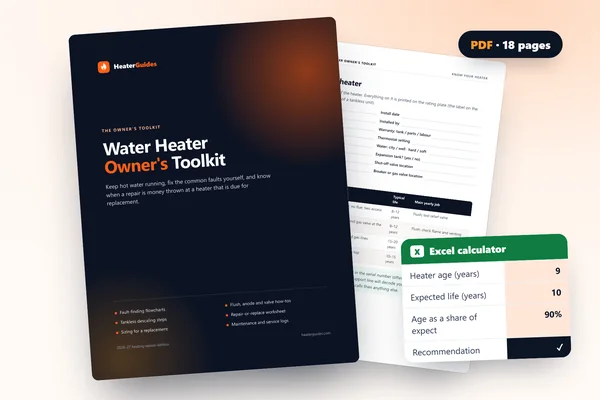 Water Heater Owner's ToolkitFix the common faults yourself, keep it running for years, and know when a repair is money wasted.No-hot-water flowcharts, gas and electricFlush, anode, relief valve and descaling stepsRepair-or-replace calculator (Excel)