For most readers, the best pick is the InoKraft 10000W Electric Garage Heater with NEMA 14-50P Plug because it combines full 10,000-watt output with a plug-in setup and adjustable controls. A 10,000-watt heater draws about 41.7 amps at 240 volts, so the circuit is the first thing to check before you buy.
The essentials
Check the circuit first: 10,000 W at 240 V is about 41.7 A, so a 15 A or 20 A outlet is out of the question.
Choose plug-in only if you already have the right 240 V receptacle; otherwise, hardwired may be the cleaner path.
A timer, remote, and ECO mode are convenience features, not substitute heat.
For a garage with poor insulation, mounting and airflow matter as much as wattage.
If the heater’s listed breaker requirement is higher than your panel can spare, skip it before you start shopping.
A 10,000-watt garage heater is serious heat, not a glorified desk fan with ambitions. If your garage is cold enough to make metal tools hurt your hands, the right unit can get you from “can’t work” to “good enough” fast.
The catch is simple: power only helps if your wiring, room size, and mounting plan match the heater. A hardwired 240V unit, a 14-50 plug, and a ceiling mount each solve a different problem, and buying the wrong one is how people end up with a warm corner and a cold garage.
Top Picks for the Most Powerful 10,000 Watt Electric Garage Heater
#1Best Plug-In Choice
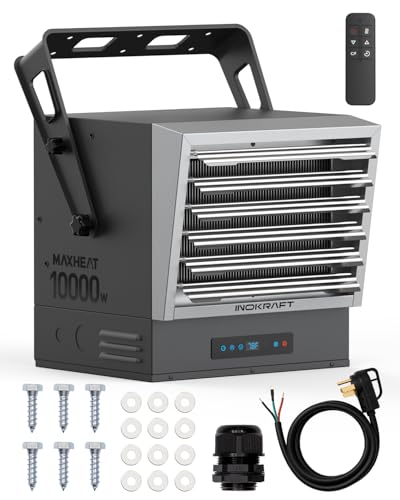
InoKraft 10,000W Plug-In Garage Heater
Best for Garages that have a suitable 240V receptacle and need flexible controls
Product 3 is the easiest pick for most readers because it delivers 10,000 watts through a NEMA 14-50P plug and includes an 8.2-foot power cord. Its digital thermostat covers 40°F to 99°F, while the 1-24 hour timer and ECO mode help you control operation. Choose it if you want plug-in installation instead of a hardwired heater, but have a professional electrician confirm the circuit first.
Heat output 10,000 wattsVoltage 240VPlug NEMA 14-50PThermostat range 40°F to 99°FTimer 1-24 hours
Why it made the cut
NEMA 14-50P plug and 8.2-foot power cord included
40°F to 99°F thermostat range
1-24 hour timer and ECO mode
Good to know
Professional electrician installation is required
Needs a suitable 240V receptacle
Skip it if Skip it if your garage is already set up for a hardwired ceiling heater and you don’t need a plug-in connection.
Best for Workshops where you want remote control and adjustable airflow direction
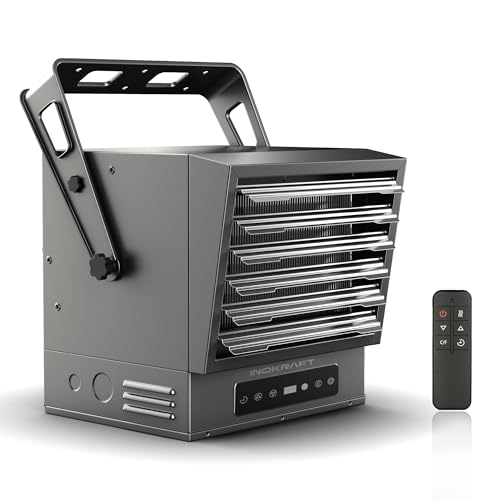
Product 1 suits a garage where you want to change settings without walking over to the heater. The included 20-foot remote works with the panel controls, and the 10-hour timer plus ECO thermostat can switch between high heat, low heat, and fan-only mode. Wall or ceiling mounting and 45-degree or 90-degree airflow adjustment give you useful placement flexibility.
Heat output 10,000 wattsRemote range 20 feet (6m)Timer 10 hoursMounting Wall or ceilingProtection Overheat protection
Why it made the cut
20-foot remote control included
10-hour timer and ECO thermostat
Wall or ceiling mounting with 45-degree or 90-degree airflow adjustment
Good to know
The product data doesn’t specify a plug or hardwired connection
The product data doesn’t state an electrical listing
Skip it if Skip it if you need a clearly specified plug-in setup or an ETL-listed heater.
Best for Large garages with planned ceiling mounting and a preference for quieter operation
Product 4 is the hardwired choice for a permanent ceiling or wall installation, with five angle adjustments and flexible louvers for aiming the heat. Its digital thermostat spans 40°F to 99°F, and the ECO mode, timer, and automatic fan delay add control after installation. The listed operating noise is 65 dB, which gives you a concrete figure to compare with other shop heaters.
Heat output 10,000 wattsVoltage 240VNoise level 65 dBThermostat range 40°F to 99°FMounting Wall or ceiling
Why it made the cut
65 dB operating noise listed
Five installation angle adjustments
40°F to 99°F thermostat, ECO mode, and 1-24 hour timer
Good to know
Hardwired installation requires a professional electrician
No plug or cord is included in the product data
Skip it if Skip it if you need a heater that can connect to an existing receptacle without hardwiring.
Best for Workshops needing hardwired installation, two power levels, and an ETL listing
Product 2 makes sense when your garage already has the electrical plan for a hardwired heater and you want two adjustable power levels. The digital temperature control is specified to maintain a 2°F temperature difference, while the remote, fan delay, and adjustable mounting angle add day-to-day convenience. Its product data also lists coverage of 90 sq. m. and an ETL listing.
The “Inokraft 7;500W electric garage heater review” search appears to be a typo or shorthand: the product data here covers InoKraft 10,000W heaters. Choose the NEMA 14-50P version for an existing 240V plug-in outlet, or the hardwired version when an electrician is installing a dedicated supply.
The plug-in InoKraft 10000W Electric Garage Heater is the practical pick if your garage already has a suitable NEMA 14-50 receptacle. The other InoKraft 10,000W model is the better fit for a planned hardwired installation, where the supply cable and disconnect or breaker arrangement are set up for the heater. A large heater is only useful when the building can feed it safely.
41.7 A
Approximate draw at 240 V
A 10,000W heater draws about 10,000 ÷ 240 = 41.7 amps. Verify the circuit, breaker, receptacle or hardwired supply before comparing controls.
Feature
Plug-in InoKraft
Hardwired InoKraft
Connection
NEMA 14-50P plug
Hardwired supply
Best fit
A garage with an existing suitable 240V receptacle
A new installation or replacement for a hardwired heater
Controls to compare
Adjustable heat, remote, timer range and ECO mode
Adjustable heat, remote, timer range and ECO mode
Air direction
Adjustable angle
Adjustable angle
Confirm the exact control and timer details on the model listing before ordering.
Remote control, ECO mode, timer range and angle adjustment affect how you use the heater, not its maximum heat output. A timer can stop the heater after a work session, ECO mode can reduce cycling at a lower demand, and angle adjustment helps aim warm air toward the occupied part of the garage. Check the listed timer range rather than assuming both InoKraft versions match.
Check before buying
An existing 240V outlet can make the plug-in model simpler, but the receptacle still needs to match the heater and its circuit. If the outlet isn’t present, installation may require an electrician, new wiring and panel work; that can change the total cost more than the heater choice. For more options by installation style, see electric garage heaters designed for ceiling mount use.
From HeaterGuides · our own guidePage 4 shows what every heater costs per hour; the Excel sheet works out your own bill.Winter Heating Bill CutterSee what every heater in your home really costs, heat the rooms you use, and cut the waste in 30 days.Cost-per-hour tables for every heaterThermostat schedule and draft-proofing planRunning-cost and bill calculator (Excel)$14.99$9.99Get it for $9.99See what's inside and watch the 2-minute video →14-page printable PDF + Excel calculator · instant download · 30-day refund
Measure Your Garage Before You Buy
A 10,000W heater suits a large, leaky or poorly insulated garage better than a small attached garage with modest heat loss. To answer “how powerful does my electric radiator need to be,” start with floor area, then adjust your judgment for insulation, ceiling height, door openings and air leakage.
Space
Starting point
What to check
Small attached garage
Lower output may be enough
Insulated walls and door, normal ceiling height, limited door opening
Large two-car garage
7,500W may fit a reasonably insulated space
Ceiling height, garage-door seals and how quickly the door opens
Large or poorly insulated workshop
10,000W is easier to justify
Drafts, high ceiling, open doors and cold masonry
Small single-bay shop
10,000W may be excessive
A lower setting or smaller heater may heat the occupied area more sensibly
These are sizing directions, not a substitute for the heater manual or a heat-loss calculation.
Worked example
Say a two-car garage has a tall ceiling, a drafty overhead door and little wall insulation. The larger air volume and steady heat loss make 10,000W more defensible, especially if you need the whole room usable. A single-bay shop with insulated walls, a normal ceiling and one person at a workbench may need far less; a 7,500W heater could be enough, while a 10,000W model would mainly give extra recovery speed rather than a necessary constant output.
Two-car garageLarge volume, more leakage, 10,000W easi
Low-watt electric heaters can work in small, well-sealed spaces, but they won’t perform the same job as a 10,000W garage heater. A standard 120V plug-in heater tops out around 1,500W, or about 12.5 amps at 120V; 10,000W garage heaters are 240V units and need a much larger electrical supply.
Measure these first
Record the garage length and width, ceiling height, insulation level, overhead-door seal and how often the door opens. If those answers point to a small, enclosed room, compare lower-output heat before paying for a 10,000W unit; if the space is tall, drafty and hard to close, the higher output has a clearer job.
For a broader comparison of output and installation types, stay cozy this winter with a look at electric garage heater options before settling on the largest model.
Check The Circuit And Mounting Plan
A 10,000W electric garage heater is a 240V appliance, not a normal 120V plug-in heater: at 240V it draws about 41.7 amps, while at 120V the same output would require about 83.3 amps. That’s why many units need a dedicated high-amperage circuit.
41.7 A
Approximate draw at 240 V
The calculation is 10,000 W ÷ 240 V = 41.7 A. A standard 120V, 15A garage receptacle cannot supply this heater at full output.
What to check
Why it matters
120V garage outlet
Suitable for smaller heaters, not a 10,000W unit at full output.
Dedicated 240V circuit
Keeps the heater’s large load from sharing a circuit with lights, tools or another appliance.
Breaker and wiring
One listed model calls for a breaker rated at least 42 A; the breaker, conductors and disconnect must match the model instructions and local code.
Plug or hardwire connection
One InoKraft model includes a NEMA 14-50P plug and an 8.2 ft cord. A hardwired model needs a professional electrical installation.
Match the installation to the exact model, not only to the wattage on the box.
Use the right circuit
Use only a properly rated 240V circuit with the breaker and wiring specified by the manual. Never run a 10,000W heater through an extension cord or power strip, and don’t adapt a plug to fit a receptacle. Keep the heater’s required clearance from combustibles, walls and stored materials exactly as the manual states.
Ceiling or wall mounting can spread warm air across a garage more effectively than leaving the heater low, but the mounting angle and louvers have to aim that stream into the room. A unit pointed at a wall or blocked by shelving may heat the nearby surface while the far end stays cold.
Before installation
Confirm the garage has the correct 240V receptacle or approved hardwire connection.
Compare the heater’s required breaker rating with the panel and branch-circuit wiring.
Measure the 8.2 ft cord on the plug-in InoKraft model before choosing the mounting location.
Leave the manual’s clearance around the heater, louvers and ceiling or wall surfaces.
Plan for a licensed electrician if the model is hardwired or the circuit needs to be added.
Myth
A 120V outlet can run a 10,000W heater if the breaker is large enough.
Fact
The voltage and wiring still limit the circuit. At 120V, 10,000W requires about 83.3 amps, far beyond an ordinary garage receptacle circuit. A higher breaker on existing wire can create an overheating hazard rather than fixing the problem.
Compare Controls, Noise, And Convenience
For an InoKraft 7,500W electric garage heater review, the useful question is how precisely and easily the heater manages its heat; the 10,000W models still win when maximum output matters, while controls decide how pleasant that output is to live with.
Feature
What to compare
Who benefits
Remote control
Whether the listed model includes one and which settings it operates
You can change heat or temperature without crossing a cold garage.
Thermostat range
The lowest and highest setpoints shown in the product data
Useful when the garage needs steady background heat instead of full blast.
Timer
The maximum timer length listed for that model
Helpful for scheduled work sessions or preheating without leaving the heater running indefinitely.
ECO mode
Whether the model reduces output or cycles after reaching temperature
Useful for holding a target temperature; it doesn’t increase the heater’s maximum wattage.
Use the exact model card and manual for these features; similarly named heaters can have different controls.
A 2°F temperature swing gives tighter control than a simple on-off heater because the thermostat waits for a smaller change before cycling. That can matter in a workshop where you’re trying to hold a comfortable temperature around tools, finishes or electronics. A basic on-off control may still be the better choice if all you want is maximum heat when the garage is cold.
Choose based on your priority
Pick the model with the remote, usable thermostat range and longest listed timer for set-and-forget control.
Pick the full 10,000W model when recovery speed and maximum heat matter more than fine adjustments.
Use ECO mode for temperature holding, not as a way to get more heat from the element.
What to give up
Remote controls and timers add convenience but don’t reduce the heater’s full-load electrical demand.
Fan-forced heaters still make fan noise, even when the thermostat and ECO mode reduce how often the fan runs.
A quieter listed model may suit a workshop better, but no heater should be called silent unless its product data says so.
In short
Choose the InoKraft 7,500W option when its lower output and control setup fit the garage; choose a 10,000W model when the circuit, mounting plan and heat demand support full output. For set-and-forget use, prioritize the thermostat swing, remote and timer over the biggest number on the label.
Know The Running Cost Before Winter Starts
A 10,000 W garage heater uses 10 kWh for every hour it runs at full output, so the right size for your space matters as much as the heater’s maximum power. For the question “how powerful does my electric radiator need to be,” use a 10,000 W model for a large, leaky garage that needs fast recovery; low watt heaters electric shoppers should consider one for a smaller space or light background heat.
The utility-cost math is simple: watts ÷ 1,000 × hours per day × days × your electricity rate. At full output, 10,000 W ÷ 1,000 equals 10 kW, and 10 kW running for one hour uses 10 kWh. Long runtimes add up fast, especially when the garage door opens often or insulation is thin.
Heater
Watts
Per hour
Per day (8 h)
Per month (30 days)
10,000 W heater at full output
10,000 W
$1.70
$13.60
$408.00
5,000 W heater or lower setting
5,000 W
85¢
$6.80
$204.00
Calculated at 17¢ per kWh. Example utility cost for 8 hours per day over 30 days at $0.17 per kWh. Your bill depends on your local rate and actual runtime.
ECO mode and a timer can reduce the hours the heater runs, but they don’t change its maximum draw. A thermostat may shut the elements off after the garage reaches its setting, so the heater won’t necessarily pull 10,000 W all night; the cost depends on how often heat is actually energized.
Use the smallest useful heater
If you only need to keep tools from getting painfully cold or take the edge off while you work, a lower-watt heater may be cheaper to live with than a 10,000 W unit. Pick the larger heater when you need rapid warm-up in a large or poorly insulated garage, then let its controls cycle the heat instead of running full power continuously.
More Questions, Answered
How powerful does my electric radiator need to be for a garage?
Size the heater for the garage’s heat loss, insulation and winter temperature rather than floor area alone. A 10,000-watt unit suits a large, drafty space or a workshop that needs a fast warm-up; a smaller garage may cycle more comfortably with less output. An electric radiator is a different category from a fan-forced garage heater, so check the product’s wattage and airflow before comparing them.
Are garage heaters electric 120 volt models strong enough?
A 120-volt garage heater can work for a small, insulated space, but common plug-in models top out around 1,500 watts. That is only 15% of a 10,000-watt heater’s output, so it won’t deliver the same recovery speed in a large or leaky garage. Don’t run a high-wattage heater from an extension cord or power strip.
What breaker rating does a 10,000 watt electric garage heater need?
At 240 volts, 10,000 watts draws about 41.7 amps, so these heaters commonly require a dedicated two-pole 50-amp circuit. The heater’s nameplate, installation manual and local electrical code control the final breaker, wire size and disconnect requirements. Have an electrician verify the existing circuit instead of sizing it from the outlet shape alone.
Can I plug a 10,000 watt garage heater into a regular outlet?
No; a regular 120-volt household receptacle cannot supply the power a 10,000-watt heater needs. A plug-in model requires the specified 240-volt receptacle and matching circuit, while a hardwired model needs a proper connection by a qualified electrician. Turn off the breaker and stop if the receptacle is warm, discolored or loose.
What is the difference between hardwired and plug-in garage heaters?
A plug-in heater uses a listed cord and matching receptacle, which makes replacement or seasonal removal simpler. A hardwired heater connects directly to the circuit and can give a cleaner installation, but electrical work and the disconnect arrangement need to follow the manual and local code. Neither option makes an undersized circuit safe.
Which is better for a workshop: ECO mode or a simple thermostat?
A simple thermostat is usually the better choice when you want the workshop held near a set temperature while you work. ECO mode can reduce output or cycle the heater more gently, which may save electricity when the space is occupied intermittently, but its behavior varies by model. Look for a control that can handle your target temperature without repeated manual resets.
Before you go · a welcome giftGet the Winter Heating Bill Cutter for $4.99See what every heater in your home really costs, heat the rooms you use, and cut the waste in 30 days. Normally $14.99; your welcome price saves $10.00. We'll email your link right now.or buy it now for $9.99 without the gift →One email with your link now. We never share your address.



 Winter Heating Bill CutterSee what every heater in your home really costs, heat the rooms you use, and cut the waste in 30 days.Cost-per-hour tables for every heaterThermostat schedule and draft-proofing planRunning-cost and bill calculator (Excel)