
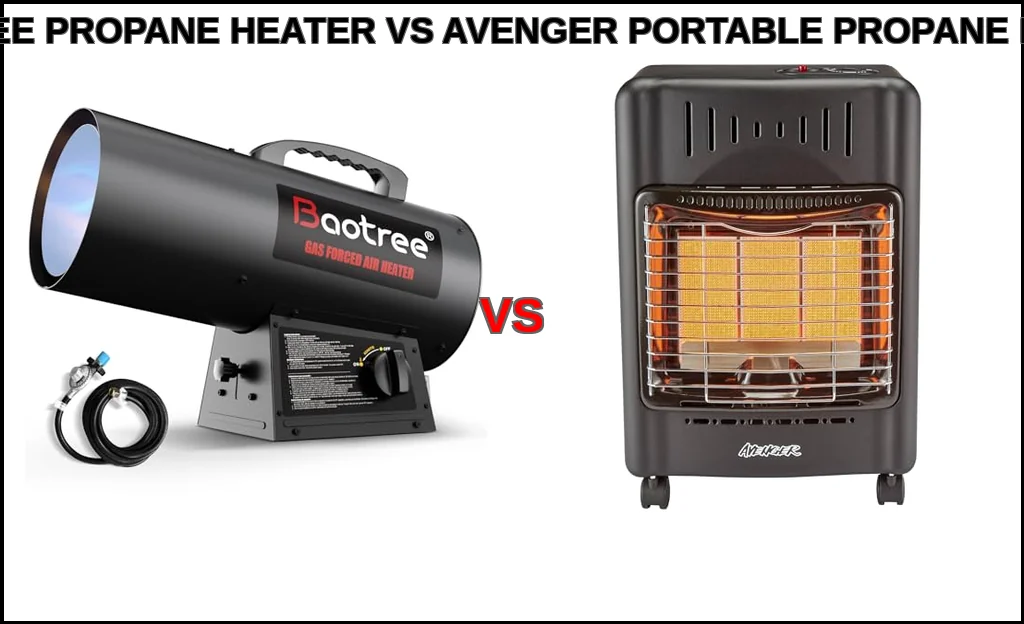
Staying warm in a large, drafty space or a smaller, contained area requires different tools. The portable propane heater market offers solutions for both, but choosing the right one hinges on understanding their core design philosophies. Two models that often come up in searches are the Baotree 60,000 BTU Forced Air Heater and the Avenger Portable Outdoor Propane Cabinet Heater. They represent two distinct approaches to portable warmth: raw, high-volume air movement versus focused, radiant heat.
This isn’t just about picking the highest BTU (British Thermal Unit) number. It’s about matching the heater’s capabilities to your specific environmentbe it a cavernous garage, a workshop, a tent, or a patio. We’re breaking down their performance, safety, and ideal use cases to help you find your perfect cold weather heating solution.
Head-to-Head Overview: Specs at a Glance
Right away, the difference in scale is apparent. The Baotree is a high-output workhorse, while the Avenger is a more refined, focused unit. Let’s look at the key specifications side-by-side.
| Feature | Baotree 60,000 BTU Forced Air Heater | Avenger Portable Outdoor Cabinet Heater |
|---|---|---|
| Heater Type | Forced Air Propane Heater | Radiant Gas Heater |
| Heat Output | Adjustable 40,000 – 60,000 BTU | Adjustable 6,000, 12,000, or 18,000 BTU |
| Coverage Area | Up to 2,497 sq ft | Up to 450 sq ft |
| Key Safety Features | Overheat protection, pulse ignition | Low Oxygen Shut-Off (ODS), automatic tip-over switch |
| Ignition | Pulse ignition | Push-and-turn piezo ignition |
| Portability | Portable handle, adjustable height, 10-ft hose included | Durable steel cabinet, smooth-rolling casters |
| Fuel & Runtime | Connects to standard propane tank (hose/regulator included) | Runs up to 72 hours on low with a standard 20 lb tank |
| Check current price on Amazon | Check current price on Amazon |
Heating Power & Performance Deep Dive
This is where these heaters fundamentally diverge. Your choice here will define your experience.
Baotree: The High-Volume Air Mover
The Baotree operates like a powerful furnace. Its forced-air fan is designed to move massive volumes of warm air quickly. It promises to significantly boost temperature in large spaces within 10 minutes, making it ideal for rapidly taking the chill out of a 1-6 car garage, workshop, or construction site. The adjustable heating angle (30 to 45 degrees) helps direct that broad stream of heat. It’s a brute-force solution for large, open areas where evenly distributed ambient warmth is the goal.
Avenger: The Focused Radiant Heater
The Avenger uses radiant heat. Instead of heating the air, it emits infrared energy that warms objects and people directly in its pathmuch like the sun. This makes it exceptionally efficient for spot heating. You feel warmth immediately, even in a drafty space, because it isn’t wasting energy heating all the air in between. With three precise settings (6K, 12K, 18K BTU), it offers fine-tuned control for spaces like a patio, a small garage bay, or a workshop station. For a detailed look at how different heaters perform, our best portable propane heater guide breaks down the various types.
BTU Output Comparison & Runtime
The BTU output comparison is stark: 60,000 vs. 18,000 max. But more BTU isn’t always betterit’s about application. The Baotree’s high output is necessary to heat its claimed 2,497 sq ft area. The Avenger’s lower, adjustable output is perfect for its 450 sq ft radiant zone. Regarding heater runtime per tank, the Avenger provides a specific figure: up to 72 hours on its low (6,000 BTU) setting with a 20 lb tank. The Baotree listing does not specify a runtime, which is a key data point for planning. Runtime is heavily dependent on the output setting used.
Safety, Features & Ease of Use
Safety is non-negotiable with any fuel-burning device. The features listed for each model reveal their intended use environments.
Critical Safety Systems
The Avenger is explicitly built with two paramount safety features for occupied spaces: an Low Oxygen Shut-Off (ODS) sensor and an automatic tip-over switch. The ODS is crucial for any indoor or semi-enclosed use, as it monitors oxygen levels and shuts the unit off if they drop to an unsafe level. This is a hallmark of indoor safe propane heater designs like the popular Mr. Heater Buddy series.
The Baotree’s listed safety features are pulse ignition for reliable startup and overheat protection that triggers during a power outage. It lacks a mentioned ODS or tip-over switch, which strongly suggests it is designed for well-ventilated, industrial-type settings where such risks are mitigated by the environment itself. Always consult an official source for safety guidelines when using heating equipment in workplaces.
Ignition and Operation
Both heaters offer electronic ignition, eliminating the need for matches. The Avenger uses a simple push-and-turn piezo system, requiring no electricitya great feature for off-grid scenarios. The Baotree uses pulse ignition, which is also reliable but note the manufacturer’s specific warning: the machine will produce an “acceptable level of noise” during operation. This is typical for powerful forced-air units.
Portability, Design & Ideal Use Cases
Portability means different things for a job site versus a backyard gathering.
Baotree: Job-Site Mobility
Its portability is functional: a handle, adjustable height legs, and a long 10-foot hose with regulator included. You can carry it, set it up on uneven ground, and connect it to a distant propane tank. It’s built for utility across construction sites, factories, and agricultural facilities.
Avenger: Patio and Workshop Ready
The Avenger is designed for easy relocation on smooth-rolling casters. Its durable steel cabinet design makes it stable and gives it a more finished look suitable for a patio or garage. Its the heater you wheel to where you’re working or sitting.
Solving the “Which is Better For…” Questions
This is where your decision crystallizes.
- Which is better for a garage Baotree or Avenger? For a large, multi-car garage you need to heat entirely, the Baotree’s forced air is the only choice. For warming a specific corner where you work on a project, the Avenger’s radiant efficiency is superior.
- Avenger propane heater vs Baotree for camping? Neither is for tent camping. The Avenger, however, could be excellent for a large ice-fishing hut or a well-ventilated cabin due to its ODS safety and silent radiant heat. The Baotree is far too powerful and noisy for such spaces.
- Baotree heater safety features compared to Avenger? The Avenger is explicitly equipped with primary safety features (ODS, tip-over) for occupied spaces. The Baotree’s features are geared towards operational safety (leak prevention, overheat) in industrial environments.
If your primary need is for smaller, occupied areas, exploring our list of the best portable indoor propane heaters is a smart next step.
Final Verdict: Which Heater Should You Buy?
This isn’t a case of one being objectively better. It’s about perfect alignment with your needs.
Choose the Baotree 60,000 BTU Forced Air Heater if: You need to heat a very large, open, and well-ventilated space quickly. Think unfinished garages, workshops, construction sites, or barns. Your priority is moving a high volume of warm air across thousands of square feet, and you accept the operational noise as part of the package. You need a powerful tool, not a subtle appliance.
Choose the Avenger Portable Outdoor Cabinet Heater if: You need safe, focused, and quiet warmth for a defined area up to 450 sq ft. Your use cases include patios, small garages, workshops where you stay in one spot, or any scenario where people are present for extended periods. The built-in Low Oxygen Shut-Off (ODS) and tip-over switch provide essential peace of mind. Its long runtime on a single tank and easy mobility make it a versatile companion for regular use.
For those seeking the most durable portable propane heater for rugged, high-output jobs, the Baotree’s design leans into that role. For efficient, safer radiant warmth in everyday scenarios, the Avenger’s feature set is compelling. Assess your space, your safety requirements, and how you want to feel the heat. The right choice will then be perfectly clear.
