
You bought a baby monitor, a humidifier, and a noise machine. Then one night your child feels warm, and you scramble for a glass thermometer that takes 90 seconds. You hold it in the dark, praying she stays still. The reading blinks, and you have no idea if the room temperature made it off. That’s the moment most people realize a basic thermometer isn’t good enough anymore.
Smart thermometers solve that problem, but not all of them do it well. Some just stick a Bluetooth chip on a cheap sensor and call it done. Others give you real insight: history graphs, remote access, high accuracy, and alerts that catch problems before they become emergencies. This article walks through the features that actually matter for home health monitoring, with concrete numbers and examples so you know what to look for.
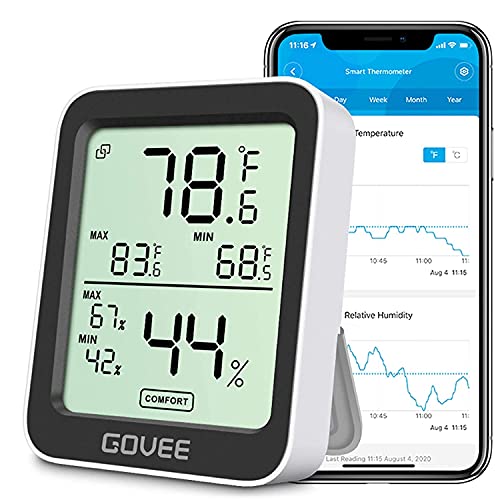
Govee
Govee Indoor Hygrometer Thermometer H5075 with Bluetooth…
Smart Features: The Govee Wireless Thermometer Hygrometer supports all basic functions as well as smart functions such as remote monitoring and temp humidity graphs. Our humidity meters are reliable and easy to use for homes, greenhouses and more.(Only supports 164ft Bluetooth connection)
See on AmazonThe Govee Indoor Hygrometer Thermometer H5075 is a good example of a device that gets these features right. It uses a Swiss sensor for accuracy and sends data to your phone via Bluetooth within 164 feet. The app shows 20-day trend graphs, lets you set alert thresholds, and stores up to two years of history you can export as CSV. It’s not the only option, but it shows what competent smart thermometer design looks like.

Accuracy and Refresh Speed Aren’t Just Specs on a Box
The first question I ask about any thermometer is: how fast does it update, and how close is it to reality? A sensor that reads every 30 seconds misses spikes from a heater kicking on or a door opening. One that updates every 2 seconds catches those changes.
For the Govee H5075, the refresh is 2 seconds. That’s fast enough to watch the humidity drop when you run a dehumidifier or the temperature rise after cooking. Accuracy is ±0.54°F for temperature and ±3% RH for humidity. Those numbers come from a Swiss-made sensor, not a generic chip. In practice, that means you can trust the reading when your baby’s room feels stuffy but the display says 50% humidity — the sensor is probably right.
Cheap thermometers often drift after a few months. The high-grade sensor holds calibration longer. If you’re monitoring conditions for asthma, allergies, or a wine cellar, that drift matters. A 2°F error can make you think a room is safe when it’s actually too warm for medication storage.
App Alerts That Turn Data Into Action
Notifications are the feature that separates useful smart thermometers from glorified clocks. You set upper and lower limits for temperature and humidity. When the reading crosses those lines, your phone gets an alert. That’s straightforward, but the implementation matters.
Some apps only push alerts when you are connected via Bluetooth. Walk out of range and you see nothing until you come back. Others, like the Govee app, store the data locally and show you a log of missed alerts when you reconnect. That’s better than nothing, but still not real-time if you are more than 164 feet away. For true remote monitoring, you need a Wi-Fi model — Bluetooth devices are best for the same building or close-range use.
Where these alerts shine is in practical scenarios. Set a low humidity alert at 40% to know when dry air might irritate your family’s sinuses. Set a high temperature alert at 78°F so you know when a malfunctioning heater is baking your living room. One reader told me her basement wine cooler failed, and the temperature alert on her smart thermometer caught it within minutes — saved about $600 worth of bottles.
Data Storage and History Graphs Give You Patterns, Not Moments
A single temperature reading tells you almost nothing. An hour of readings tells you a little. A 20-day graph tells you everything. The Govee H5075 stores 20 days of data on the device and can export up to two years of history from the app as a CSV file. That’s enough to see trends: your bedroom drops to 62°F every morning at 3 AM because the furnace cycle is weak. Your greenhouse humidity peaks at noon and drops at night.
Exporting to CSV lets you do your own analysis. I’ve used it to compare room conditions with allergy medication effectiveness. You can overlay graphs from multiple devices if you buy a few for different rooms. That kind of data turns a simple thermometer into a home environment tracking system.
The comfort indicator on the Govee display — dry, comfort, wet — is a quick visual cue. It’s not precise enough for scientific work, but for someone who just wants to know if the air is okay, it works well. The Max/Min records for the day are also handy. You can glance at the screen and know what happened while you were out.
Which Smart Thermometer Features Actually Matter? A Real Comparison
Not all features are created equal. Here is a breakdown of common smart thermometer capabilities ranked by practical usefulness for health monitoring.
| Feature | Why It Matters | Nice-to-Have vs. Must-Have | Example Impact |
|---|---|---|---|
| High accuracy sensor (±0.5°F or better) | False readings cause bad decisions (e.g., turning up heat when unnecessary) | Must-have | ±0.54°F prevents over-correcting room temp for a sick child |
| Fast refresh (≤10 seconds) | Catches sudden changes from cooking, HVAC cycles, open windows | Must-have | 2-second refresh shows the moment humidity drops after opening a door |
| App alerts with custom thresholds | Know when conditions go dangerous while you are in another room | Must-have | High temp alert saves wine cellar or prevents overheating in a nursery |
| Long data history (weeks or years) | Identify patterns: daily humidity drops, weekly temperature cycles | Must-have | 20-day graph reveals your bedroom never drops below 65°F so you can skip the space heater |
| Remote monitoring (Wi-Fi vs Bluetooth) | Check conditions when away from home (vacation, office) | Nice-to-have (depends on use case) | Wi-Fi models let you see basement temp from a hotel; Bluetooth works for same-building use |
| Comfort indicator (dry/comfort/wet) | Quick glance assessment without opening app | Nice-to-have | Handy when you walk into a room and want to know if air feels off |
| CSV export | Advanced analysis in spreadsheets or logging for medical recommendations | Nice-to-have | Export data to show doctor how humidity varies during allergy season |
You can find similar smart technology in other household devices. For example, a remote monitoring heater uses the same app-based alert principles to keep your pet warm overnight. And a smart pool heater with mobile app shows how temperature tracking works at larger scales.
Frequently Asked Questions
Can a smart thermometer replace a medical thermometer?
No. Smart temperature and humidity sensors like the Govee H5075 measure ambient conditions, not body temperature. They are for rooms, not foreheads or armpits. Keep a separate medical thermometer for fevers. The smart device tells you if the room is comfortable for recovery, which matters a lot.
How far away can I be and still get data from a Bluetooth smart thermometer?
The Govee H5075 has a rated range of 164 feet in open space. Walls and floors cut that drastically. In a typical house, you’ll get reliable readings from one floor away if the device is near a door. For true long-distance monitoring, buy a Wi-Fi model that works anywhere with internet.
Is humidity or temperature more important for health monitoring?
Both matter, but humidity affects breathing comfort more directly. Dry air (below 30%) irritates nasal passages and can worsen asthma. High humidity (above 60%) promotes mold and dust mites. Temperature affects sleep quality and metabolic rate. A good smart thermometer tracks both simultaneously — that’s why I recommend units that measure humidity too.
How often do I need to calibrate a smart thermometer?
High-end sensors like the Swiss chip in the Govee stay accurate for years. You can check calibration by placing the device next to a known reference (like a certified hygrometer) once a year. Most consumer models drift less than 1°F over five years. If you notice consistent deviations, reset or replace the unit. Cheap sensors may drift in months.
Can I use a smart thermometer for a greenhouse or cigar humidor?
Yes, as long as the range and accuracy match your needs. The Govee H5075 works well for small greenhouses and wine cabinets. For a large greenhouse, you’d need multiple units placed in different zones, and Bluetooth range may limit you. Also, the display is not waterproof, so keep it out of direct spray. The 2-year data export is great for tracking seasonal growing conditions.
What to Do With What You Just Learned
- Pick a smart thermometer with a refresh rate under 10 seconds and accuracy within ±0.5°F. That’s the baseline for useful data.
- Set alerts for both temperature and humidity ranges. 30-50% humidity and 65-75°F are good starting points for most homes.
- Place the sensor at the height where people spend time — waist level for adults, crib height for babies. Readings at the ceiling can be 5°F off.
- Check the history graph weekly, not daily. Patterns matter more than spikes. A sudden dry period after rain might mean your dehumidifier is working correctly.
- Back up exported CSV data if the app allows it. Some apps delete old history after a device reset.
- If you need alerts while traveling, skip Bluetooth-only models and get a Wi-Fi version. The convenience is worth the extra $10-20.
- One sensor per room is ideal. A single device in the hallway tells you almost nothing about the bedroom with closed doors.

