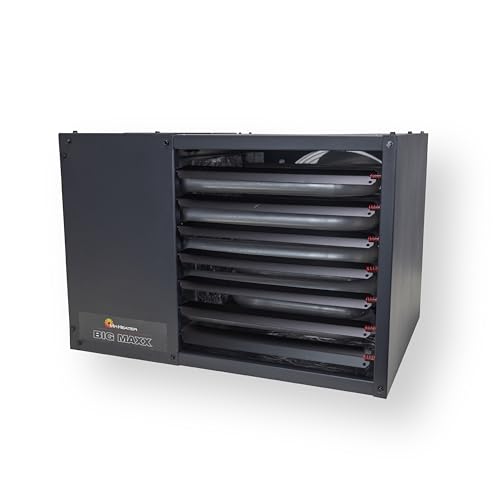
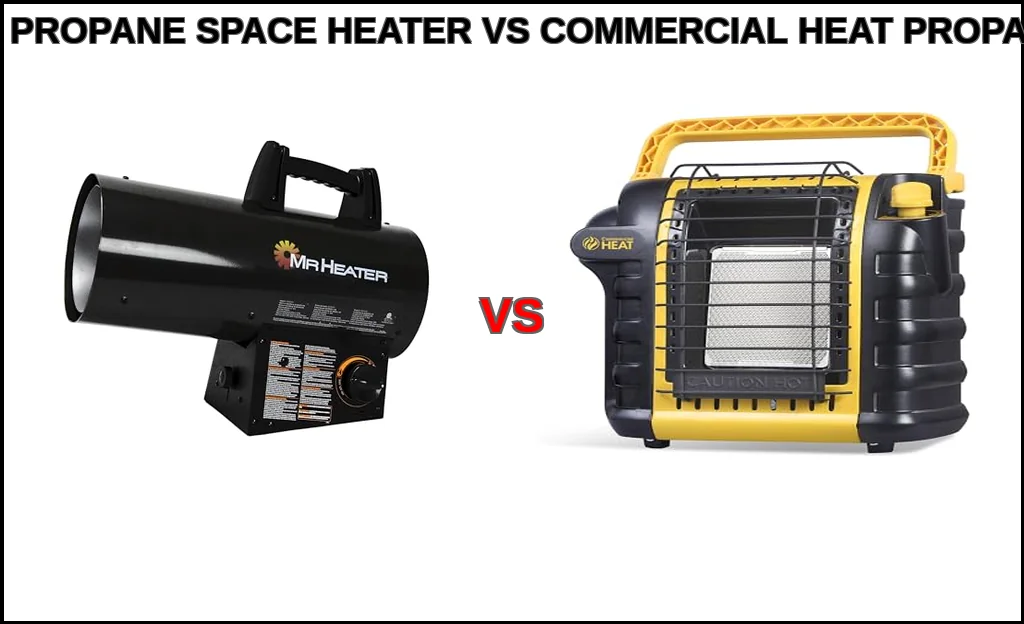
Selecting the right propane heater often comes down to a single question: raw power or versatile convenience? The debate between heavy-duty forced air units and compact portable heaters is a classic one. Two models that perfectly represent this divide are the Mr. Heater 60,000 BTU Forced Air Propane Space Heater and the Commercial Heat 9000 BTU Portable Propane Heater.
While both are propane-powered, their design philosophies and intended applications are worlds apart. One is built for large, open, and well-ventilated spaces, while the other prioritizes portability and flexibility for smaller areas. This comparison will break down their features, safety, and performance to help you decide which one fits your specific heating needs.
Mr. Heater vs Commercial Heat: A Head-to-Head Overview
At first glance, the difference is stark. The Mr. Heater model is a high-output, forced-air workhorse. It’s designed to move a massive volume of warm air, making it a common sight on construction sites and in large barns. The Commercial Heat unit, in contrast, is a compact, radiant-style heater focused on portability and dual indoor/outdoor use for areas like patios, tents, or small garages.
This fundamental difference in purpose dictates every other feature, from BTU rating and fuel source to portability and safety certifications. Let’s examine the specifics in a detailed feature comparison.
Feature Comparison Table
| Feature | Mr. Heater 60,000 BTU Forced Air | Commercial Heat 9000 BTU Portable |
|---|---|---|
| BTU Output | Variable from 30,000 to 60,000 BTU | Two settings: 4,000 BTU (Low) / 9,000 BTU (High) |
| Heating Coverage | Designed for large, ventilated spaces (e.g., construction sites, barns) | Up to 300 sq. ft.; for indoor areas, garages, camping, outdoor events |
| Portability | Large, glove-friendly handle; adjustable heating angle | Highly portable design for indoor/outdoor use |
| Fuel Source & Runtime | Includes 10 ft. hose and regulator for large propane tanks | Uses 1 lb. propane cylinder (not included); ~6 hrs on low, ~3 hrs on high. Optional hose for 20-lb. tank extends runtime significantly. |
| Key Safety Features | Built for well-ventilated use; specific safety features not listed in provided data. | Tip-over protection switch |
| Primary Use Case | Industrial, construction, large agricultural spaces | Personal space heating, emergencies, camping, small workshops, patios |
| Check current price on Amazon | Check current price on Amazon |
Safety Features & Certifications Analysis
Safety is non-negotiable with any combustion appliance. The features and intended use of these two heaters highlight very different safety paradigms.
The Commercial Heat 9000 BTU model is marketed as a vent-free heater suitable for indoor use, which places a premium on built-in safety mechanisms. Its listed tip-over protection is a critical feature, automatically shutting off the unit if it’s knocked overa common risk in busy workshops or during camping. For true indoor safe operation, one would expect additional features like an oxygen depletion sensor (ODS) or low oxygen shut-off, though these are not specified in the provided data. Always verify the exact safety certifications, such as CSA International certification, before using any heater indoors.
The Mr. Heater forced air model presents a different scenario. Its product description explicitly states it’s “Perfect for well ventilated construction sites, barn [sic].” This indicates it is not designed for sealed, indoor living spaces. High-output forced air heaters like this are engineered for environments with massive air exchange. Their primary safety consideration is proper ventilation to prevent carbon monoxide buildup. The inclusion of a 10-foot hose also emphasizes safe distance from the fuel source. For any propane heater, understanding propane hose requirements and connections is a key part of safe operation.
When evaluating the safest indoor propane heater comparison, the Commercial Heat’s design and tip-over switch give it an edge for controlled interior spaces. However, the Mr. Heater’s forced-air design is inherently safer for its intended large, drafty environments where other heaters would be ineffective. For more on safe heating solutions for specific environments, explore our guide on the best propane heaters for controlled climates.
Performance: Heating Capacity & Fuel Efficiency
This is where the two heaters truly diverge, answering the core question of heating capacity versus fuel efficiency for different scales.
Heating Power and Coverage
The Mr. Heater’s variable BTU output from 30,000 to 60,000 BTU is in a different league. This kind of power is meant to take the edge off a freezing, uninsulated warehouse or dry out a concrete pour on a construction site. It’s about volume heating, not subtle warmth.
The Commercial Heat maxes out at 9,000 BTU, designed to heat a personal space up to 300 square feet. It’s perfect for warming a small workshop corner, a tent, or a patio seating area. For the question of which is better Mr. Heater or Commercial Heat for workshops, the answer depends entirely on the workshop’s size. A small home garage? The Commercial Heat may suffice. A large, drafty commercial space? The Mr. Heater is the only contender.
Fuel Efficiency and Operating Cost
Evaluating propane heater cost to run requires context. The Commercial Heat provides specific runtime estimates: approximately 3 hours on high and 6 hours on low with a 1 lb. cylinder. Its optional hose for a 20-lb. tank dramatically extends this to an estimated 45 hours (high) or 105 hours (low). This makes it a potentially very efficient option for intermittent, small-space heating.
The Mr. Heater’s propane consumption will be significantly higher due to its immense output, but that’s the trade-off for its job. Its efficiency is measured in how quickly it can raise the temperature in a vast, cold space, not in hours per pound of fuel. It connects directly to larger propane tanks via its included hose, implying an expectation of high fuel use for professional-grade heating. A factor often overlooked is altitude performance adjustments; combustion efficiency can drop at high elevations, affecting both heaters’ output and runtime.
In the search for the most fuel efficient portable propane heater, the Commercial Heat’s lower BTU output and long runtime with a 20-lb. tank make it a strong candidate for sustained, low-level heat. For a different take on efficient portable design, our thermomate heater review explores another popular model.
Verdict: Best Use Cases & Final Recommendation
Choosing between these heaters isn’t about picking a “winner,” but about matching the tool to the task. Their optimal applications are distinctly different.
When to Choose the Mr. Heater 60,000 BTU Forced Air Heater
This is your go-to for large-scale, industrial heating challenges. Its strengths are undeniable in specific scenarios.
- Large Construction Sites: For Mr. Heater vs Commercial Heat propane heater for construction sites, the Mr. Heater is the clear choice. It can heat a large work area or dry building materials.
- Agricultural Buildings: Heating a barn, stable, or large workshop where insulation is poor and ventilation is ample.
- Emergency Thawing: Quickly thawing frozen pipes or equipment in a large commercial space.
Remember, this heater demands respect for ventilation requirements. It’s a powerful appliance for professionals who need rapid, high-volume heat in open settings.
When to Choose the Commercial Heat 9000 BTU Portable Heater
This heater excels in personal, flexible, and smaller-scale heating situations. Its portability and indoor-outdoor designation are its superpowers.
- Small Garages & Workshops: For a best propane heater for garage that’s under 300 sq. ft. and used for hobbies or light work.
- Camping & Outdoor Events: Its portability and compatibility with 1 lb. cylinders make it ideal for tailgating, ice fishing, or patio heating.
- Emergency Indoor Backup: As a supplemental heat source during a power outage in a room or small apartment (always ensure proper ventilation and confirm safety certifications).
- Targeted Spot Heating: Warming a specific area like a workbench or a seating nook without heating an entire large space.
The Final Call
Your decision hinges on scale and mobility. Need to heat a vast, drafty space quickly and powerfully? The Mr. Heater forced air model is your only real option from this pair. Its variable BTU rating and forced-air design are built for that exact heavy-duty purpose.
Require a versatile, portable heat source for personal use, smaller rooms, or outdoor activities? The Commercial Heat portable heater is designed for you. Its dual heat settings, tip-over safety, and flexible fuel options from small cylinders to a large tank offer adaptable and efficient warmth.
Always prioritize safety. Verify all certifications, ensure adequate ventilation for the specific model, and follow all manufacturer instructions. For comprehensive guidelines on managing heat exposure in work environments, consult the official source on occupational safety. Invest in the heater that matches your space, not just the one with the biggest number.

I am a mechanical engineer and love doing research on different home and outdoor heating options. When I am not working, I love spending time with my family and friends. I also enjoy blogging about my findings and helping others to find the best heating options for their needs.
Related guides

Is the Comfort Glow 17000 BTU Wall Heater Worth It? Find Out!
Stay warm this winter with our Comfort Glow 17000 BTU Wall Heater review. Find out why this heater…
Propane Heater Safety: Essential Precautions for Safe Use
When using propane heaters, ensure proper ventilation, keep flammable materials away, regularly check for gas leaks, use a…
Noritz NRCB199DV-LP Review: The Ultimate Combo Boiler for Comfort
Get the inside scoop on the Noritz NRCB199DV-LP with our in-depth review. See why this heater stands out…