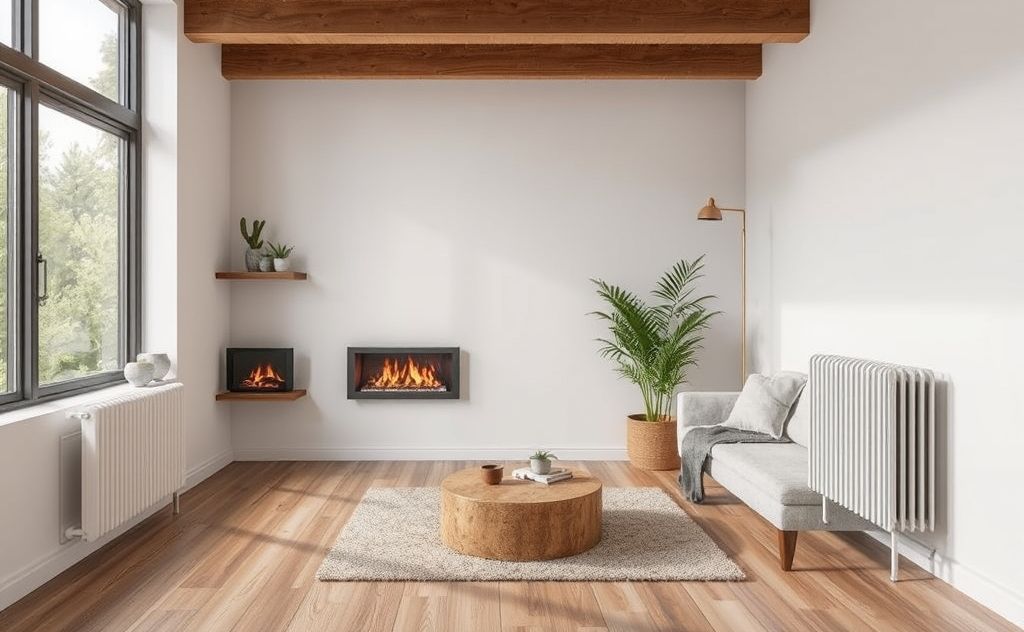
You spent months picking the perfect sofa, nailing the wall color, and arranging art. Then winter hits, and you drag in a clunky space heater that clashes with everything. That beige plastic box sitting in the corner — it works, but it ruins the room. Most people assume they have to choose between staying warm and having a nice-looking home.
That assumption is wrong. Heating equipment has come a long way in the last few years. You can get real warmth without the visual penalty. This article lays out specific strategies for blending heat sources into your design — not hiding them, but making them part of the look. You’ll learn what actually works for different room types, which specs matter (and which ones don’t), and where most people waste money on features they never use.
ZAFRO
ZAFRO Electric Fireplace Stove with Dual Heat…
- Charming Design: ZAFRO electric fireplace stove adopts a vintage - style stove body design, paired with highly realistic simulated…
- High-Efficiency Heating: This fireplace heater has a powerful 5100 BTU heating function with two modes of 1000W and 1500W, quickly…
- Realistic flame effect: This fireplace electric stove adopts 3D dancing flame technology with freely adjustable flame brightness f…
A quick note before we dive in: one of the easiest ways to pull this off is with a freestanding electric fireplace that doubles as a heater. The ZAFRO Electric Fireplace Stove is a good example — it’s compact enough to tuck into a reading nook or next to a media console, and the vintage-style body with transparent glass viewing windows adds character rather than detracting from it. We’ll talk more about choosing the right model later.
Myth #1: All Space Heaters Look the Same (and They All Look Bad)
Walk through any big-box store in October and you’ll see rows of identical white or black plastic boxes. People buy them because they’re cheap. But cheap comes with a cost — they make a room feel like a dorm or a workshop.
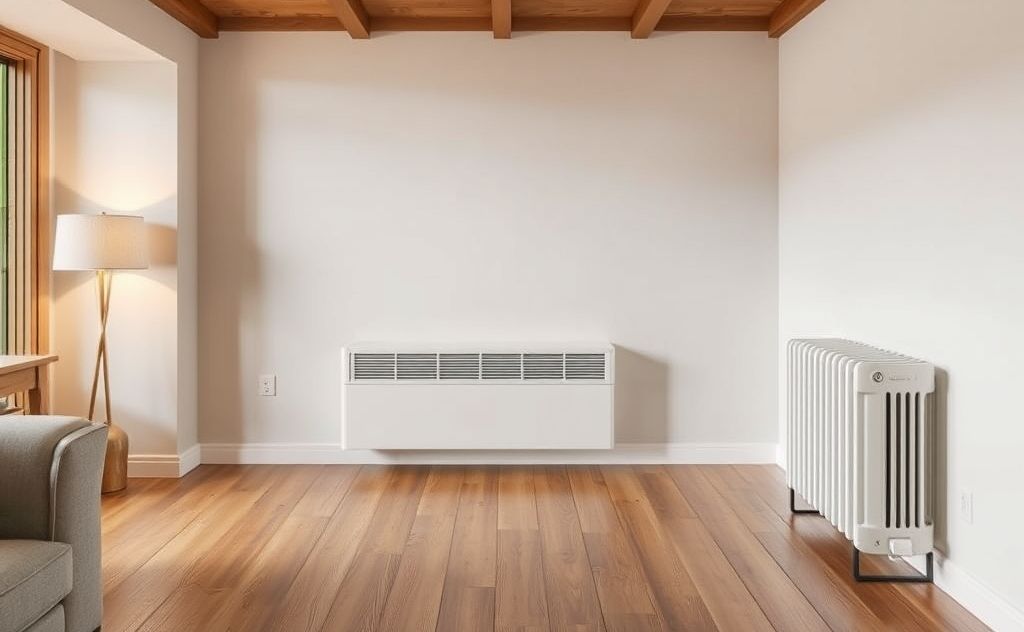
The truth is that many manufacturers now build heaters that look like furniture. The ZAFRO unit mentioned above mimics a cast-iron stove, complete with a ebony finish and brass-toned details. That’s not an exception anymore. You can find heaters styled like mid-century radiators, minimalist cubes, even wall-mounted panels that look like abstract art.
What to look for: a heater that matches your room’s dominant material. If your space has lots of wood and warm tones, go for something with a dark metallic or bronze finish. If your style is Scandinavian white and light oak, pick a heater in matte white or pale gray. The finish matters more than the shape.
Myth #2: More Watts Always Means More Heat
This is the most common mistake I see. People look at the wattage number and assume bigger is better. But wattage tells you how much electricity the heater draws, not how effectively it warms your room. Two 1500W heaters can perform very differently based on fan design, heating element type, and thermostat accuracy.
The ZAFRO model runs at 1000W or 1500W (you can toggle between them). That 1500W setting delivers 5100 BTU — enough to heat a 200-square-foot room comfortably. But if you put it in a drafty 400-square-foot living room, it’ll struggle. Instead of maxing out wattage, match the heater’s BTU rating to your room’s square footage. Rule of thumb: 20 BTU per square foot for average insulation, 25 for poorly insulated rooms. Going way over that just cycles the heater on and off faster, wasting energy without making you warmer.
Another detail that matters more than raw power: the thermostat. A heater with a precise thermostat (one that holds within a degree or two) will keep you comfortable without constantly cycling. The ZAFRO unit includes a thermostat control, which lets you set a target temperature and let the heater manage itself. That’s smarter than running it on full blast for an hour then turning it off.
For rooms where you want uniform heat that doesn’t disrupt your furniture arrangement, consider pairing a standalone heater with underfloor heating mats that tuck invisibly under tile or vinyl. That combo gives you both a design accent (the fireplace) and background warmth that you can’t see.
How to Place Heaters So They Look Intentional
Position is everything. A heater shoved into a corner looks like an afterthought. A heater placed deliberately looks like a design element. Here’s the approach I recommend:
- Make it a focal point. Put an electric fireplace or stove where your eye naturally goes — an empty wall space, next to a bookshelf, or across from the main seating area. The ZAFRO’s compact size (15.35 inches wide by 22 inches tall) fits onto a side table or low credenza without overwhelming the space.
- Use symmetry. Place identical heaters on both sides of a console table or flanking a sofa. That creates balance and makes the heaters look like intentional decor, not utility items.
- Layer with objects. A heater shouldn’t sit alone. Put a small plant, a stack of books, or a ceramic vase next to it. That integrates the heater into your vignette.
- Mind the cord. Nothing ruins a clean look faster than a visible power cord snaking across the floor. Use cord clips to run it along baseboards, or position the heater near an outlet so the cord is out of sight.
If your heater has a flame effect like the ZAFRO does (adjustable brightness from dim to bright), you have an extra lever. Dim the flames during the day for just a subtle glow, then crank them up at night for ambience. That two-mode functionality means the heater works as decor even when you don’t need heat.
Comparing Heating Options for Design-Conscious Homes
Not every heating solution fits every room. The table below compares four common approaches across factors that matter to both comfort and appearance.
| Heating Type | Best Room | Design Impact | Heat Output (BTU) | Installation |
|---|---|---|---|---|
| Freestanding electric fireplace (e.g., ZAFRO) | Living room, bedroom, office | Acts as a decorative accent; vintage or modern styles | 5,100 | Plug-and-play, no venting |
| Wall-mounted electric panel | Bathroom, hallway, small room | Minimalist; can be painted to match wall | 3,000–5,000 | Wall mount, hardwired or plug-in |
| Hydronic baseboard radiator | Large living area, open plan | Low profile but visible; limited color options | 6,000–12,000 | Needs plumbing or boiler connection |
| Underfloor electric mat | Bathroom, kitchen, any tiled space | Invisible; zero visual footprint | 12–15 watts/sq.ft. | Under flooring, requires electrical connection |
The freestanding option wins for people who want visible style plus heat in one package. Wall panels are better if you want the heater to disappear. Underfloor heating is ideal for cold tile floors but doesn’t provide quick warm-up — it’s a slow, steady heat.
Smart Controls and Thermostats: Why They Matter for Design
Nobody wants to crouch behind a sofa to adjust the temperature. A heater that works with a smart thermostat or remote control lets you set the mood from across the room. The ZAFRO model has a manual thermostat dial, which is fine for most people, but if you want automation, look for models that integrate with smart home systems.
Programming your heater to run only when you’re home saves energy and keeps the heater from being an eyesore when not in use. You can also set it to pre-warm the room before you wake up. For a deeper look at how to set up those scenarios, check out custom heating scenarios with a smart system.
One more tip: use a smart plug if your heater doesn’t have one built-in. That gives you app-based scheduling and voice control through Alexa or Google Home. Just make sure the smart plug is rated for the heater’s wattage (most handle 1500W fine).
Frequently Asked Questions
Can an electric fireplace really heat a whole room?
It depends on the room size and the heater’s BTU rating. A 5100 BTU unit like the ZAFRO will comfortably heat a 200- to 250-square-foot bedroom or small living room. For larger open-plan spaces, it works best as a zone heater — warm the area you’re sitting in rather than trying to heat the entire floor. It can handle the whole room if the room is compact and well-insulated.
Do electric fireplaces use a lot of electricity?
Running a 1500W heater on high draws about 1.5 kWh per hour. At the US average electricity rate of roughly $0.14 per kWh, that’s about $0.21 per hour. If you run it 5 hours a day for a month, that’s around $31.50. The low (1000W) setting cuts that by a third. Compared to running central heating for the whole house, it’s significantly cheaper for spot heating.
How do I clean a fireplace heater without damaging the finish?
Unplug it first. Use a soft, dry microfiber cloth to dust the exterior. For the glass viewing window on models like the ZAFRO, a damp cloth with a drop of mild dish soap works, then dry immediately. Never use abrasive cleaners or steel wool. The heating vents inside can be vacuumed gently with a brush attachment once a month during heavy use.
Is it safe to leave an electric fireplace on overnight?
Most modern units, including the ZAFRO, have overheat protection that shuts them off automatically if internal temps get too high. That said, general safety guidelines recommend not leaving any space heater unattended for long periods. If you want overnight warmth, set the thermostat low (around 60°F) and use the timer or a smart plug to turn it off after a few hours. Keep it away from curtains and bedding.
What’s the difference between a flame effect and a real flame?
Electric fireplaces use LED lights and mirrors to simulate flickering flames. No combustion, no smoke, no venting needed. The ZAFRO uses 3D dancing flame technology with adjustable brightness. Real flames require a chimney or flue and produce actual heat from burning wood or gas. Electric flames are safer, cleaner, and can be run with or without the heat element on — you can have the visual effect year-round without raising the room temperature.
What You Can Do Starting Tomorrow
- Measure your room and match the heater’s BTU to your square footage — don’t oversize or undersize.
- Choose a heater finish that copies your room’s dominant material (wood, metal, matte white).
- Place the heater where it becomes a focal point, not a corner afterthought. Add a plant or lamp nearby.
- Hide the power cord with clips or run it along baseboard molding.
- Set the thermostat to a target temperature instead of running the heater on max all day.
- Use a smart plug for scheduling if your heater doesn’t have built-in timers.
- Test the flame-only mode in summer — it adds ambience without heat, so the unit stays useful all year.
Related guides
5 Heated Gloves for Snowmobiling That Will Transform Your Winter Experience
Did you know that 80% of outdoor enthusiasts choose the best heated gloves for snowmobiling for unmatched warmth?…
Why COSNIGHT Clear Contact Paper is a Kitchen Game Changer
Revamp your projects with COSNIGHT Clear Contact Paper! This versatile 17.7x118 solution is perfect for crafting, decorating, and…
Find Your Ideal Match with These Heated Gloves for Work
Struggling to keep your hands warm during outdoor work in winter? Heated gloves are the perfect solution for…