
Selecting the right propane heater often comes down to a fundamental choice in heating technology. Do you need the rapid, whole-space warmth of a forced air system, or the targeted, object-focused comfort of radiant heat? This decision impacts everything from your energy bills to where you can safely use the heater. We’re putting two popular models head-to-head: the high-powered Habitio 60,000 BTU Forced Air Heater and the compact Gasland MHA18BN Propane Radiant Heater.
Both are excellent examples of their respective categories, but they serve distinctly different purposes. Understanding their core strengths is key to making an informed purchase that matches your specific needs, whether that’s a drafty workshop or a semi-enclosed patio.
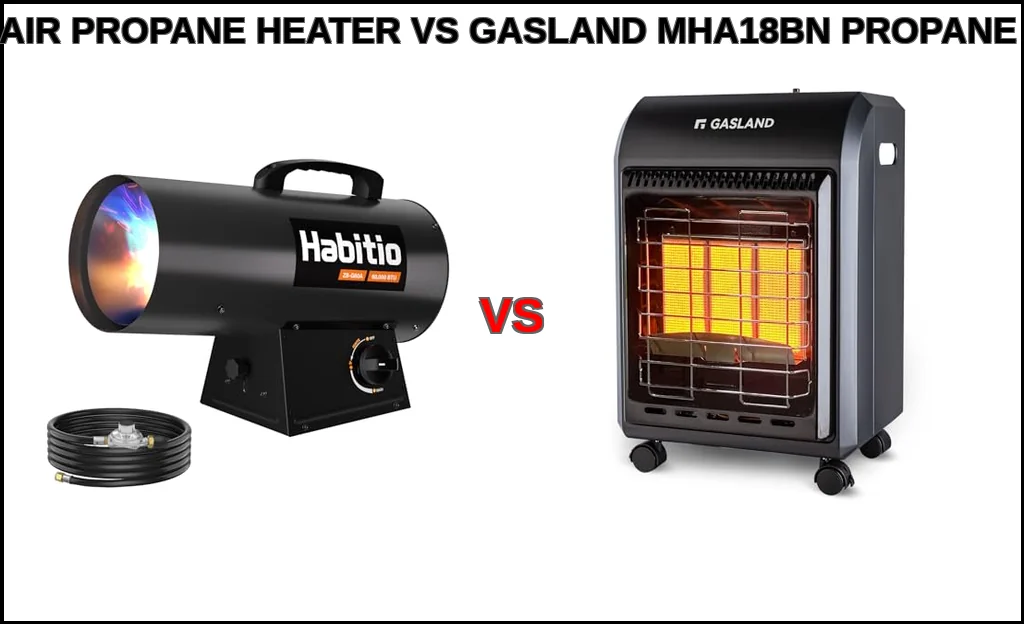
Forced Air vs. Radiant Heating: A Core Technology Breakdown
Before diving into the specs, let’s clarify the technology. A forced air technology heater, like the Habitio, works like a hair dryer on a massive scale. It uses a fan to pull in cold air, passes it over a hot heat exchanger, and then blows the warmed air back into the space. This creates convection currents, circulating heat to warm the entire volume of air in a room. It’s fast and effective for large, open areas.
In contrast, a radiant heat heater, like the Gasland, operates like the sun. It emits infrared energy that travels in a straight line, warming solid objects (people, furniture, tools) directly without needing to heat the air first. This provides immediate warmth to whatever is in its path, making it highly efficient for spot heating but less effective for evenly warming a large, drafty space.
Head-to-Head: Habitio Forced Air vs. Gasland Radiant
Heres a direct comparison of their key specifications and features based on their manufacturer listings.
| Feature | Habitio 60,000 BTU Forced Air Heater | Gasland MHA18BN Radiant Heater |
|---|---|---|
| Heating Technology | Forced Air (Torpedo Style) | Radiant (Infrared) |
| BTU Output | 40,000 – 60,000 BTU/h (Adjustable) | Up to 18,000 BTU/h (High/Med/Low) |
| Heating Capacity | Up to 2195 sq. ft. | Up to 450 sq. ft. |
| Primary Safety Features | Overheat protection, automatic shutdown on power outage, pulse ignition. | Tip-over switch, low-oxygen shut-off (ODS). |
| Certification | CSA certified. | Not specified in provided features. |
| Power Source | Propane only (requires 100V outlet for fan/ignition). | Propane only (no electricity required). |
| Noise Level | Produces an acceptable level of noise from fan. | Described as ultra-quiet operation. |
| Portability | Portable handle, adjustable height, includes 10 ft hose & regulator. | Built-in rolling wheels, easy-carry handle, cabinet hides propane tank. |
| Estimated Run Time | ~53 hrs (low) / ~36 hrs (high) on a 100 lb tank. | Not specified. Runs on a standard 20 lb cylinder. |
| Common Use Cases | Large garages, construction sites, factories, patios, farming functions. | Ventilated garages, offices, workshops, patios, barns. |
| Check current price on Amazon | Check current price on Amazon |
Runtime is a critical factor in heater efficiency and total cost of operation. The Habitio provides specific data linked to tank size, allowing for better fuel planning. For the Gasland, you’d need to calculate based on its 18,000 BTU max output and a standard 20 lb tank’s capacity.
Performance in Real-World Scenarios
Specs on paper are one thing. How do these heaters actually perform where you need them? The choice between forced air and radiant becomes crystal clear based on your environment.
Garage and Workshop Heating
This is a classic debate: which is better for garage heating forced air or radiant? The answer depends on your garage.
For a large, high-ceilinged, or drafty workshop where you move around a lot, the Habitio is a powerhouse. Its 60,000 BTU output and fan-driven heat can conquer a large volume of cold air quickly. It’s the tool for taking a space from freezing to workable in short order. The forced air heater creates air movement, which can help with minor ventilation but also stirs up dust.
The Gasland, as a radiant heater, excels in a smaller, more insulated garage or a defined workshop area. If you’re working at a bench for hours, its infrared rays will warm you and your tools directly, even if the air remains cool. It won’t fight massive drafts effectively, but for personal comfort in a zone, it’s superb. The Habitio vs Gasland heater for workshop question leans Gasland for focused tasks and Habitio for whole-space recovery.
Indoor vs. Outdoor Use and Safety
Propane heater safety is non-negotiable, especially concerning indoor vs outdoor use. Both heaters list indoor-appropriate applications, but with major caveats.
The Gasland is explicitly designed for “ventilated garages, offices, and workshops.” Its oxygen depletion sensor (ODS) and tip-over switch are essential for any indoor scenario. It requires constant, adequate fresh air exchange to prevent dangerous CO buildup. Never use it in a tightly sealed room.
The Habitio’s listing mentions patios and garages, but its massive BTU output and combustion process generate significant emissions and consume oxygen rapidly. It is fundamentally a portable heating solution for large, open, or very well-ventilated industrial spaces. Its CSA certification is a major plus, indicating independent safety testing. For the safest propane heater for indoor use between these two, the Gasland’s lower output and built-in ODS make it the more appropriate choice for occupied, ventilated indoor spaces. Always consult an official source for safety guidelines.
Portability and Convenience
Both are portable propane heaters, but in different ways. The Gasland wins for moving between rooms indoors with its wheels and handle, offering a cleaner look with the tank hidden. The Habitio is portable in the sense that you can carry it to a jobsite; it’s a tool meant to be placed and run. Its adjustable height and long hose offer flexibility in positioning relative to the propane tank.
Safety and Operational Features Deep Dive
Let’s go beyond the basic specs. A deeper look at their operational profiles reveals their true nature.
Ignition and Power Requirements
The Habitio uses pulse ignition (spark-based) and requires a 100V outlet to power its fan and ignition system. It has automatic shutdown during a power outage. The Gasland requires no electricity at all, making it immune to power failuresa significant advantage during storms or in off-grid settings.
Thermostat Control and Steady Heat
Neither unit appears to have a true ambient thermostat control. The Habitio offers adjustable fan speeds and a BTU dial, letting you modulate heat output. The Gasland has three heating modes (High/Medium/Low). You manually set them based on comfort, as neither will cycle on and off automatically to maintain a set room temperature.
Emissions and Ventilation Requirements
This is a critical, often overlooked entity. Any combustion heater produces carbon monoxide (CO) and carbon dioxide (CO2). Ventilation requirements are paramount. The Gasland’s 18,000 BTU output and ODS make it suitable for a properly ventilated indoor area. The Habitio’s 60,000 BTU output implies a much higher fuel consumption rate and emission output. It is designed for spaces where natural ventilation is abundant (e.g., a construction site with open doors, a large barn). Always ensure compliance with local codes regarding heater use in occupied spaces.
Final Verdict: Choosing the Right Heater For Your Needs
So, which heater deserves a spot in your space? It’s not about which is universally “better,” but which is the right tool for your specific job.
Choose the Habitio 60,000 BTU Forced Air Heater if:
- You need to heat a very large, open, or high-ceiling area (up to 2195 sq. ft.) quickly.
- Your primary use is in a workshop, jobsite, barn, or garage where maximum raw heating capacity trumps quiet operation.
- You have access to a power outlet and can manage the noise from the fan.
- You plan to use a large propane tank (e.g., 100 lb) for extended run times.
Choose the Gasland MHA18BN Propane Radiant Heater if:
- You need to heat a smaller, defined area (up to 450 sq. ft.) or provide spot heating for people.
- You want a quiet heater for a home office, insulated garage, or workshop where you stay in one zone.
- You require a truly electricity-free heating solution for emergency preparedness or off-grid use.
- You prioritize a low-profile, wheeled design for easy movement indoors with built-in critical safety sensors (ODS, tip-over).
For those exploring other efficient heating solutions, our review of the thermomate propane heater offers insights into another popular model in the propane space heater category. And if your needs lean towards growing plants, our guide on the best greenhouse heaters delves into the unique requirements for that application.
In the end, the most energy efficient propane heater comparison is contextual. For rapidly warming the air in a cavernous space, the forced air efficiency of the Habitio is unmatched. For efficiently delivering warmth directly to you and your projects with minimal energy waste, the radiant efficiency of the Gasland shines. Assess your space, your power access, and your comfort goals. Your perfect heater is waiting.
