
Two names consistently pop up when you’re searching for a reliable portable propane heater: Fitfirst and VEVOR. Both promise robust 9000 BTU warmth for your garage, campsite, or patio, but they take different paths to get there. Choosing between them isn’t just about specs on paper; it’s about how those features translate to your specific cold-weather needs, whether that’s a weekend in a deer blind or knocking the chill out of your workshop.
This head-to-head breakdown cuts through the marketing to compare these popular models directly. We’ll examine their specifications, real-world performance, and overall value to help you decide which portable propane heater deserves a spot in your gear.
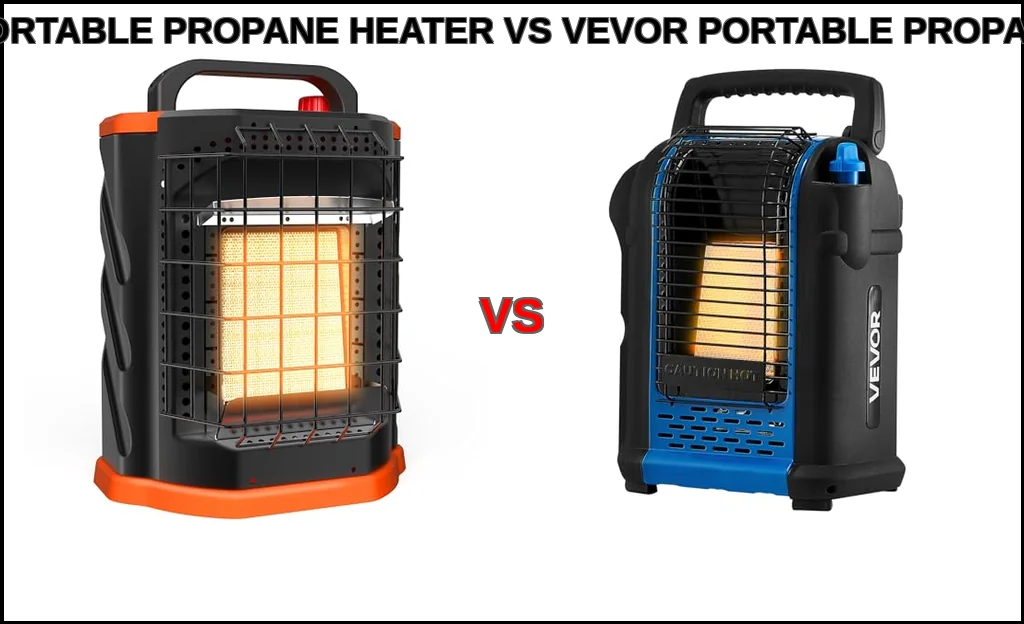
Head-to-Head Specifications & Features
At first glance, the Fitfirst and VEVOR heaters share a core mission. Both are rated for 225 square feet, use a standard 1 lb propane cylinder, and incorporate critical safety systems. The devil, as always, is in the details. A side-by-side look reveals key differences in control, design, and operational nuance that could sway your decision.
Core Specifications Comparison
| Feature | Fitfirst Portable Propane Heater | VEVOR Portable Propane Heater |
|---|---|---|
| BTU output | 6000-9000 BTU (2 settings) | Up to 9000 BTU (stepless control) |
| Heating Area | Up to 225 sq. ft. | Up to 225 sq. ft. |
| Ignition System | Piezo ignition | Piezo ignition |
| Key Safety Features | Tip-over switch, Oxygen Depletion Sensor (ODS) | Tip-over protection, low oxygen protection |
| Propane Tank Compatibility | 1 lb & 20 lb (with optional hose) | 1 lb / 0.45 kg tank |
| Portability Features | Carry handle | Ergonomic large handle, 9.26 lbs weight |
| Fuel Efficiency (Est.) | Up to 3.5 hours on 1 lb tank | 2.4-5.2 hours on 1 lb tank |
| Noise Level | Not specified | 30-40 dB |
| Check current price on Amazon | Check current price on Amazon |
Breaking Down the Key Differences
The table tells a clear story. The most significant divergence is heat control. The Fitfirst offers two preset levels (6000 and 9000 BTU), functioning like a high/low switch. The VEVOR employs a stepless knob, allowing you to dial in any heat output from zero to maximum. This is a major point for users who want fine-tuned temperature management.
Another critical area is fuel efficiency and runtime. The Fitfirst cites a maximum runtime of 3.5 hours per 1 lb tank. VEVOR provides a wider range of 2.4 to 5.2 hours, directly tying runtime to the heat setting selected via its stepless control. Lower heat means longer operationa practical detail for extended use.
Safety & Certification: A Non-Negotiable Priority
Both heaters prioritize user safety with automatic safety shut-off via tip-over protection and an oxygen depletion sensor (ODS). This is paramount for any propane heater, especially for scenarios like garage use or emergency heating where attention may be divided. While specific certifications like CSA (Canadian Standards Association) aren’t listed in the provided features, the inclusion of an ODS is a fundamental safety component that addresses the critical risk of oxygen depletion in enclosed spaces. Always ensure proper ventilation, a point emphasized by the official source on occupational safety.
Performance & Real-World Use Comparison
Specifications are a blueprint; performance is the lived-in house. How do these heaters actually behave in the scenarios you care about? Let’s translate features into experience.
For Camping & Outdoor Adventures
As a dedicated camping heater, both units are strong contenders. Their cordless, propane-powered design is ideal for remote sites. The Fitfirst’s straightforward two-setting operation is simple in the dark or cold. Its compatibility with a 20 lb tank via an optional hose is a huge plus for base camp or long hunting trips in a deer blind, effectively turning it into a longer-lasting outdoor heater.
The VEVOR fights back with its lighter weight (explicitly listed at 9.26 lbs) and compact footprint. The stepless control lets you run it on a low, fuel-sipping setting to take the edge off a chilly tent without overheating it. Its listed noise level of 30-40 dB is notably quietabout the level of a whisperwhich is a significant advantage for a peaceful campsite.
For Garage, Workshop & Indoor Spaces
This is where details matter most. The common question, “are VEVOR propane heaters safe for indoor use?” applies to both brands. The answer hinges entirely on ventilation. Both have ODS sensors, a critical feature. However, no unvented propane heater is truly safe for occupied indoor living spaces like bedrooms due to carbon monoxide and moisture risks. They are designed for well-ventilated, semi-enclosed areas like garages, workshops, or ice shelters.
The VEVOR’s stepless control might be more appreciated here, allowing you to maintain a consistent, comfortable temperature while working. The Fitfirst’s high/low switch is more of a “blast heat” or “less blast” operation. For quick jobs, either works. For longer projects, finer control can prevent the space from becoming oppressively hot.
Value Analysis: Price vs. What You Get
Determining the winner in a propane heater comparison often comes down to the price-to-performance ratio. You’re not just buying BTUs; you’re buying convenience, control, and suitability.
Fitfirst: The Straightforward Workhorse
The Fitfirst presents a compelling value as a budget heater with versatile fuel options. Its core strengths are:
- Dual Fuel Flexibility: The built-in readiness for a 20 lb tank is a major cost-saving feature for prolonged use.
- Simple Operation: Two heat settings mean no guesswork.
- Proven Safety Package: Tip-over and ODS provide essential protection.
You’re paying for robust heating capability and fuel versatility. The potential Fitfirst vs VEVOR heater price difference (always check live prices) often leans in Fitfirst’s favor, making it an efficient tool for heating a defined space without extra frills.
VEVOR: The Feature-Focused Performer
VEVOR justifies its potential price point with enhanced user experience and detailed engineering. Its value proposition includes:
- Precision Control: The stepless knob is a premium feature for tailored comfort.
- Quantified Portability: Explicit light weight and small storage footprint.
- Quiet Operation: The listed low noise level is a unique and valuable spec for many users.
- Wider Runtime Range: Acknowledges the direct link between heat setting and fuel consumption.
You’re investing in finer control, quieter operation, and a design that seems more meticulously specified. It’s for the user who values nuance over sheer utility.
When considering the best portable heater for your needs, also explore our guides on the best portable propane heaters and top picks for indoor-safe portable propane heaters to see how these models stack up in a broader field.
Final Verdict & Recommendation
So, which portable propane heater is better? It’s not a single answer. It’s a match between product philosophy and your personal checklist.
Choose the Fitfirst Portable Propane Heater if:
- Your priority is straightforward, powerful heat with maximum fuel flexibility (1 lb and 20 lb tanks).
- You need a reliable garage heater or workshop heater for intermittent, high-heat sessions.
- You plan on extended outdoor use like hunting camps and value the option to connect a larger tank.
- You prefer simple, high/low operation without a dial to adjust.
Choose the VEVOR Portable Propane Heater if:
- You want precise temperature control with a stepless dial to fine-tune your comfort.
- Quiet operation (30-40 dB) is important for your setting, like a tent or ice fishing shelter.
- You value detailed specifications like exact weight and noise level in your heater review process.
- Your use cases benefit from a wider, adjustable runtime range per tank.
The Fitfirst vs VEVOR debate highlights a classic trade-off. Fitfirst is the adaptable, no-nonsense tool built for flexibility and power. VEVOR is the refined appliance designed for controlled comfort and quieter operation. Both are competent heaters with essential safety features. Your decision ultimately hinges on whether you value versatile fuel options or precision control and quiet performance. Assess your typical use case, and the right choice becomes clear.
