
Selecting the right portable propane heater can be the difference between a comfortable experience and a frustrating one. The market offers a wide range, but two models consistently draw attention: the Fitfirst Portable Propane Heater and the Avenger Portable Outdoor Propane Cabinet Heater. While both are excellent propane space heaters, they cater to distinctly different needs and environments. This head-to-head comparison will break down their specifications, performance, and ideal use cases to help you make an informed decision.
Head-to-Head Comparison: Fitfirst vs Avenger
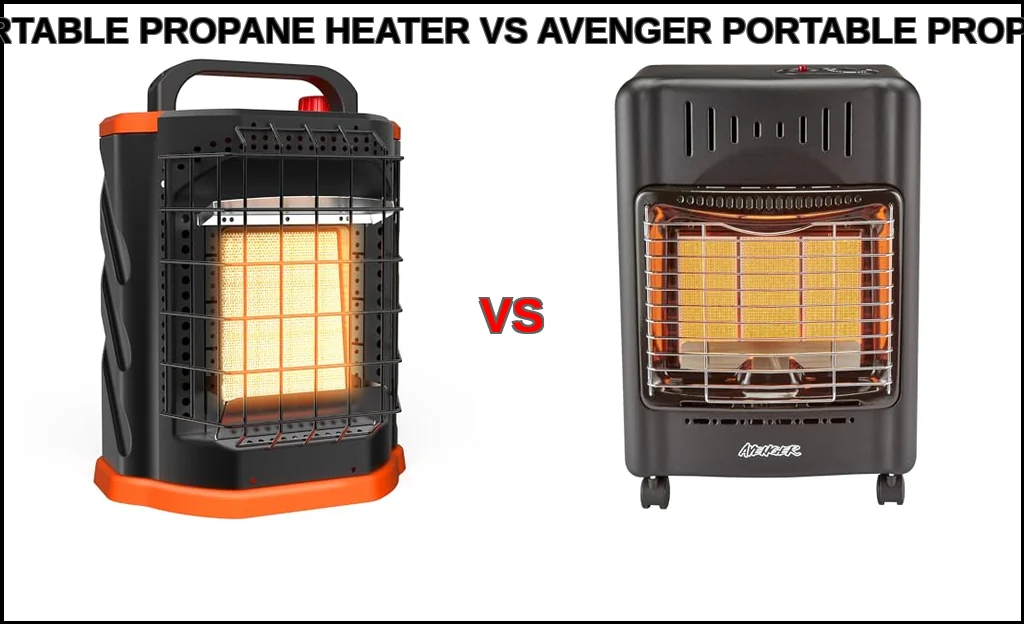
At first glance, the core difference is obvious. The Fitfirst is a compact, highly portable unit designed for mobility and smaller spaces. The Avenger, with its cabinet design and casters, is a more substantial heater built for stationary power in larger areas. This fundamental distinction in form dictates their entire function. Let’s see how they stack up across key categories.
| Feature | Fitfirst Portable Propane Heater | Avenger Portable Outdoor Propane Cabinet Heater |
|---|---|---|
| BTU Output | 6000 – 9000 BTU | 6000, 12,000, or 18,000 BTU |
| Heating Capacity | Up to 225 sq. ft. | Up to 450 sq. ft. |
| Fuel Source | 1 lb propane cylinder (standard), Optional 20 lb tank with hose | Standard 20 lb propane tank |
| Run Time (Approx.) | Up to 3.5 hours on a 1 lb tank | Up to 72 hours on low with a 20 lb tank |
| Ignition | Piezo ignition | Push-and-turn piezo ignition |
| Safety Features | Tip-over switch, Oxygen Depletion Sensor (ODS) | Tip-over switch, Oxygen Depletion Sensor (ODS) |
| Portability | Carry handle, lightweight | Steel cabinet with smooth-rolling casters |
| Check current price on Amazon | Check current price on Amazon |
Key Specifications & Technical Breakdown
Diving deeper into the specs reveals why these heaters serve different masters. The BTU rating is the most significant technical differentiator. The Avenger’s maximum 18,000 BTU output doubles the Fitfirst’s peak, translating directly to its ability to heat a 450 sq. ft. space versus 225 sq. ft. This makes the Avenger a powerhouse for large workshops or garages.
Fuel Compatibility and Run Time
This is where your intended use becomes critical. The Fitfirst runs primarily on a standard 1 lb propane cylinder, offering supreme portability for a camping heater. Its listed run time is up to 3.5 hours per small tank. For extended use, it can connect to a 20 lb tank with an optional hose. The Avenger, however, is designed from the ground up for a 20 lb tank. Its staggering claim of up to 72 hours on the low 6,000 BTU setting means you can heat a space for days without refuelinga key factor for a workshop heater during a multi-day project.
So, how long does a 1lb tank last on each heater? The answer is simple: the Fitfirst uses it, the Avenger doesn’t. If your primary fuel is disposable cylinders, the Avenger is not an option without significant modification.
Ignition and Design
Both utilize reliable piezo ignition systems, eliminating the need for electricity or matches. The Fitfirst has a top-mounted button for easy viewing of the spark. The Avenger uses a convenient push-and-turn mechanism on its control knob. Physically, the Fitfirst is a traditional radiant heater you can pick up and carry. The Avenger’s durable steel cabinet on casters makes it mobile in a different wayeasy to roll across a garage floor but not something you’d toss in a backpack.
Performance, Safety & Real-World Use
Performance is dictated by the specs, but real-world application is about matching those numbers to your environment. Safety, however, is non-negotiable and deserves its own spotlight.
Heating Performance and Application
The Fitfirst’s 6000-9000 BTU range is perfect for targeted warmth. Think inside a camping tent, a small ice fishing shelter, a deer blind, or a patio table area. It’s a radiant heater that warms people and objects directly in its path. The Avenger, with its three precise settings, offers versatile power. Use 6,000 BTU for maintenance heat, 12,000 for comfortable warming, and 18,000 to quickly take the chill out of a large, drafty space like a 2-car garage. It’s the definitive choice for the best portable heater for garage workshops among these two.
Critical Safety Features
Both heaters are equipped with two essential safety systems: an automatic tip-over switch and an Oxygen Depletion Sensor (ODS). The tip-over switch immediately cuts the gas supply if the unit is knocked over. The ODS is crucial for indoor or enclosed spaces; it monitors oxygen levels and will shut the heater off if they drop to an unsafe level, helping to prevent dangerous situations. This is a fundamental Fitfirst vs Avenger heater safety comparisonthey are equal on these core features.
However, savvy buyers look beyond the basics. When evaluating any propane heater for indoor vs outdoor use, considering certifications like CSA (Canadian Standards Association) is wise, as it indicates rigorous independent testing for safety standards. Checking manufacturer details on emissions and warranty length can also provide peace of mind beyond the marketing copy. For authoritative guidelines on safe thermal environments, especially in workplaces, the OSHA website remains an invaluable official source.
Ideal Use Cases & Target User
Choosing between these heaters isn’t about which is objectively better, but which is better for you.
Who Should Buy the Fitfirst Portable Propane Heater?
This heater is for the mobile adventurer and the person needing spot heat in small, semi-enclosed spaces.
- The Camper & Outdoor Enthusiast: Its lightweight design, carry handle, and 1 lb tank compatibility make it a top contender for which portable propane heater is better for camping. It’s easy to transport and set up at a campsite.
- The Portable Spot-Heater User: Perfect for quickly warming a patio during a fall gathering, taking the edge off in a garden shed, or providing warmth in an RV.
- The Person Seeking Simple Backup Heat: For emergency heating in a single room during a power outage (with proper ventilation), its simplicity is a benefit.
Who Should Buy the Avenger Portable Propane Cabinet Heater?
This heater is for the user who needs serious, sustained heat in a larger, fixed location.
- The Workshop Warrior: If your primary need is heating a garage, workshop, or large shed, the Avenger’s power and 20 lb tank compatibility are unmatched. You can work for hours, even days, without interruption.
- The Event Planner or Contractor: The cabinet-on-casters design allows you to easily roll substantial heat across a warehouse, a tented event space, or a construction site before power is connected.
- The User Prioritizing Long Run Times: If refueling is a hassle you want to avoid, the potential 72-hour run time on low is a game-changer.
For those still exploring the broader market of compact indoor options, our guide to the best portable indoor propane heaters offers a wider perspective on safe, ventilated heating.
Final Verdict & Buying Recommendation
So, which one wins? The answer is entirely situational. Both are competent propane heaters, but they solve different problems.
Choose the Fitfirst Portable Propane Heater if: Your priority is true portability and you primarily need to heat small, enclosed spaces like tents or blinds, or provide spot warmth on a patio. Its compatibility with 1 lb cylinders makes it the go-to for outdoor recreation. Its a classic, effective radiant heater.
Choose the Avenger Portable Outdoor Propane Cabinet Heater if: You need to heat a large area like a workshop or garage, and you value powerful, adjustable heat with exceptional run time from a standard 20 lb tank. Its cabinet design with casters makes it mobile within a space, but it’s not meant for hiking. It’s a robust, high-output solution for stationary applications.
For a comprehensive look at top performers across all categories, including other brands like Mr. Heater, our review of the best portable propane heaters is an excellent next step. Your perfect heater is the one that matches your specific scenario for BTU output, fuel source, and portability. Assess your primary use case, and the choice between these two excellent but distinct models becomes clear.
