Do Electric Fireplaces Look Real? The Truth About Flame Effects
On this page 6 sections
Electric fireplaces don’t burn wood or gas. Instead, they use lighting and visual tricks to mimic flames. The quality of that illusion depends on the technology inside the unit.
Understanding how these flame effects work helps you pick a model that fits your room, budget, and expectations for comfort and safety.
How Electric Fireplaces Create Their Flame Effects
An electric fireplace flame comes from light, moving reflectors, projected images, or water vapor—not burning fuel—so the fire you see is an optical effect. The outlet type doesn’t change that flame picture, but it can affect whether the built-in heater gets enough power to run normally.

Most electric fireplaces combine an LED light source with a screen, translucent flame pieces, a reflective surface, or a mist chamber. The heater is a separate electrical element and fan, which is why you can usually run the flame display with the heat turned off. No chimney, gas line, ash pan, or tiny fire department is required.
LED Flame Effects
LED systems shine light through or across shaped plastic, fabric, or printed flame surfaces while a controller varies the brightness and color. Rapid changes in light intensity create the flicker; red, orange, yellow, and blue LEDs create different flame colors; an ember bed or layered screen adds visual depth.
Some designs move the light source or the flame material slowly, so the pattern doesn’t repeat in one obvious loop. Others use several light zones, allowing the lower ember bed to glow separately from the taller flame shapes. Your eye reads those changing layers as movement, even though the fireplace has no flame to feed.
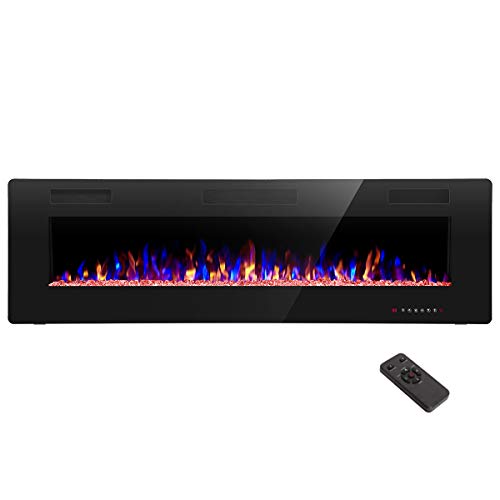
Holographic Projection
Holographic-style fireplaces project moving flame imagery onto or behind a transparent screen, sometimes with reflective layers placed at different depths. The shifting image supplies the flicker, while the layered screen makes parts of the flame appear closer than others. That separation can look more three-dimensional than a single flat orange panel.
The word holographic is used loosely in product descriptions. In many cases, you’re seeing a carefully arranged projection or reflection rather than a free-floating hologram. The useful question is how the image is layered and viewed from your normal seating position, not whether the marketing department has discovered new physics.
Water Vapor Mist
Water-vapor fireplaces use a small reservoir, an ultrasonic mist maker, and colored LEDs. The mist rises through a flame-shaped opening, and the light catches the fine droplets so they resemble flames and smoke. Because the visible plume has physical height, it can create convincing depth at close range without combustion or hot exhaust.
Mist systems need water added and occasional cleaning according to the manual. The effect also depends on room lighting and viewing angle: strong sunlight can wash out the colors, while a dim room gives the projected or lit mist more contrast. The mist is part of the display, not a substitute for a vented combustion system.
Mechanical Reflectors
Mechanical-reflector fireplaces use a motor to turn a faceted cylinder, mirrored strip, or other reflective piece in front of LEDs. As the surfaces move, they throw irregular patches of light onto a flame screen or plastic log set. That moving reflection supplies the familiar dancing motion found in simpler electric fireplaces.
This approach can produce a pleasant flame effect with fewer parts than a projection or mist system, though the movement may look flatter if the display has only one light layer. A clicking, rubbing, or stalled pattern can point to a motor or reflector problem; don’t force the mechanism while the unit is plugged in.
What The Outlet Changes
A standard three-prong outlet can power the display, but the outlet doesn’t determine whether the fireplace uses LEDs, projection, reflectors, or mist. The design and control board create the flame effect. Product 2, for example, is described as plugging into a standard three-prong outlet while allowing the heater to be switched off for flame-only use.
Power matters more for the heat function. Many plug-in electric fireplaces offer a 750-watt low setting and a 1,500-watt high setting; at 120 volts, 1,500 watts draws about 12.5 amps. A weak circuit, overloaded branch circuit, or unsuitable outlet can cause the heater to trip a breaker even while the flame display still works.
Flame-only mode generally draws far less power than flame plus heat because the heating element and fan are off, but the exact draw depends on the model’s lights, controls, and mist system. Check the rating label or manual for the number that applies to your fireplace, and plug the unit directly into the wall rather than treating a power strip like a spare electrical circuit.
How to Spot Realistic vs. Fake Flames in Electric Fireplaces
Electric fireplaces use different techniques to create flame effects, some more convincing than others. Basic models often rely on two-dimensional images or simple light patterns that can look flat or repetitive. More advanced units use 3D holographic effects, rotating mirrors, or layered LED lighting to mimic the flicker and depth of real flames. The most realistic flames combine multiple effects, like changing colors, subtle movement, and shadows, to fool your eye into seeing fire that isn’t there.

Check Why the Flame Won’t Stay On
If an electric fireplace flame won’t stay on, first check that flame-only mode is selected and that a timer, sleep setting or remote-control command isn’t switching it off. Try the controls on the fireplace itself, replace weak remote batteries, and unplug the unit briefly before reconnecting it according to the manual.
A flame that cuts out while the heater also stops may indicate an overheat or automatic safety shutoff; blocked air openings, dust or an abnormal fault can trigger that protection. Let the unit cool, keep its vents clear and follow the manual’s reset instructions. Stop using it if you smell scorching, see sparking or hear electrical buzzing, and arrange service rather than repeatedly resetting it.
Look For These Visual Clues
- Natural flicker: The flame should vary in height, speed and brightness instead of repeating one identical sweep.
- Color gradients: Real fire shifts between darker orange, yellow and red areas. A single solid blue, orange or red LED wash usually looks less convincing.
- Visible depth: Better effects place the flame behind logs, crystals or a separate ember bed, creating shadows and layers as the light moves.
- Glowing embers: A soft, irregular glow below the flame gives the lower part of the display something to reflect and keeps the fire from looking like a flat screen.
The best test is to watch the display for a few minutes from your normal seating position, with the room lights at their usual evening level. A flame can look impressive in a bright showroom and strangely flat above the sofa; viewing distance changes what your eyes notice.
Recognize Cheap Flame Effects
Many older or inexpensive fireplaces use a spinning reflector that throws light onto a screen. The rotating parts create movement, but the pattern can look mechanical because the same wave returns at the same interval. Flat flames projected onto one surface and single-color LEDs have the same giveaway: movement without much depth or tonal change.
Adjustable speed and brightness help, but more settings don’t automatically mean a more natural fire. Slow the effect down, lower the brightness and compare the flame with the ember bed; harsh, fast movement can draw attention to the mechanism hiding behind the screen.

Use Flame-Only Mode For Comfort
Flame realism affects comfort because a steady, layered glow can make a room feel settled, while a bright repeating pattern becomes visual noise after a few minutes. Flame-only mode lets you keep that ambiance in spring or fall without adding heater output or fan sound, provided your model supports the setting.
Running Costs and Heat Output for Electric Fireplaces
An electric fireplace usually offers two heat levels—750 watts and 1,500 watts—so its running cost depends on the setting, how long you run it and your electricity rate. Flame-only mode uses far less power because the heating element and fan stay off, although the LEDs and flame mechanism still draw some electricity.
Running a 750-watt heater for eight hours consumes 6 kWh (0.75 kW × 8 hours). With electricity priced at 17 cents per kWh, that totals about $1.02 per night or $30.60 for a 30-day month. If rates rise to 25 cents per kWh, the cost climbs to roughly $1.50 per night or $45 monthly.
High heat doubles the use: 1.5 × 8 = 12 kWh. That works out to about $2.04 per night at 17 cents per kWh, or $3.00 per night at 25 cents. Over 30 nights, those figures become about $61.20 and $90. The arithmetic is simple; winter electric bills are where it develops a personality.
| Heater | Watts | Per hour | Per day (8 h) | Per month (30 days) |
|---|---|---|---|---|
| 750 W heat setting | 750 W | 13¢ | $1.02 | $30.60 |
| 1,500 W heat setting | 1,500 W | 26¢ | $2.04 | $61.20 |
Infrared models warm people, furniture and nearby surfaces directly with radiant energy, so you may feel warmer before the whole room reaches the thermostat setting. A conventional electric fireplace generally heats the air with a resistance element and fan. Neither method creates heat from the flame image; the heating element makes the warmth.
Turning heat off usually removes the largest power draw. LEDs, a rotating reflector, a display or a water-vapor system may still consume a small amount, but the exact standby or flame-only wattage depends on the model. Check the manual if you want a precise cost instead of treating every glowing ember as free.
Size an electric fireplace for supplemental heat and the room’s heat loss, not for the full advertised coverage number. A drafty, open living room may need more help than a smaller enclosed room with insulation, and a 1,500-watt plug-in unit is still limited by the standard outlet supplying it. Product 1 lists supplemental heating for up to 400 square feet and lets you choose 750 or 1,500 watts, making it useful when you want lower-cost shoulder-season heat or a stronger boost during a cold spell.
Best Uses for Electric Fireplaces
Electric fireplaces work best in indoor rooms where you can view the flame from the main seating area and match the installation style to the room, rather than treating the fireplace like a one-size-fits-all heater. A living room, bedroom, den or finished basement can suit one well; a damp bathroom, open porch or poorly protected garage usually doesn’t.
Check The Viewing Angle Before You Install
Most flame effects look strongest straight on, so sit where you normally watch television and check the fireplace from that position before choosing a wall. Moving reflectors and projected images can lose depth when you move far to the side, while some layered ember effects remain convincing across a wider angle. View the unit from the sofa, a nearby chair and the room entrance. If the flame turns into a bright stripe from the side, the installation height or location needs another look.
Distance matters, too. A screen viewed from across a large room may look calmer and more natural than one mounted close to your chair, where repeated motion and bright color are easier to spot. Keep the display near eye level for the primary seating area, and avoid placing it opposite a sunny window or strong lamp; reflections can make a convincing flame look like a screensaver having a rough day.
Match The Installation To The Room
| Style | Where it fits | What to check |
|---|---|---|
| Wall-mounted | Apartments, bedrooms and finished walls | Confirm the wall can support the unit and leave the listed clearance around it. |
| Recessed | Remodels and clean built-in feature walls | Frame the opening to the manufacturer’s dimensions; don’t cover air inlets or outlets. |
| Insert | Existing fireplace openings | Measure the opening and check depth, trim and electrical access before ordering. |
| Freestanding | Rentals, corners and rooms needing flexible placement | Leave the required clearance and place it on a stable, level surface. |
A wall-mounted model avoids cutting into the wall, while a recessed unit gives the cleanest built-in appearance but needs careful framing and power planning. Inserts suit an existing fireplace opening, although the old chimney still needs to be safe and closed off as the manufacturer directs; an electric insert doesn’t use the chimney for combustion. For a deeper comparison of insert sizes and fit, see electric fireplace inserts for real fireplaces. A freestanding stove or stand can move with you, which is useful in a rental or a room that serves several purposes.
Moisture can reduce flame visibility by adding glare and condensation to the glass or screen, and high humidity can be hard on electronics over time. Keep electric fireplaces out of locations the manual excludes, especially bathrooms, directly beside sinks or in areas exposed to splashing. Electric models don’t burn fuel, so they don’t need a combustion flue or added ventilation for exhaust, but their air openings must remain clear and the room’s normal airflow shouldn’t be blocked.
If a wide feature wall is the goal, measure the wall, seating distance and available circuit before shopping; the guide to the best 60 inch recessed electric fireplace is aimed at that particular installation problem.
Safety Features and Maintenance Needs of Electric Fireplaces
If your electric fireplace flame won’t stay on, unplug it, let it cool, then check the power connection, timer, flame setting and air vents before assuming a part has failed. Flame and heat controls often work separately, so a working heater doesn’t prove the flame circuit is healthy—or the other way around.
Check The Safety Shutoffs First
An electric fireplace should shut itself off if its internal temperature rises too far, and a tip-over switch should cut power if a freestanding unit is knocked over. Those safeguards reduce risk; they don’t make a blocked or unstable fireplace safe to keep running.
- Set the fireplace upright on a firm, level surface so the tip-over switch can reset.
- Unplug the unit and wait for it to cool before checking for dust or blocked vents.
- Keep curtains, furniture and other combustibles at least 3 feet from the heater outlet unless the manual requires more clearance.
- Use a model with a UL, ETL or CSA listing, and don’t bypass a tip-over switch or thermal cutoff.
Clean The Vents And Flame Panel
Dust on the air intake can trigger the overheat shutoff, while dust on the flame panel, screen or reflective parts can make the effect look dim and cloudy. Unplug the fireplace, let it cool completely, then vacuum the vents with a soft brush attachment and wipe accessible glass or panels with a dry, soft cloth.
Don’t spray cleaner through a vent or pour liquid near the controls. Follow the manual if the front glass or flame panel requires removal; otherwise leave sealed parts alone. A little dusting beats an ambitious repair on a cold evening.