Rheem EcoSense RET-E 13kW Review: Pros, Cons, Specs
On this page 5 sections
Choosing the right water heater can feel overwhelming. You’re balancing performance, cost, and space. For a compact, efficient solution, the Rheem EcoSense RTE 13 13kW electric tankless water heater is a standout contender. It promises endless hot water in a tiny package, but does it deliver for your specific needs? Let’s break it down.
This guide dives deep into the RTE 13’s specs, real-world performance, and installation quirks. We’ll also compare it to other options. For larger whole-house demands, many installers point to the Check price on Amazon as a more powerful sibling. But for targeted applications, the 13kW model has its own compelling story.
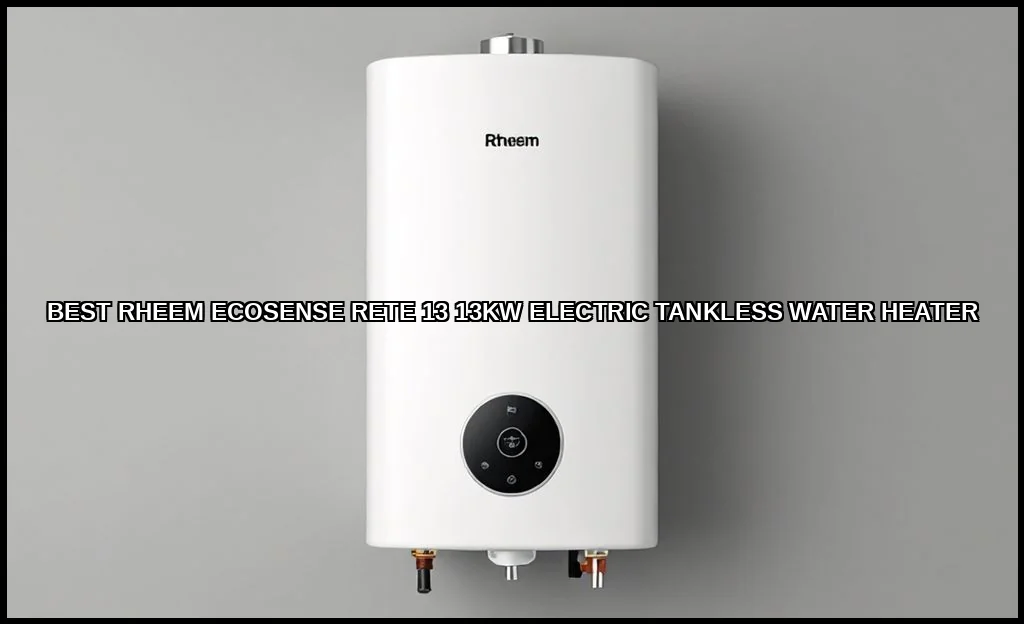
Rheem EcoSense RTE 13: A Compact Powerhouse
The Rheem EcoSense RTE 13 is designed as a point-of-use unit. That means it’s installed close to a single fixture, like a kitchen sink or a bathroom faucet. Its primary mission is to deliver instant, endless hot water right where you need it, eliminating the wait and waste of running water from a distant tank.

Rheem’s EcoSense series focuses on smart energy use. The RTE 13 modulates power to match demand, which can lead to savings. Its sleek, white design is unobtrusive. It’s a simple plug-and-play solution for many scenarios, assuming your electrical system is ready for it.
Key Features & Specifications at a Glance
Before we get into the nitty-gritty, here are the core RTE 13 specs you need to know:
- Power Input: 13 kW at 240 volts
- Amperage Requirements: 54.2 amps (this is critical for installation)
- Dimensions: Approximately 11.5″ x 8″ x 3.75″ truly a compact water heater
- Connection Size: 1/2″ NPT water connections
- Flow Rate: Up to 1.5 gallons per minute (GPM) we’ll explore what this means shortly.
- Warranty: 3-year limited warranty on parts.
For the complete technical manual, always refer to the official source from Rheem. It’s the authority guide for installers.
Installation: Electrical Demands and Cost Considerations
This is where many DIY plans meet reality. An electric on-demand heater isn’t like plugging in a toaster. The electrical requirements are significant and non-negotiable for safe operation.
Electrical Setup: The Big Question
So, what size breaker do I need for a 13kW tankless heater? The RTE 13 requires a dedicated 60-amp double-pole circuit breaker. Your wiring must be 6-gauge copper to handle the 54.2-amp draw. If your electrical panel is old or full, upgrading can be a major cost factor.
Hiring a licensed electrician is strongly recommended. They’ll ensure compliance with local codes, which is vital for safety and insurance. This isn’t an area to cut corners.
Breaking Down the Installation Costs
How much does it cost to install a Rheem EcoSense RTE 13? The answer varies wildly. The unit itself is relatively affordable. The real variable is your home’s readiness.
- Unit Cost: $250 – $400.
- Electrician Labor: $500 – $1,500+ if a new circuit and breaker are needed.
- Plumber Labor: $200 – $500 for simple point-of-use connections.
- Permits: Local permit fees may apply.
For a straightforward install where the circuit already exists, total cost might be under $800. For a complex install requiring panel work, it can easily exceed $1,500. Always get multiple quotes.
Performance: Flow Rate, Temperature Rise & Real-World Use
Spec sheets tell one story. Your morning shower tells another. Performance hinges on two intertwined concepts: flow rate and temperature rise.
Understanding Temperature Rise
Temperature rise is the number of degrees Fahrenheit the heater can increase the incoming water temperature. It’s not a fixed output temperature. If your groundwater is 50F and you want 110F shower water, you need a 60F rise.
The RTE 13 provides a 1.5 GPM flow rate at a 60F rise. That’s its sweet spot. Colder inlet water or a desire for higher output temperature reduces the flow. Heres a quick reference:
| Temperature Rise Needed | Approximate Flow Rate (GPM) |
|---|---|
| 50F | ~1.8 GPM |
| 60F | 1.5 GPM |
| 70F | ~1.3 GPM |
Is This Enough for You?
This brings us to a key question: is the Rheem RTE 13 good for a small apartment? Absolutely, but with precise application.
It’s perfect for a single sink or a low-flow showerhead (under 1.5 GPM). It will not simultaneously supply a shower and a sink. It’s not for filling a large tub quickly. Think of it as a dedicated, efficient hot water source for one fixture at a time. For a small apartment’s kitchen or bathroom sink, it’s an excellent way to get endless hot water without a tank.
 Water Heater Owner's ToolkitFix the common faults yourself, keep it running for years, and know when a repair is money wasted.No-hot-water flowcharts, gas and electricFlush, anode, relief valve and descaling stepsRepair-or-replace calculator (Excel)
Pros, Cons & Ideal Use Cases
Let’s weigh the good against the limitations.
Advantages
- Space-Saving: Its tiny size allows for installation under sinks or in tight closets.
- Energy Efficiency: Only heats water when you call for it, eliminating standby heat loss.
- Endless Hot Water: No more cold showers because the tank ran out.
- Simple Maintenance: No tank to corrode, minimal descaling needed in most areas.
Limitations
- High Electrical Demand: The 60-amp requirement is a barrier for many homes.
- Limited Flow Rate: It’s a single-fixture unit, not a whole-house solution.
- Cold Water Sandwich: A brief burst of cold water can occur between uses, common in many electric tankless water heater models.
- Performance Depends on Inlet Temp: Colder climates challenge its output.
Who Is It For?
The RTE 13 shines in specific scenarios: a cabin sink, a workshop, a pool house bathroom, a supplemental unit for a remote fixture, or as the primary heater for a small studio apartment with low-flow fixtures. It solves a specific problem elegantly.
Buying Guide: Comparisons, Price & Final Decision
How does it stack up against the competition? And is it your best choice?
Rheem EcoSense RTE 13 vs. Stiebel Eltron DHC-E 10
A common comparison is the Rheem EcoSense RTE 13 vs Stiebel Eltron DHC-E 10. Both are premium point-of-use units. The Stiebel Eltron is a 10.8 kW unit, so it requires a smaller 50-amp breaker. Its flow rate is slightly lower (around 1.3 GPM at a 60F rise). The trade-off is less electrical burden for less hot water output. The Stiebel often has a reputation for robust build quality, but the Rheem offers a bit more performance if your wiring can handle it.
When considering whole-house gas options, it’s worth looking at how brands like navien stack up in terms of reliability and features. For traditional tank heaters, many wonder if brands like Bradford White are a good long-term investment.
Making Your Choice
Ask yourself these questions:
- What fixture(s) am I heating? (One low-flow shower? A kitchen sink?)
- What is my groundwater temperature? (This dictates the required temperature rise.)
- What is the state of my electrical panel? Can it support a 60-amp dedicated circuit?
- What is my total budget, including professional installation?
If your answers align with the RTE 13’s capabilities, it’s a fantastic, efficient solution. If you need to run two fixtures or have very cold inlet water, you must look at more powerful models, like the previously mentioned Check price on Amazon, or consider a small gas tankless system.
The Rheem EcoSense RTE 13 13kW electric tankless water heater excels in its niche. It delivers on the promise of compact, on-demand hot water for a single point of use. Its success in your home, however, is entirely dependent on your existing electrical infrastructure and realistic flow expectations. Do the homework on your inlet water temperature and consult an electrician first. When matched correctly to the application, its a reliable upgrade that saves space and energy for years to come.