

Two propane heaters sit on opposite ends of the spectrum. One is a powerhouse built for large, demanding spaces. The other is a compact companion designed for personal comfort outdoors. The Baotree 60,000 BTU Forced Air Propane Heater and THE BOSS 6,000 BTU Portable Heater represent fundamentally different solutions for staying warm. This head-to-head comparison cuts through the marketing to help you decide which unit aligns with your specific heating needs, whether that’s a drafty workshop or a chilly patio conversation.
Choosing the wrong type can mean wasted fuel, inadequate warmth, or even safety concerns. We’re breaking down their performance, safety, and design using only their stated specifications. This isn’t about which is universally “better”it’s about which is better for you.
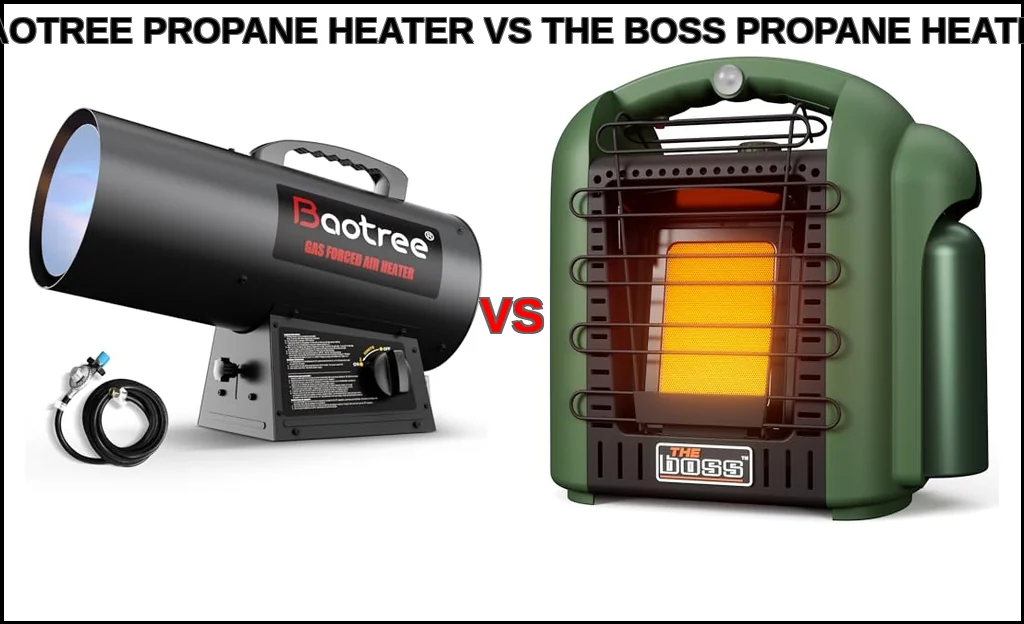
Head-to-Head Overview: Specs at a Glance
At first glance, the difference is staggering. The Baotree operates on an industrial scale, while THE BOSS focuses on intimate, ambient heating. Let’s lay out the core facts in a clear comparison table.
| Feature | Baotree 60,000 BTU Forced Air Heater | THE BOSS 6,000 BTU Portable Heater |
|---|---|---|
| BTU Output | Variable 40,000 – 60,000 BTU | Up to 6,000 BTU (3 levels) |
| Primary Use Case | Large indoor/outdoor spaces: Garages, workshops, job sites | Focused outdoor areas: Patios, tents, decks, camping |
| Heat Distribution | Forced-air fan for rapid, wide-area heating | Radiant/infrared heating for direct, localized warmth |
| Portability | Handle & adjustable height; includes 10-ft hose | Lightweight, compact with carry handle |
| Key Safety Features | Pulse ignition, overheat protection | Tip-over Safety Switch, Low Oxygen Shut-off (ODS), CSA Certified |
| Special Features | Adjustable heating angle (30-45) | Built-in LED lighting |
| Check price on Amazon | Check price on Amazon |
Heating Power & Area Coverage
This is the most dramatic differentiator. The term BTU (British Thermal Unit) gets thrown around a lot, but here the numbers tell a stark story.
Baotree: The Industrial Workhorse
The Baotree is a forced-air beast. Its variable output from 40,000 to 60,000 BTU is designed for spaces up to an estimated 2,497 square feet. That’s the footprint of a large multi-car garage or a modest workshop. The heavy-duty fan doesn’t just produce heat; it throws it. This forced-air design is key for workspace heatingit aims to boost temperatures significantly within 10 minutes and distribute warmth evenly across expansive, open areas. The adjustable heating angle adds versatility for targeting specific zones.
THE BOSS: The Personal Patio Performer
THE BOSS is an infrared heater with a maximum 6,000 BTU output. It’s not designed to heat the air in a large volume. Instead, it emits radiant heat that warms people and objects directly in its path, much like sunshine. It’s perfect for creating a “bubble” of warmth on a patio, next to a camping chair, or inside a tent. Its three heat levels let you fine-tune the intensity for changing conditions, but its purpose is focused, personal comfort, not space heating.
For a true propane heater showdown on power, the Baotree wins outright for large areas. But for a cozy nook, THE BOSS’s approach is more efficient and comfortable.
Safety, Build Quality & Certifications
Safety is non-negotiable, especially with fuel-burning appliances. The features and certifications each brand highlights reveal their intended environments.
Baotree Safety Profile
The Baotree emphasizes reliability for demanding use. Its pulse ignition technology aims for safe, reliable startups to prevent flameouts and gas leaks. It also includes an overheat protection system that triggers an automatic shut-off during power outages. Notably, the product instructions stress using a wrench to securely tighten the gas hose connectiona critical step for preventing leaks that underscores its use with larger, potentially higher-pressure setups. It’s built for physical durability on a job site.
THE BOSS Safety Credentials
THE BOSS is explicitly built for safer outdoor use and carries specific certifications. Its feature set is crucial for close-quarters scenarios like tents or enclosed patios:
- Low Oxygen Shut-off (ODS): This is vital. If oxygen levels drop to an unsafe point, the heater automatically turns off, helping to prevent carbon monoxide buildup.
- Tip-over Safety Switch: If the unit is knocked over, it shuts off immediately.
- CSA Certified: This independent certification indicates the product has been tested to meet specific safety standards, a significant trust marker.
While both have safety shut-offs, THE BOSS provides a more comprehensive suite for environments where people are in close, prolonged proximity to the heater. For any indoor-adjacent or semi-enclosed use, these features are paramount. Always consult an official source for safety guidelines in work environments.
Portability & Design
“Portable” means very different things for these two heaters. It’s about more than just a handle.
Baotree: Portable for its Class
Within the category of high BTU heaters, the Baotree is designed for mobility. It has a carry handle and an adjustable height feature, allowing you to set it up where needed. Its portability is enhanced by the included 10-foot hose, giving you flexibility in positioning relative to a larger 20 lb propane tank. This is mobility within a workspace, garage, or between job site locations.
THE BOSS: Truly Grab-and-Go
This unit defines portable heater. It’s lightweight and compact with a comfortable handle, designed to be carried from your porch to your garden or packed for a camping trip. Its solid shape ensures stable transport. The built-in LED lighting is a clever design addition, providing ambient light for evening use on a patio or in a tent, enhancing both utility and atmosphere. It’s meant to be an appliance you move with your activity.
Fuel, Tank Use & Runtime
Fuel consumption directly ties into operating cost and convenience. This is where the Baotree vs THE BOSS comparison gets practical.
Baotree Fuel Considerations
The Baotree’s massive output comes with significant fuel demand. It’s designed to connect to a standard 20 lb propane tank via its 10-foot hose and regulator. At its maximum 60,000 BTU setting, it would theoretically consume roughly 1.4 pounds of propane per hour. A full 20 lb tank might last around 14 hours at that peak output, though variable settings extend this. This makes it a tool for intermittent, high-heat-demand sessions in a garage heater or workshop context, not for continuous 24/7 operation.
THE BOSS Fuel Efficiency
THE BOSS is the epitome of sipping fuel. At its maximum 6,000 BTU, it would consume approximately 0.14 pounds of propane per hour. This extreme efficiency means it can run for days on a standard 20 lb tank, or for many hours on a smaller 1 lb disposable cylinder, making it ideal for weekend camping or extended patio evenings. The THE BOSS heater fuel consumption per hour is a fraction of the Baotree’s, which is a major factor for long-duration, low-intensity use.
For other efficient options, our review of the thermomate propane heater explores another balanced model.
Noise, Emissions & Warranty: The Missing Details
Most comparisons stop at the headline specs. But real-world use involves nuance competitors often omit.
The Baotree listing explicitly states the “machine will produce an acceptable level of noise during operation.” For a forced-air heater with a powerful fan, this is expected. It’s a consideration for workshops where noise is less critical than for a quiet patio setting. THE BOSS, as a radiant heater, likely operates nearly silently, save for the faint hiss of gas.
Emissions and indoor air quality are critical. While THE BOSS is CSA Certified and has an ODS for safer outdoor/ventilated use, neither listing provides specific emissions data (PPM of CO/CO2). For any indoor or semi-enclosed use, this is a crucial gap. Proper ventilation is an absolute must, a point underscored by every safety authority guide.
Warranty and service network details are also absent from the provided data. For a tool-like investment in a Baotree or a reliability-critical product like THE BOSS, the manufacturer’s support commitment is a key part of the long-term value equation you should research.
Final Verdict: Best Use Cases & Value
So, which is better, Baotree or THE BOSS propane heater? The answer is entirely situational. This heater comparison review shows they are tools for different jobs.
Choose the Baotree 60,000 BTU Forced Air Heater if:
- You need to heat a large, open space like a 2-6 car garage, workshop, or construction site quickly.
- Your primary need is raising the ambient air temperature of a substantial area (1500+ sq ft).
- You have access to 20 lb propane tanks and value rapid, powerful heat over quiet operation.
- You accept the higher fuel consumption as the cost of serious heating power.
It’s the definitive choice for propane heater for large workshop comparison scenarios.
Choose THE BOSS 6,000 BTU Portable Heater if:
- You want warmth for outdoor leisure: patios, decks, camping, or tailgating.
- You value a compact, truly portable design, quiet operation, and built-in mood lighting.
- Safety certifications like CSA and features like tip-over and low-oxygen shut-off are priorities for your use case.
- You want extended runtime from a small fuel source for personal, directed warmth.
It’s a strong contender for best portable propane heater for outdoor social and recreational use.
The Value Proposition
Value isn’t just about price. It’s about cost per unit of comfort delivered appropriately. The Baotree offers immense heating power for its price, a brute-force solution for big problems. THE BOSS offers refined, safe, and feature-rich comfort for intimate settings. Trying to use the Baotree on a patio would be overkill and uncomfortable. Trying to use THE BOSS in a garage would be utterly ineffective.
For other specialized applications, like protecting plants, our guide to the best greenhouse heaters is a useful resource.
Your decision hinges on a simple question: Are you heating a space or heating people? Answer that, and the right choice between these two capable but distinct heaters becomes clear.

HeaterGuides covers home heating, water heating and HVAC: how the equipment works, what it costs to run, and how to use it safely.