
Two propane heaters sit on opposite ends of the spectrum. One is a powerhouse designed to conquer the chill in vast, open spaces. The other is a focused, radiant unit built for steady, localized warmth. The Baotree 60,000 BTU Forced Air Heater and the Gasland MHA18BN Propane Radiant Heater represent fundamentally different approaches to solving the same problem: staying warm without grid power. This head-to-head propane heater comparison will break down their real-world capabilities, helping you decide which one aligns with your specific heating needs.
Choosing between them isn’t just about picking the most powerful option. It’s about matching the tool to the task. Are you trying to take the edge off a drafty garage workshop or quickly warm a large, semi-enclosed patio? The answer dictates your choice. We’ll analyze heating performance, safety, portability, and overall value, using only the features and specifications provided by the manufacturers.
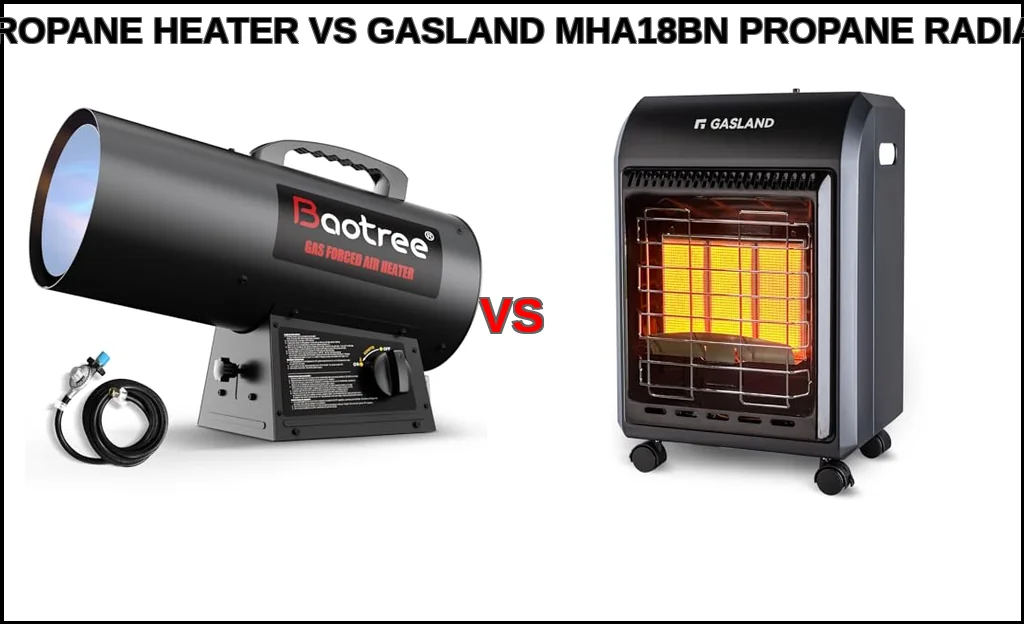
Detailed Feature-by-Feature Comparison
At their core, these heaters use different technologies. The Baotree is a forced-air unit, acting like a high-powered hair dryer that pushes warm air across a space. The Gasland employs radiant heat technology, warming objects and people directly in its path, similar to sunlight. This fundamental difference shapes every other aspect of their design and use.
| Feature | Baotree 60,000 BTU Forced Air Heater | Gasland MHA18BN Propane Radiant Heater |
|---|---|---|
| Heating Technology | Forced Air with adjustable heating angle (30-45) | Radiant Heat |
| BTU Output | Variable 40,000-60,000 BTU | Up to 18,000 BTU (High/Medium/Low modes) |
| Primary Safety Features | Pulse ignition, overheat protection, automatic shut-off during power outages | Tip-over safety switch, oxygen depletion sensor (ODS) |
| Portability Features | Portable handle, adjustable height, 10-foot hose included | Built-in rolling wheels, easy-carry handle, cabinet design hides tank |
| Noise Level | Produces an acceptable level of operational noise | Described as ultra-quiet |
| Power Source | Propane (requires external tank) | Propane (20lb tank housed inside cabinet) |
| Check current price on Amazon | Check current price on Amazon |
Performance & Heating Capacity Analysis
This is where the Baotree vs Gasland decision becomes crystal clear. The BTU output tells the story: one is for massive spaces, the other for focused areas.
Baotree: The Industrial Workhorse
The Baotree’s variable 40,000-60,000 BTU rating is formidable. It’s designed for spaces up to 2,497 square feetthink large garages (1-6 cars), construction sites, or agricultural facilities. Its heavy-duty forced-air fan promises to significantly boost temperature within 10 minutes, distributing heat evenly across expansive areas. The adjustable heating angle (30 to 45 degrees) adds versatility for targeting specific zones. For sheer heating power in a ventilated, large-volume space, it’s in a different league. If you’re looking for the most efficient propane radiant heater comparison for a warehouse, this isn’t itit’s a forced-air beast.
Gasland MHA18BN: The Focused Comfort Provider
The Gasland delivers up to 18,000 BTU, effectively warming spaces up to 450 square feet. Its three heating modes (High/Medium/Low) allow for customization, which directly impacts runtime per tank. While a precise fuel efficiency (BTU/hr per lb of propane) isn’t specified, the lower BTU output and multiple settings inherently promote longer runtimes from a standard 20lb tank compared to running the Baotree on high. This makes the Gasland MHA18BN vs Baotree for garage heating question highly contextual. For a standard one or two-car garage where you’re working in one area, the Gasland’s radiant heat can be more comfortable and efficient. For heating the entire, cavernous space quickly, the Baotree is the tool.
Safety, Portability & Ease of Use
Safety is non-negotiable with any fuel-burning device. Both units incorporate critical protections, but their approaches differ based on their design and intended use cases.
Safety Features Deep Dive
The Gasland MHA18BN review consistently highlights its two key indoor-safe features: the tip-over safety switch and the oxygen depletion sensor (ODS). These are essential for any indoor propane heater used in spaces like a workshop or garage. The tip-over switch is a crucial fail-safe for a portable cabinet-style unit on wheels.
The Baotree emphasizes safe ignition and operational protection. Its pulse ignition technology aims to prevent flameout and gas leaks at startup. It also features overheat protection that triggers an automatic shut-off during power outages. Important note: Always consult an official source for safe heater operation guidelines. For large, well-ventilated industrial spaces, these features address the primary risks associated with a high-output forced-air heater.
Portability and Design in Practice
Portability means different things for these heaters.
- Gasland MHA18BN: Built for easy relocation within a home or shop. The rolling wheels and carry handle make it simple to move from a garage to a patio. The cabinet design that hides the propane tank is a sleek, space-saving touch.
- Baotree Heater: Built for transport between job sites. The portable handle and adjustable height stand aid in setup and positioning. Its portability is about being a rugged tool you can take to the location, not necessarily roll around a room frequently. The included 10-foot hose offers flexibility in tank placement.
Noise Level & Operational Experience
This is a stark contrast. The Gasland is marketed as “ultra-quiet,” promoting a serene environment for reading or working. The Baotree explicitly states it “will produce an acceptable level of noise during operation,” which is typical for a high-CFM forced-air fan. If noise is a concern for your outdoor heating event or indoor workshop, it’s a major factor in your portable heater comparison.
Final Verdict & Recommendation
So, which is better Baotree or Gasland propane heater? The answer depends entirely on your specific scenario. This isn’t a case of one being objectively superior; it’s about application.
Choose the Gasland MHA18BN Propane Radiant Heater if:
- You need to heat a focused area up to 450 sq ft, like a section of a garage, a workshop, a sunroom, or a patio seating area.
- Quiet operation is important for your environment.
- You want the convenience of built-in wheels and a cabinet that hides the tank for a cleaner look.
- You prioritize the specific indoor safety features like tip-over and ODS protection for use in enclosed (but ventilated) spaces.
- Your goal is to cut electricity bills with a primary or supplemental heat source in a room.
For more focused, quiet warmth, our review of the thermomate propane heater explores another popular radiant-style option.
Choose the Baotree 60,000 BTU Forced Air Heater if:
- You need to rapidly heat a very large, open, or drafty space (up to ~2500 sq ft). Think construction sites, large barns, multi-car garages, or industrial workshops.
- You require variable, high-intensity heat and are operating in a well-ventilated area.
- Operational noise is not a primary concern compared to raw heating power.
- Portability means being able to transport it to a site and position it effectively with its adjustable stand.
- Your applications are primarily commercial, agricultural, or for large-scale DIY projects.
For other large-space heating solutions, consider our guide to the best greenhouse heaters, which often face similar challenges of heating voluminous, semi-enclosed areas.
The Bottom Line
The Gasland MHA18BN is a refined, indoor-safe radiant heater perfect for personal comfort in defined zones. Its safety features and quiet operation make it a strong candidate for residential and small shop use. The Baotree is an industrial-grade forced-air heater built for power and coverage in vast, ventilated areas. It’s the tool you bring in when space and time are against you.
Your decision hinges on the square footage, the environment, and the type of warmth you need. Assess your space, consider the need for quiet versus sheer power, and let that guide your choice in this propane heater comparison. Both are competent tools, but for dramatically different jobs.
